

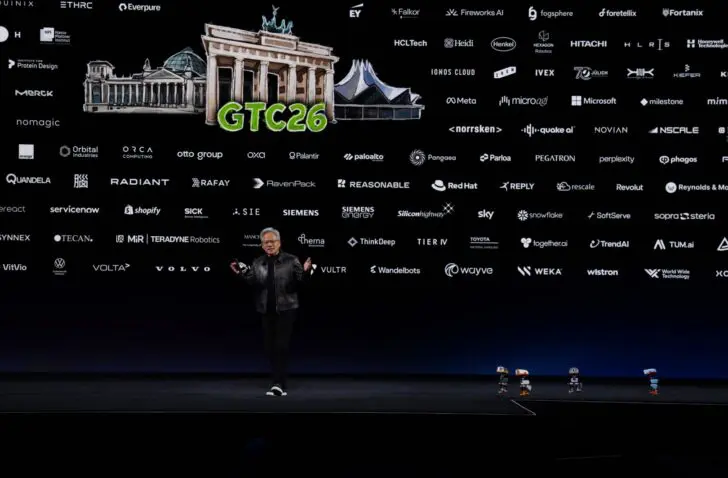
At GTC Berlin, Nvidia CEO Jensen Huang calls on Europe to produce its own AI. The building blocks he offers for that, from chips and data centre modules to models and software, all happen to come from his own company.
Jensen Huang’s keynote on Wednesday morning was the highlight of the show at Nvidia GTC. Over the past few days, the Nvidia boss toured Europe via Paris, London, Stockholm and Dublin, before finally settling in Berlin. During his keynote, Jensen spends an hour and a half convincing the room how important Nvidia can and wants to be for Europe.
He opens his keynote by listing a few well-known European companies, such as L’Oréal, Spotify, Revolut, Zara and Porsche. What do they have in common? They are European, and they are Nvidia customers. In Berlin, he also addresses Europe directly: “To be part of this AI economy, you don’t want to simply consume AI. You want to produce it.”
At Nvidia GTC, Huang naturally finds a receptive audience. The Nvidia event looks like one big fan day for the chipmaker. A Greenpeace activist who slipped in causes a moment of commotion when she asks Huang what he thinks of Nvidia chips turning up in Russian weaponry. Huang pays it minimal attention, but does ask security not to remove the woman from the room too roughly.
A five-layer cake
“To be able to build AI, it’s important that you first understand what it is,” says Huang. Like a qualified teacher, he conjures up a slide. Huang sees the AI stack as a five-layer cake, with infrastructure as the foundation.
“Long before the AI models appear, the infrastructure has to be there,” he said. He compares it to the internet, which first needed networks, and to electricity, which first required a power grid. “We can do all of that here in Europe, and in fact we have already started.”
Nvidia places itself on the layer above, the compute layer. No Huang keynote is complete without him showing the audience a chip. A slide sometimes says more than a thousand words, because Nvidia presents itself as the only player on this layer, as if rivals such as AMD simply don’t exist. Only then come AI factories, models and software.
At the same time, Huang reveals that Nvidia wants to bake as many layers of the cake as possible, or is looking for loyal partners across all layers. “Previous generations up to Blackwell were all about the GPU. With Vera Rubin, we have evolved to the full AI stack.” He sees Nvidia more as an AI company that happens to develop the chips for it as well. Later in the keynote, he will call CUDA, which in his metaphor is only the top layer of the cake, the ‘crown jewel’ of his company.
Ready-made data centres
Building AI infrastructure is an expensive and lengthy process, Huang realises, so Nvidia is announcing new solutions to generate revenue from those investments faster. At GTC, Nvidia presents DSX POD, a container with seven liquid-cooled Vera Rubin NVL72 racks in which networking, cabling and cooling are already installed. “This will change how companies install and build data centres, and hopefully the pace will go up as a result,” says Huang.
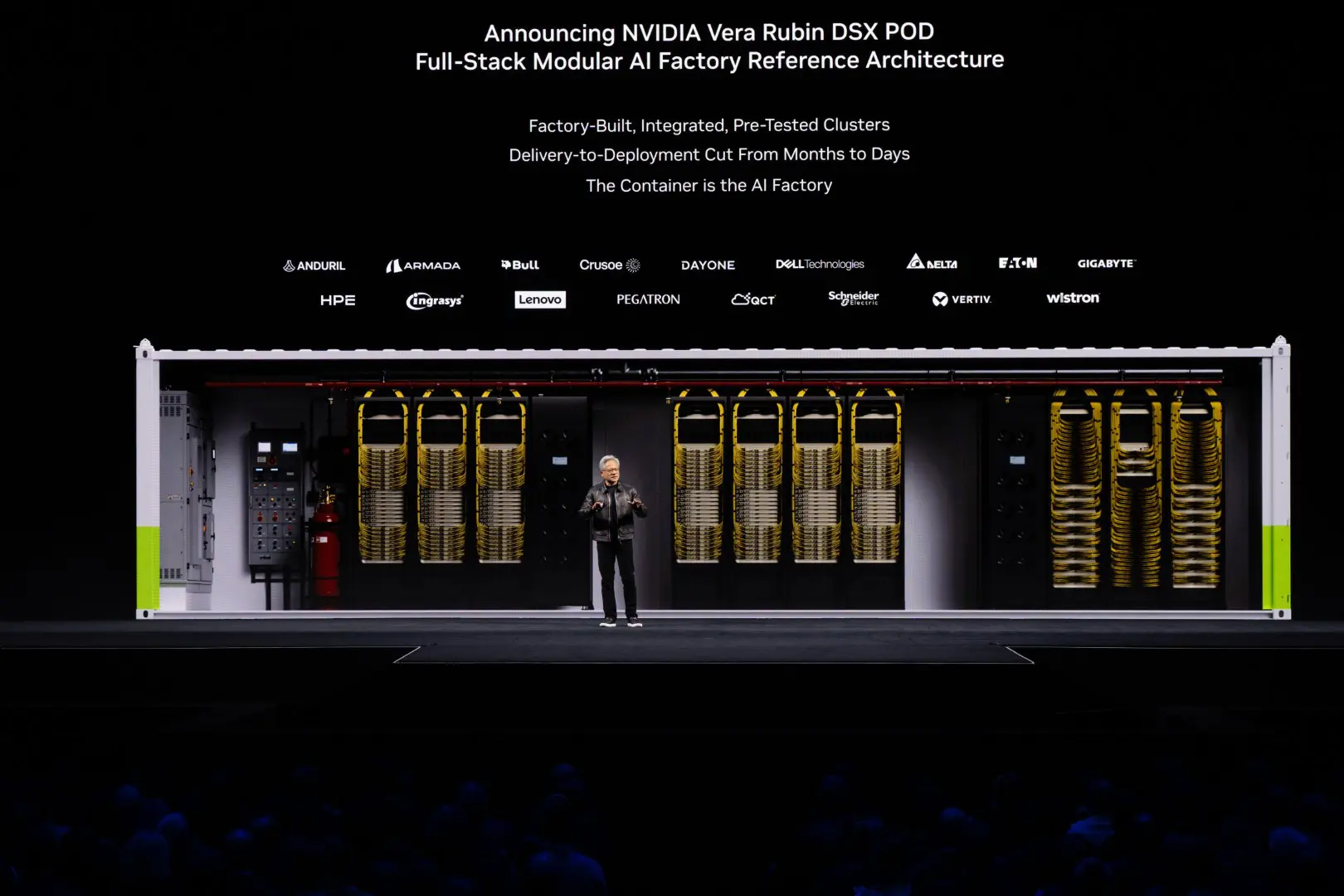
At a prepared site, installation time drops from six months to fourteen days, according to Nvidia. Power, connectivity and the rest of the on-site infrastructure must already be ready. DSX POD comes to market in early 2027, with seventeen partners, including Bull, Dell, HPE, Lenovo, Schneider Electric and Vertiv. Some are European, some are not.
Huang also tries to strike other chords that are sensitive in Europe. Closed, American-controlled models pose a risk for European companies. That risk became clear a few months ago when the US got involved in the availability of Anthropic models. Huang: “We haven’t just been talking about OpenAI for a long time now. OpenClaw has made us realise that open agents are possible.”
That is why Nvidia is playing with open cards with open models such as Nemotron, which companies can train further with their own data. Huang himself calls this ‘sovereign intelligence’. Nvidia’s CUDA-X libraries are meant to give AI agents the tools they need, while the OpenShell platform keeps an eye on things. “This is the foundation with which we can make Europe part of the AI ecosystem, the AI economy.”
Dependent on Nvidia
All the building blocks for AI come from Nvidia’s toy box. In Huang’s plan, everything from chips, models and software to complete data centres comes from his company. Nvidia asserts itself not only on the technological front. According to Huang, Nvidia invested almost ten billion dollars in Europe over the past year, in startups and partners.
During his European tour, Huang once again made generous promises. Nvidia doesn’t lack cash these days, but behind every euro promised and spent lies a carefully considered strategy. Giving promising startups a financial boost makes them pledge loyalty to Nvidia early in their growth.
The word ‘sovereignty’ is used eagerly for collaborations between Nvidia and European partners. In February, Deutsche Telekom opened its Industrial AI Cloud in Munich, with around 10,000 Nvidia Blackwell GPUs. The operator positions that AI factory as sovereign AI on German soil, together with SAP. France’s Mistral is proud that its AI models are trained in European data centres and with European data, but on American chips.
According to the Dutch research organisation SOMO, Nvidia holds 80 to 90 percent of the data centre chip market. When it comes to sovereignty, the talk is often about Microsoft, AWS and Google, but rarely if ever about Nvidia. Reality undermines the debate: there are simply no European chips to replace those from Nvidia.
Sovereignty is therefore much more a software issue than a hardware one. It is as if the only way to become less dependent on American cloud giants is to go all-in on an American chip giant.
Master builder of AI factories
It is no coincidence that Nvidia is reaching out to Europe right now. On 30 July, the European Commission launched a tender for ‘AI gigafactories’. It is setting aside up to ten billion euros of European and national funding for this and is counting on at least twenty billion euros in private investment. Which chips will go into those gigafactories is not yet fixed on paper, but who dares doubt that Nvidia will be entrusted with the building plans?
The Brussels think tank CEPS warns of the consequences if European AI factories were to rely too heavily on Nvidia. Nvidia’s ecosystem reaches far beyond chips and also includes networking technology, for example. According to researcher Nicoleta Kyosovska, the hardest dependency to break lies mainly in the software. Nvidia is also tightening its grip on open AI platforms such as Hugging Face with its recent acquisition of it.
The dependency on Nvidia lies not in chips, but in the CUDA software.
Nicoleta Kyosovska, researcher at CEPS
“Operational control may not be guaranteed if AI models are developed with the CUDA software layer,” writes Kyosovska. CUDA may be free, but code written in CUDA works only on chips produced by Nvidia. That makes switching in the future harder if a European chip supplier ever does emerge. She urges the EU to invest more in computing power that doesn’t depend on GPUs and in smaller, specialised models.
According to the Commission, construction of the first facilities is due to start in 2027. That is when Nvidia brings its DSX POD solution to market, coincidence or not, we’ll leave that open. Architect, master builder and site manager Huang seems to have his blueprint ready already.
12 points for Nvidia?
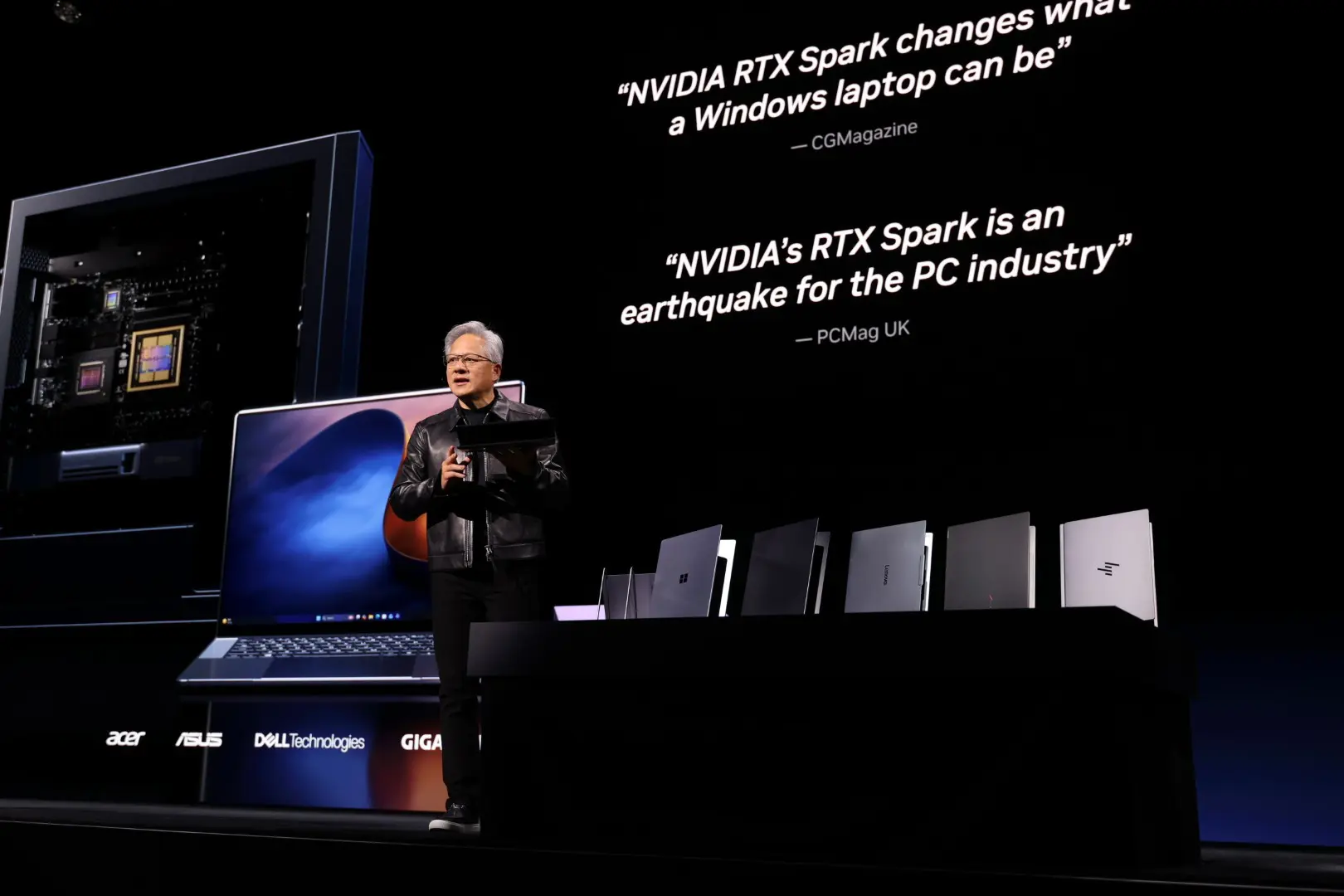
Huang is no fool and is already working today on how to secure Nvidia’s AI dominance tomorrow. Towards the end of his keynote, he has a few more surprises up his sleeve. He shows an arsenal of RTX Spark PCs, which are arriving in Europe only sparingly. Nvidia worked on the laptop chip ‘in secret for four years’ before the veil was finally lifted at Computex in Taiwan.
“Imagine this: it contains 1 petaflop of AI computing power,” says Huang, holding up a randomly chosen laptop from the set. “Ten years ago, you needed two people to move that much computing power. Now I hold it in one hand.”
According to Huang, Nvidia RTX Spark brings the next step in AI evolution closer. The Nvidia CEO has long said that robotics will be the next big wave, and sees Europe as the ideal breeding ground for smart robots. “There is no region in the world that is better at the manufacturing process. We have many partners here. If we can build the AI to develop general skills, it will become more accessible for many companies.”
A demonstration of course stays with the audience longer. Four Microducks, small robot ducks developed by Pollen Robotics to learn the basics of robotics by doing, suddenly waddle onto the stage from the wings. On Huang’s command, they sit, fall and even do somersaults, and listen spellbound to what he has to say. We like to think Huang took at least one of them home.
Huang closes with a toe-curling video in which robots imitate the Eurovision Song Contest to liven up the keynote once more. GTC served as the ideal invitation for European companies to join the Nvidia ecosystem. “Every European company will inevitably become an AI company. We need industrial leaders to make the AI economy possible.” Huang gives Nvidia twelve points and hopes that soon all of Europe will follow him.