

Mistral introduces Mistral Large 4. Following a preview, the model with one trillion parameters will be widely, openly, and Europeanly available.
Mistral Large 4, unofficially ML4 and according to Mistral very officially le Chonk, is the largest and most capable model built by the French AI developer to date. This instantly makes it the most advanced frontier model on European soil.
Bundled knowledge
Le Chonk is a mixture-of-experts model that is multimodal from the ground up, combining instructions, reasoning, and AI agent capabilities into a single model. Of the trillion parameters, 49 billion are active per token. Mistral Large 3, released in December 2025, featured 675 billion parameters, of which 41 billion were active.
Those looking to run Mistral Large 4 only need to calculate with 49 billion parameters at a time, but must load the full trillion-parameter model into memory so that all ‘experts’ are available.
From testing to European-flavored rollout
Developers can try the preview API today via Mistral Studio, at $1.36 per million input tokens and $4.18 per million output tokens. The model will appear in various regions worldwide. This includes a fully European rollout, which Mistral manages itself from start to finish, independent of other digital service providers and under European law.
Mistral calls the model the first milestone on a roadmap funded by its €3 billion Series D. According to the company, this is the largest equity round ever for a European technology firm.
Homegrown product
Mistral trained Mistral Large 4 from scratch on 3,800 Nvidia Grace Blackwell GPUs in its own data centers in Europe. The company does not specify exactly which data center. In March, Mistral raised $830 million in loans for a data center with 13,800 Nvidia chips in Bruyères-le-Châtel near Paris. In Borlänge, Sweden, it is investing €1.2 billion in an AI data center set to open in 2027.
It is notable that this powerful frontier-class model was trained entirely on European soil. The fact that American Nvidia chips performed the calculations in that data center is currently unavoidable.
Mistral also notes that a large portion of the training data is multilingual. The company worked with data in more than 160 languages, including all official languages of the European Union. This will hopefully benefit its multilingual capabilities.
Open weights and control
Mistral wants Le Chonk to deliver top performance for critical sectors via open weights, allowing customers to maintain control over their AI. Open weights is an AI variant of open source. This makes it possible for companies to host the model themselves, although it is not yet clear under which license this will be. According to Mistral, it will at least give organizations the ability to run Le Chonk within their own environment and according to their own policies.
Mistral has long positioned itself as a European alternative to American and Chinese AI technology. Arthur Mensch, CEO and co-founder of Mistral, called the investment in the Swedish data center in February a concrete step toward independent AI capacity in Europe, with data processed and stored locally.
Le Chonk as a cybersecurity expert
Mistral considers Le Chonk to be among the strongest AI models in the world for cybersecurity. It ranks in the global top five on Artificial Analysis’s Cyber Index. Among open models developed outside of China, it leads by a wide margin.
In a test where a model must reproduce and then patch a real vulnerability in open-source software, it achieves the highest score of all models. The fact that the model refuses tasks less often plays a role and is one of the strengths Mistral is highlighting with this launch.
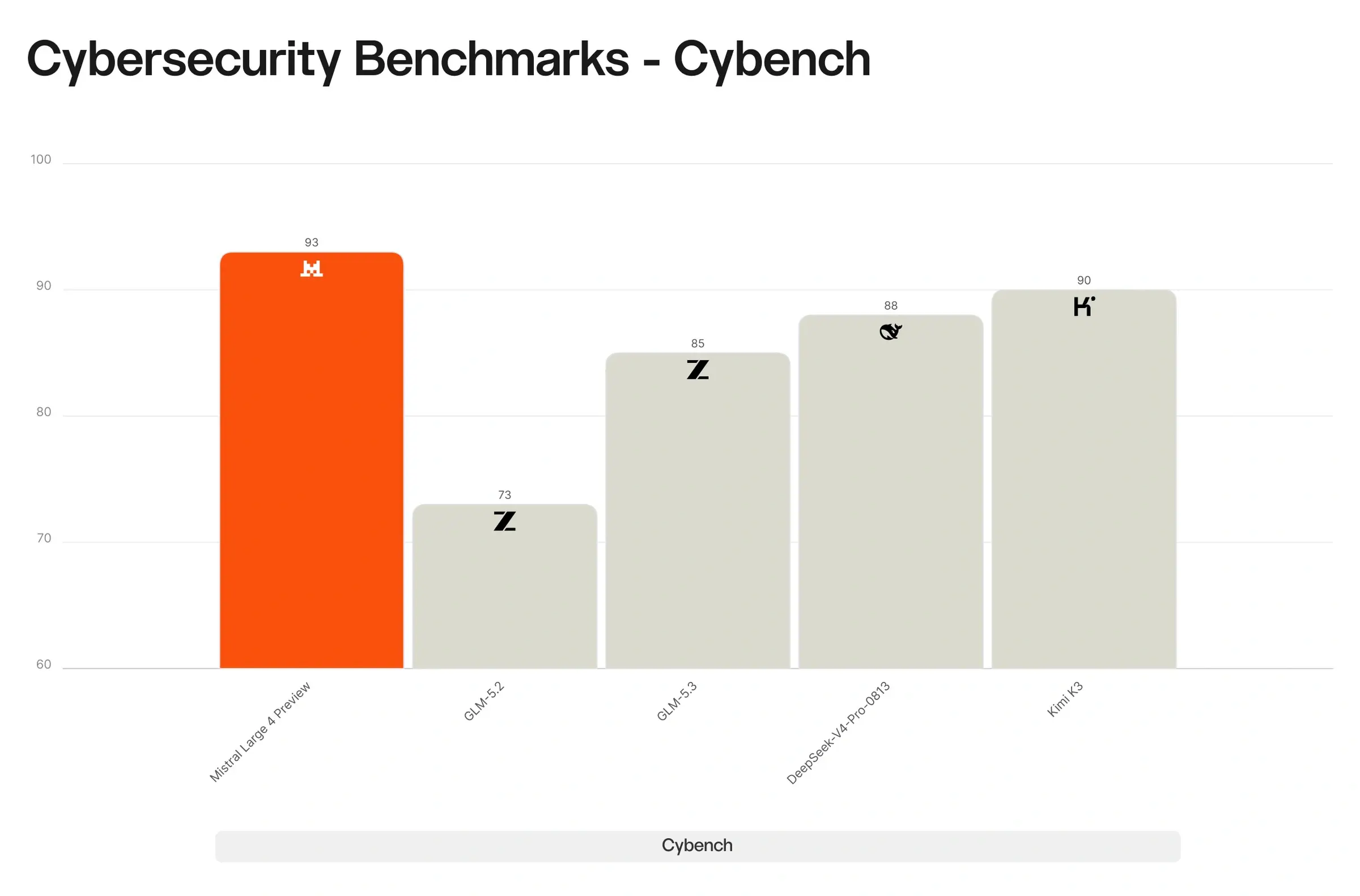
Closed models such as Claude Opus 5.5 and GPT-6 Astra score nearly zero on the same test because they refuse the task. According to Mistral, securing software often begins with demonstrating that a leak actually exists, and the safety filters of closed models can block that kind of work. Furthermore, attackers are increasingly jailbreaking these same models for offensive purposes. Defenders therefore need systems that can go just as far without being hampered by the same refusals, Mistral claims.
Internal tests showed the model was also useful for analyzing malware, prioritizing vulnerabilities, and writing detection rules. Organizations requiring sovereign and controllable AI for their security operations will be able to run the model in a private cloud or on-premises. Their environment must, however, be able to handle a trillion-parameter model.
Coding and AI agents
Mistral claims the model performs well in software development, understanding repositories, and complex terminal workflows. On a combined index for coding agents, it outperforms DeepSeek V4 Pro and Qwen3.8 Max. In a blind human evaluation of code quality by Surge AI, it finished second out of five models, ahead of Kimi K3, GLM-5.3, and GLM-5.2. Only Claude Opus 5 received a better rating.
Mistral Large 4 can power AI agents that gather information, use tools, and deliver finished results. On AutomationBench, featuring 657 business processes in applications like Gmail, Google Sheets, Slack, and Salesforce, it outperforms Kimi K3, MiMo-V2.6-Pro, and DeepSeek V4 Pro. It also beats DeepSeek V4 Pro on longer tasks that produce spreadsheets, presentations, and PDFs.
It is striking that Mistral primarily compares Le Chonk to open models from Chinese makers on these points. The fact remains that open Chinese models are gaining importance in professional contexts, not only because they are open, but also due to their high efficiency compared to American frontier LLMs.
Image, science, and knowledge work
Mistral speaks of a major leap in image understanding. The new model reasons strongly about complex documents, charts, and natural images, combining this with agent-based work.
Mistral cites examples such as searching gigapixel satellite imagery for disaster relief and step-by-step inspection of technical drawings. On Dense 200, a test for visual grounding, Le Chonk reportedly performs slightly better than GPT-6 Astra.
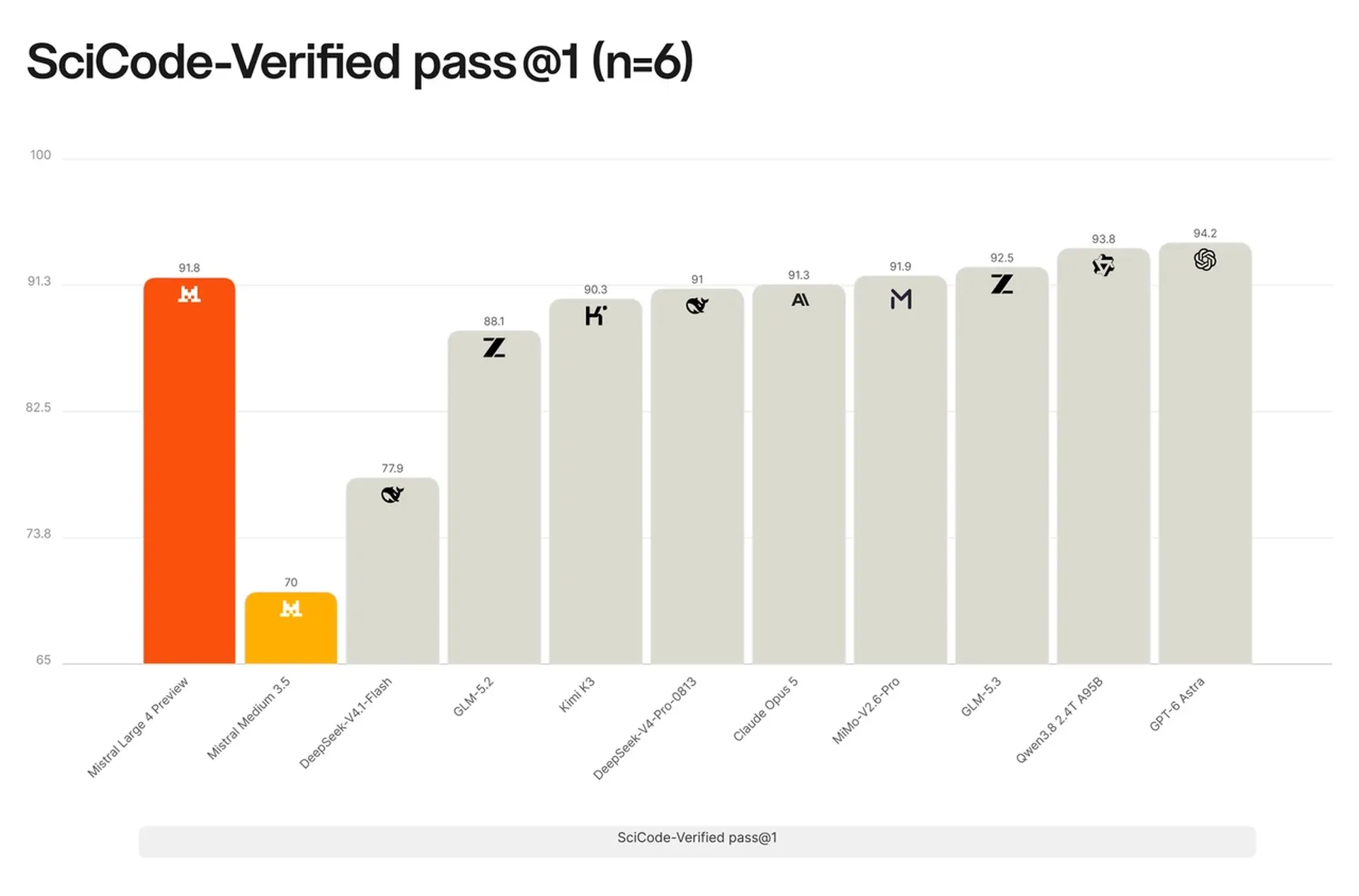
For scientific work, Mistral combined AI-driven methods with the expertise of its researchers in mathematics, physics, and chemistry. The model scores best among all open models on SciCode-Verified.
For knowledge work, Mistral again calls Le Chonk its most capable model. The LLM can create, edit, and repair complex spreadsheets and documents. External evaluator vals.ai tested it on legal and financial tasks, and in both cases, it outperformed GPT-6 Astra. On Harvey AI’s Legal Agent Benchmark, it scores better than all open models.
Safety
Mistral Large 4 achieves a perfect score on Mistral’s own tests for resilience against indirect prompt injections. On Lakera’s public B3 AI Security Benchmark, it resists 93.3 percent of attacks. On cyber-related requests from JailbreakBench, StrongREJECT, and AgentHarm—test sets containing harmful commands—the model refuses on average more often than all other open models.
Mistral is currently subjecting the model to red teaming in real-world conditions, alongside cybersecurity specialists, screened partners, and government agencies. They are granted access to Le Chonk with less moderation and expanded cyber capabilities.
Foundation for new models
Le Chonk will become the foundation for a new generation of specialized and optimized models from Mistral, intended for the sectors and workloads that customers value most.
With the funds from the Series D, Mistral is significantly expanding the computing power in its own European data centers, and according to the company, much more capacity will be added in the coming months. The LLM is currently still being improved via reinforcement learning. Mistral therefore expects major and rapid improvements in the weeks and months ahead.
Mistral plans to release the weights at the end of this month, along with more details on the architecture, additional benchmarks, and the post-training methodology. The company has not yet stated under which license this will occur.