

DeepSeek has launched a new generation of open-source AI models with V4-Pro and V4-Flash.
DeepSeek introduces a new generation of open-source AI models, featuring remarkable efficiency gains and scaling up to 1.6 trillion parameters. The new V4 series aims to be a higher-performing and more economical alternative to existing frontier models.
Two models, one architecture
The V4 family consists of two models: V4-Pro and V4-Flash. Both utilize a mixture-of-experts (MoE) architecture, where multiple neural networks work together instead of one large model. V4-Pro is the flagship with 1.6 trillion parameters, but only activates a portion of them per task. V4-Flash is smaller and more efficient, with fewer active parameters and lower hardware requirements, but also slightly lower output quality.
The most striking innovation lies in the ‘hybrid attention’. This technique reduces the KV cache, an internal representation that models use to process context. According to DeepSeek, memory consumption during inference drops by approximately 90 percent compared to the previous generation.
Competition with top models
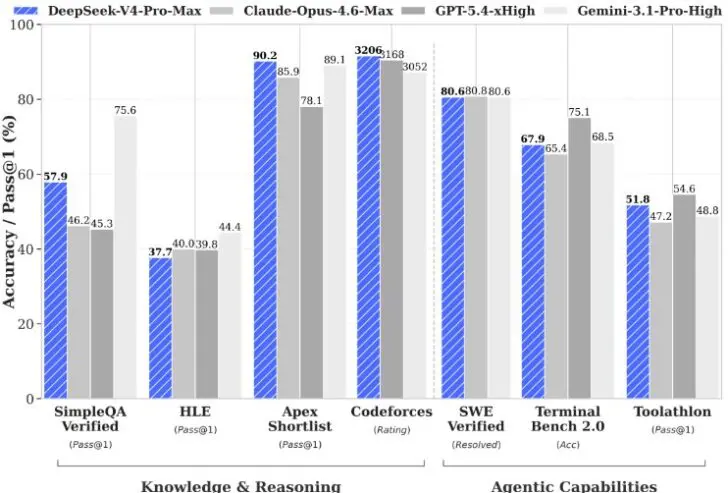
In benchmarks, V4-Pro performs competitively with other top models, including Claude Opus 4.6. In several tests, the model even achieves better scores, although the results are mixed depending on the benchmark.
Faster training, better output
The training process was also addressed. With techniques such as mHC, data can move directly between non-adjacent layers, which reduces errors and increases output quality. Additionally, the Muon module optimizes the model’s internal layers, making training faster and requiring less infrastructure.
DeepSeek trained the models on a dataset of approximately 27 trillion tokens and then refined them in two steps to improve collaboration between the different neural networks. The models are available in preview on Hugging Face.