

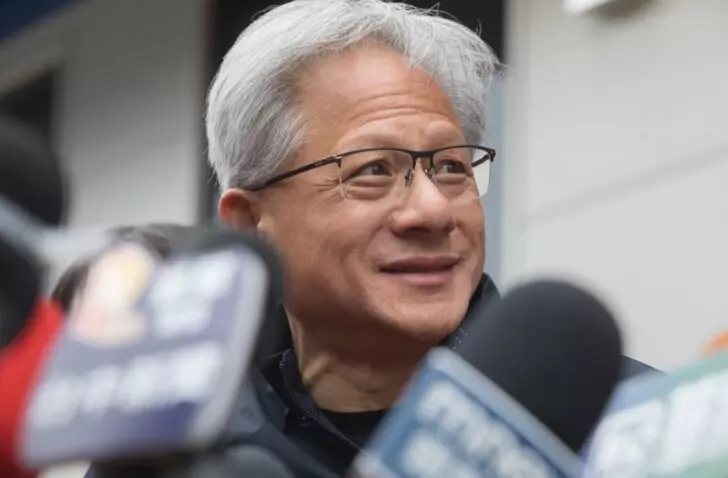
What is Nvidia worth without its founder, CEO and poster boy? After lengthy deliberation by the board of directors, Jensen Huang is resigning from the role he has held for more than 30 years. A new affair, this time with an employee, proved his downfall.
The market is initially reacting negatively. Nvidia opens on the Nasdaq with a 13 percent loss, after an earlier drop of 37 percent over the past few days. The share is trading at 150 dollars at the start of trading, but already seems to be climbing a little.
Earlier updates (1)
Jensen Huang, co-founder of Nvidia, is stepping down as CEO of the company after 33 years. He is also giving up his seat on the board of directors. CFO Colette Kress is taking over as interim CEO.
One affair could not fully shake the position of Nvidia’s golden goose and CEO Jensen Huang (63), even though it involved a relationship with a woman who now turns out to be a Chinese spy. A second extramarital relationship, this time with an Nvidia employee for whom Huang was formally the boss, is now the straw that breaks the camel’s back.
Throwing in the towel
After Nvidia’s board of directors spent an entire day deliberating the fate of its CEO, Huang is now resigning of his own accord. Reuters reports this. Nvidia thereby loses its founder, CEO and public face. The entire AI sector, in turn, loses its most important apostle.
Huang holds 3.61 percent of Nvidia. He is also leaving the board of directors. Chief Financial Officer Colette Kress takes over as interim CEO while the company searches for a permanent successor. Harvey C. Jones becomes chairman of the board of directors.
That puts Nvidia under the leadership of a finance chief, whereas Huang, as an engineer and co-founder, stood close to the technological side of the company. It is a move that feels safe but is dangerous in practice. Intel, for instance, lost its leadership position in the market after financial experts took over from engineers.
Kress has worked at Nvidia since 2013. Before that, she held financial roles at Texas Instruments and worked at Microsoft. Between 2010 and 2013, Kress was CFO at Cisco.
The stock market’s first reactions to Huang’s departure are, as expected, not positive. When the market opens, the share price immediately drops thirteen percent. The share stands at 150 dollars at the time of writing, down from 228 a month ago.
Huang largely has himself to thank for his sudden fall. The saga started earlier this week, when it emerged that the CEO was having an affair with a certain Alice Huang (no relation). Alice Huang is CEO of Megaspeed from Singapore. The US authorities already suspected that company of channelling Nvidia GPUs to China.
Chinese spy
After an investigation by the US security services, the woman in question turned out to have been recruited by China as a spy. The US reportedly knew about this for several months before the bomb dropped this week.
Whether Jensen Huang leaked trade secrets to Alice Huang is unclear at this point. The relationship did put Jensen’s lobbying to be able to sell GPUs in China in a different light.
After the revelations, Nvidia’s board of directors opened its own investigation and an external lawyer was appointed. Huang’s position was not really called into question, at least pending the investigation.
Immediate effect
From a personal standpoint, however, the revelation certainly had its effect. Huang is married, after all. He publicly apologised to his wife after the saga was widely reported in the international press.
All of the above was already enough to create uncertainty on the stock market. Nvidia’s share price fell, although there was a chance the matter would blow over. That chance vanished like snow in the sun after the revelation of a second affair.
Victim or perpetrator?
Jensen Huang reportedly also had a relationship with Kimberly Powell, the vice-president for Healthcare at Nvidia. This was reported by the New York Times. Whereas in the saga with the Chinese spy Huang could still cast himself as a victim, in this story he is very much the perpetrator. A relationship with his employee is prohibited under the internal code of conduct.
A clear power dynamic plays a role in the relationship with Powell. Powell reportedly reports to Huang. A relationship between a boss and an employee is rarely kosher, and certainly not at the level of Nvidia’s top echelons.
From Denny’s to the White House
Now that Huang is stepping down, Nvidia loses more than just a CEO. Jensen Huang founded the company himself with two associates. According to the annals, that happened in a Denny’s in 1993, where the three decided to build a chip for something a computer could not really do at the time: parallel computing.
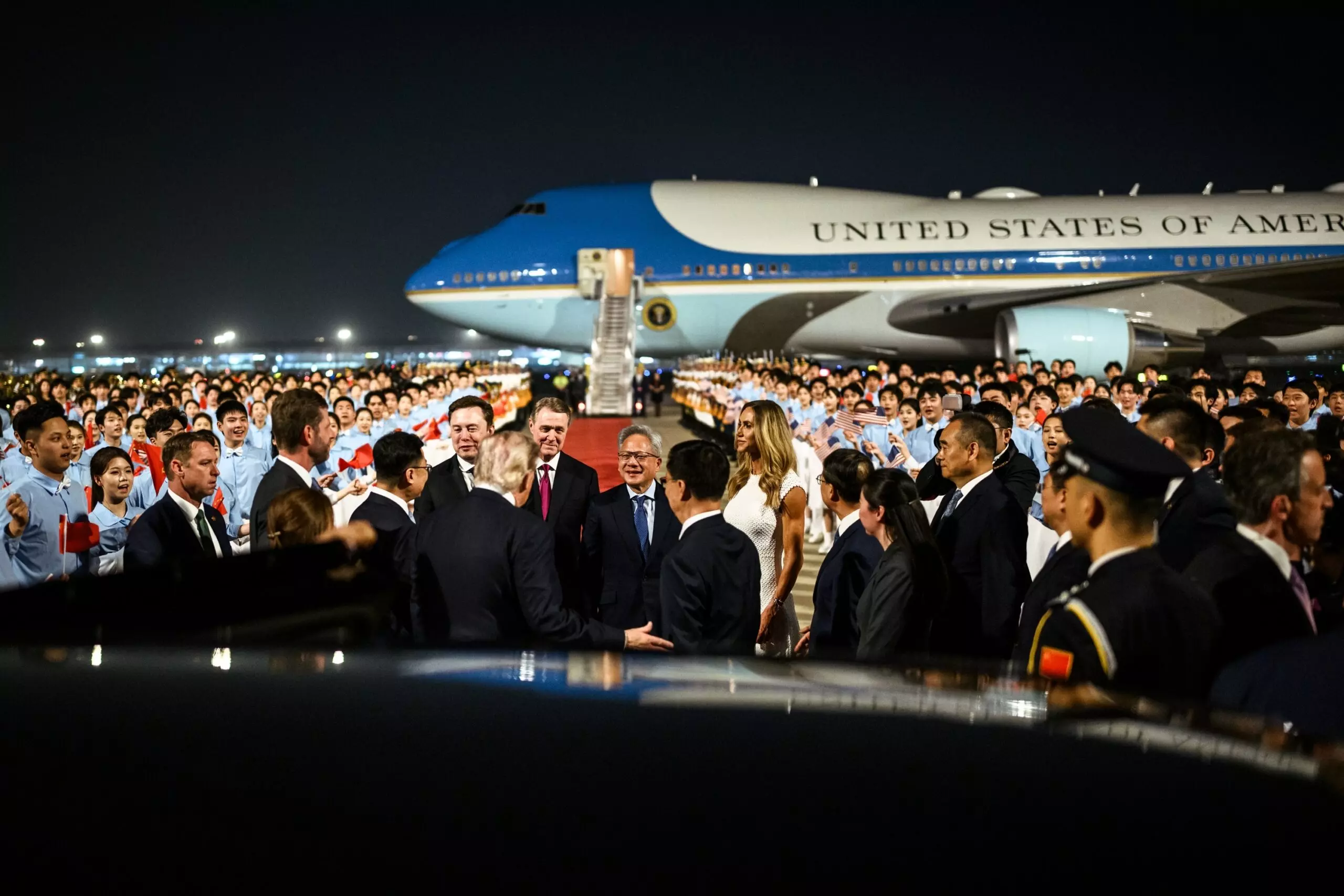
The idea proved to be a bullseye. Nvidia’s GPUs helped grow the 3D and gaming market. That alone was visionary. Nvidia grew into a seal of quality for PC gamers and later also for 3D and CAD designers, with chips tailored to the professional market.
CUDA
When GPUs were picked up for HPC purposes, Huang realised his chips could play a more important role. Under his leadership, Nvidia made several crucial decisions. The most important is perhaps the development of CUDA (Compute Unified Device Architecture). CUDA is the software platform that allows developers to use GPUs for HPC and later AI. The platform underpins Nvidia’s dominant AI ecosystem today, and is a thorn in the side of competitors who cannot get around it.
The second smart choice was to start developing chips specifically for AI. Nvidia did that even before the generative AI hype was unleashed by the launch of ChatGPT. The well-known GeForce chips for gaming were joined by more purpose-built chips such as the Nvidia Jetson series for machine learning applications, launched in 2014.
Beyond gaming
The focus on data centres also grew. Initially, data centre chips were derivatives of the ever more powerful GeForce GPUs. In 2016, the Pascal P100 chips with HBM2 memory and NVLink appeared. In 2017, Nvidia took a big step by integrating Tensor cores into the Volta V100. The Ampere A100 generation from 2020 is now synonymous with the first large and well-known AI training clusters.
With a bit of luck and many right choices, Jensen Huang thus made his Nvidia the AI champion. No other company could capitalise on the rise of AI like that. The much larger Intel of the time missed the boat and AMD also remains reliant on playing catch-up.
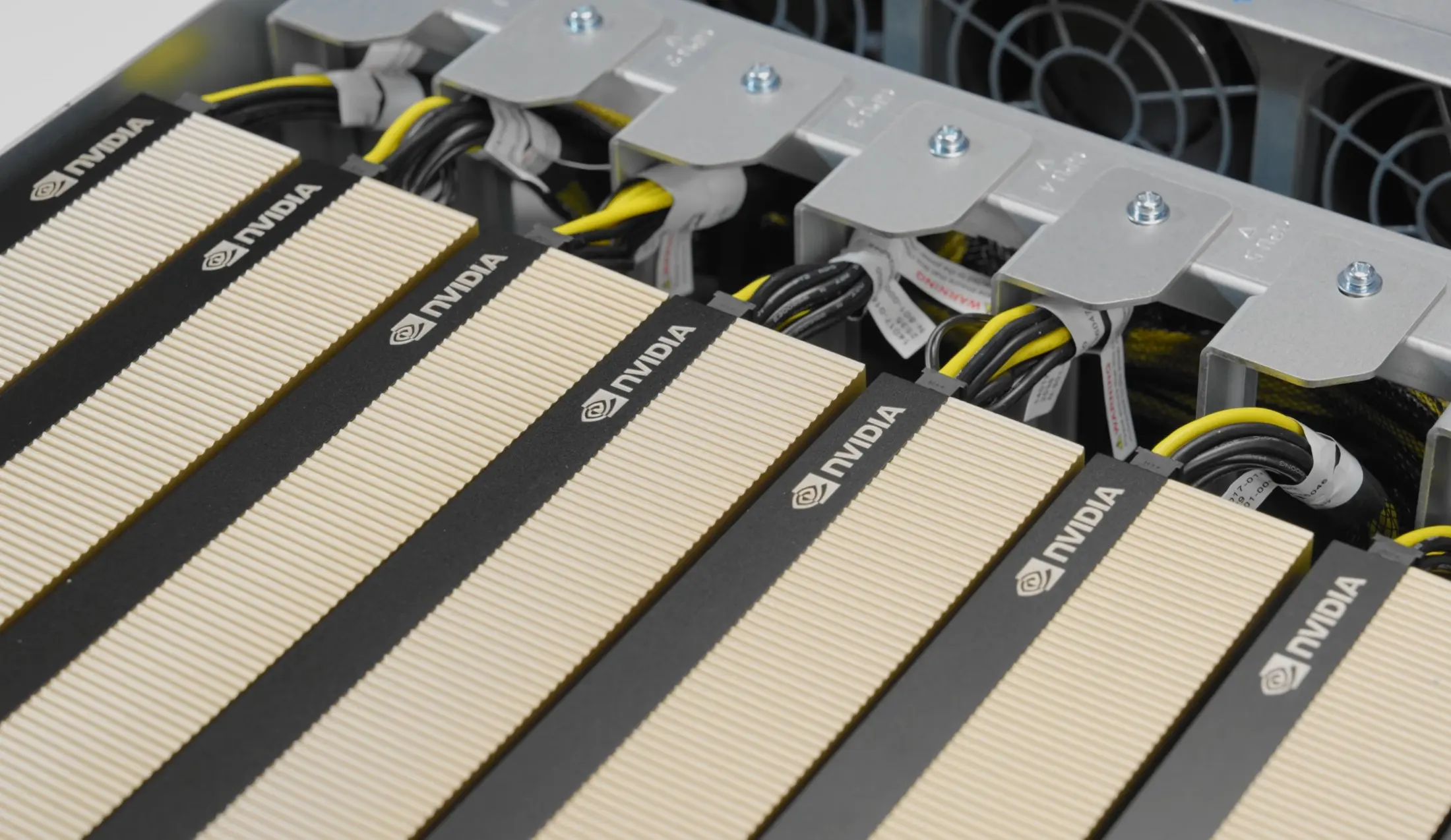
In 2023, Nvidia’s data centre segment became larger than its gaming segment for the first time. Today, Nvidia no longer even reports gaming separately. Together with workstations and chips for robotics and cars, gaming GPUs sit in the Edge Computing division, good for revenue of 7.2 billion dollars in the most recent quarter. By comparison: the data centre segment swelled to 89 billion dollars in the same period.
Real value from real sales
Nvidia also plays a very different role in the AI ecosystem than, say, Anthropic or OpenAI. Whereas the big AI labs are valued on the basis of promises and future plans, Nvidia’s value comes from real sales. Demand for AI chips exceeds production capacity, and Nvidia sells every chip it can put on the market without difficulty. And it does so at healthy margins.
Huang deployed Nvidia’s financial strength to create a flywheel effect in the AI sector. Nvidia invested in its own customers, who then used that money to buy GPUs again. Such constructions make Nvidia a kind of bank for the AI sector, or Huang the sugar daddy of the tech sector. He apparently took that role a little too literally.
AI apostle
The investment practices, coupled with its own enormous revenue, helped drive an ever-rising share price. Jensen Huang himself emerged as an apostle of the AI hype. The CEO, always dressed in a leather jacket, enjoyed rock star status in the IT world.
He was a welcome guest at every major IT conference in recent years, whether or not via video call, to preach his AI gospel. Sometimes he even did so twice in one day, on opposite sides of the world: first via a video call, then on a stage.
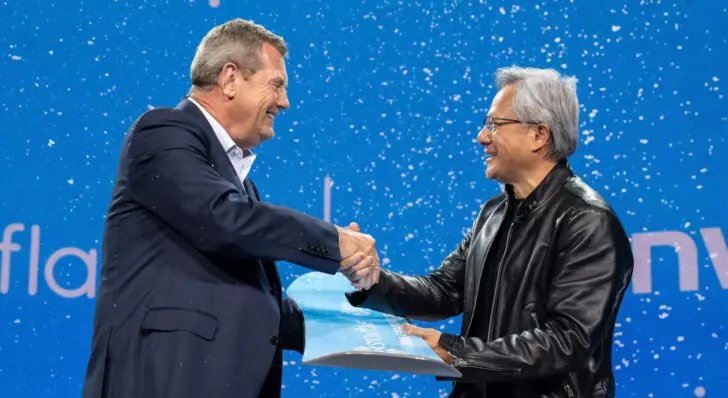
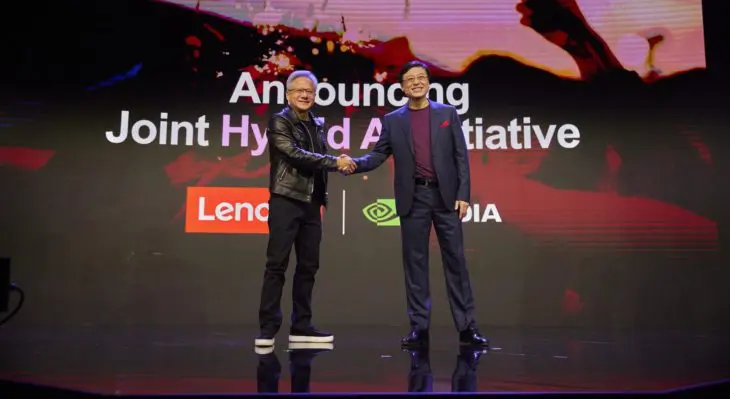
The White House was no stranger to Huang either. Jensen Huang has appeared several times in the company of President Trump and was present, alongside Mark Zuckerberg, Elon Musk, Sundar Pichai, Satya Nadella and (Huang’s cousin once removed) Lisa Su, at the signing of the one-page pact that gave the entire AI sector the green light to regulate itself. The only brake on the growth of AI was allowed to be the availability of Nvidia chips.
No Nvidia without Jensen?
The rise of Nvidia cannot be separated from the role of its CEO, who, with his renowned work ethic and technical background, has always made the right business choices.
That the man has been at the helm of his company for more than three decades is unheard of in Silicon Valley. No transformation was too much for Huang: from start-up to gaming company to AI specialist, Jensen Huang stood charismatically at the centre. It is telling that it is personal choices that are now bringing Jensen Huang down.
A spy with impact
An important question now arises. What is Nvidia worth without its founder? The stock market currently seems to agree that the answer is in any case “less”. The share price on the NASDAQ has plunged by around 37 percent since the start of the revelations. Since the formal announcement of his departure, a sizeable dip has been added to that. To what extent is that decline structural, or emotional? Demand for Blackwell accelerators will in any case not drop immediately.
Going back to the start of the soap opera, we have to conclude that China does not come out of this badly. Even if spy Alice Huang did not obtain any valuable information, and exerted no relevant influence on Jensen Huang himself, the impact is unmistakable.
The reputational damage for the CEO and for Nvidia will linger and the company’s falling share price is a measurable result. If China wanted to level the playing field between its own AI industry and the American sector with the spy, then that already seems to have succeeded, at least in small part. Not to mention the state of the private life of the most rock ‘n’ roll CEO in the tech world.