

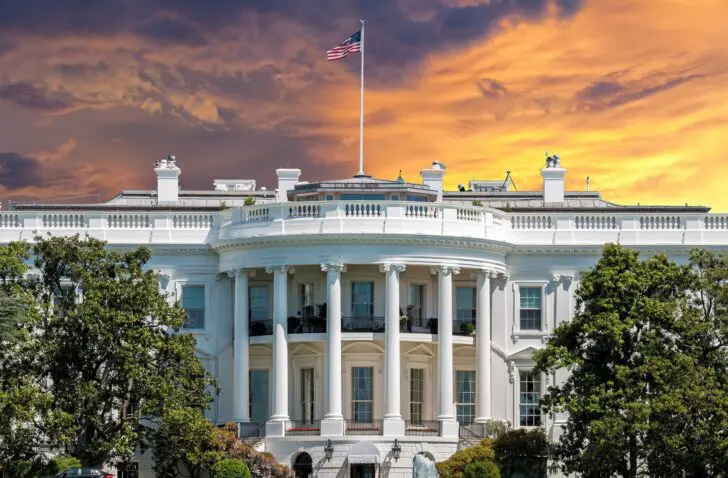
The Trump administration and Big Tech have signed an agreement for AI regulation. It is primarily based on self-regulation and proposes few to no concrete measures.
The elite of the AI world were guests at the White House yesterday for a conclave. A historic photo shows Jensen Huang (Nvidia), Mark Zuckerberg (Meta), Elon Musk (xAI), Sundar Pichai (Google), Satya Nadella (Microsoft), and Lisa Su (AMD), among others, posing with President Donald Trump. The guest list also included OpenAI, Anthropic, Palantir, and former Amazon CEO Jeff Bezos.
323 words
The result of the summit: a vague agreement of exactly 323 words regarding (the absence of) AI regulation. Even with a large font, the entire text fits easily on a single page in Word. Trump describes the agreement as ‘in a sense, a constitution,’ and the AI leaders present also spoke highly of the ‘sense of responsibility’ that filled the room.
Furthermore, do not say ‘artificial intelligence’ anymore, but ‘superintelligence.’ Trump also found the time to sign a decree making the new term official. Additionally, a government chatbot for citizens was launched in the presence of the AI leaders. That platform is supported in part by Google Gemini and xAI’s Grok.
Moral commitment to self-regulation
What is and isn’t included in what Trump calls a historic agreement? Four measures are proposed. Developers of AI systems must implement internal controls to monitor the capabilities and ‘alignment’ of models and designate an internal team for this purpose. Furthermore, an external, independent auditor must be appointed to report to an equally external and independent committee tasked with overseeing potential security issues.
The focus on internal measures is particularly striking. The agreement is a commitment to self-regulation. Companies are themselves responsible for implementing the four layers. At most, it involves a voluntary obligation that, in Trump’s own words, is ‘morally binding.’ This is also stated literally in the agreement: “It could be meaningful to eventually codify these steps into laws or regulations.”
Vague measures
The American government is washing its hands of the matter. There are few to no consequences associated with meeting or failing to meet these moral obligations. The validity of the external audits is also questionable. For instance, they only seem authorized to assess the controls, and it is unclear who appoints them.
If these are chosen by the companies themselves, one might question how independent they truly are. Furthermore, the agreement provides no definition of what constitutes a ‘frontier’ model to which the obligations apply, and potential security risks are mentioned only very briefly, with no concrete measures proposed for them. The who, what, and how seem largely to be determined by the AI companies themselves.
Sincere repentance?
We should not have expected a strict approach from the Trump administration. The president calls the doomsday theories about AI technology that have emerged following recent security incidents a ‘hoax’ devised by ‘left-wing conspiracy theorists.’ Trump is also the first to lash out when rules ‘against’ American companies are proposed elsewhere in the world. The president believes that he only needs to snap his fingers and tech leaders will listen.
Whether that sense of responsibility from the tech industry is so sincere is also questionable. OpenAI and Anthropic claim to be open to a call for a pause in AI development, yet they continue to launch new models incessantly. It was only under increasing public pressure that OpenAI decided to intervene. Every company at the table yesterday benefits from the AI machine continuing to run smoothly without too many restrictive regulations.
Other tech leaders such as Jensen Huang and Mark Zuckerberg are openly against regulation for their sector. Zuckerberg even dedicated a manifesto to it. The promises from Palantir are also somewhat implausible here. The company’s AI technology is linked to ICE and the Israeli military, among others. And whether one can expect Elon Musk, who has the sense of responsibility of a moody teenager, to silence his foul-mouthed chatbot Grok, is something we also take the liberty to doubt.
Anthropic back at the table
The presence of Anthropic CEO Dario Amodei is noteworthy. The company has been persona non grata at the White House for several months following an ethical disagreement with Defense Secretary Pete Hegseth. Anthropic is allowed back at the White House table for the first time in a long while, but the ban remains in effect for now.
The disagreement concerned the fact that Anthropic wanted an explicit ban on the use of AI for mass surveillance and autonomous weapons. These applications are not mentioned as potential risks of AI technology in the agreement; only ‘cybersecurity, biological and chemical weapons’ are listed. What is not in an agreement sometimes says more than what is.
EU bowing down?
What the White House meeting should teach us is that the American government will not stand in the way of Big Tech too much. This fits perfectly with Trump’s policy: winning is a must, and anything goes to achieve that. We just have to trust that the grand promises are sincere and will be kept.
However, the European Union is also changing its stance. Legislations such as the GDPR and AI Act are being weakened to give AI companies more room to maneuver with the processing of European citizens’ data. This is not to the liking of privacy advocates.