

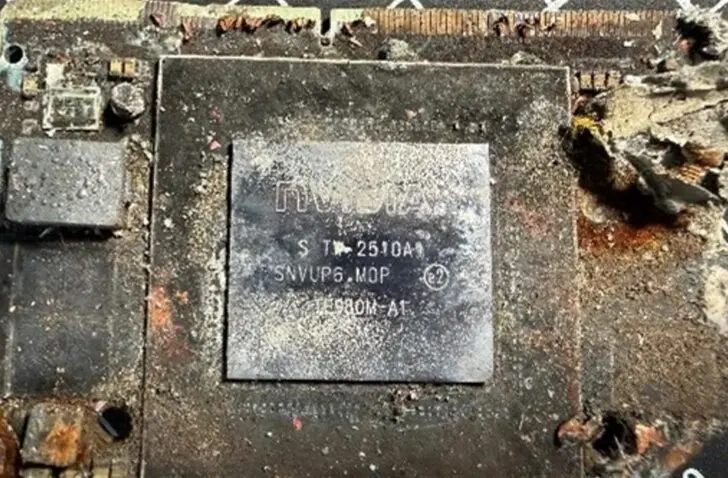
The Ukrainian military intelligence service has found an Nvidia Jetson Orin chip in a new Russian S-71 cruise missile.
An Nvidia Jetson Orin chip is part of Russia’s new S-71 Monochrome cruise missile. This was determined by Ukraine’s military intelligence service (HUR) after recovering the component from the weapon’s remains.
Autonomous robots
Nvidia’s Jetson family includes microchips intended for autonomous machines. Jetson Orin chips consist of ARM Cortex cores, memory, and a GPU accelerator component. The GPU is built on the slightly older Ampere architecture.
It is unclear exactly which Orin chip the Russians have integrated into their cruise missile. Orin chips date from 2023 and come in three main variants: the light Nano (up to 25 watts and 67 INT8 TOPS), the Orin NX (up to 157 TOPS at 40 watts), and the Jetson AGX Orin (up to 60 watts and up to 275 TOPS).
The Orin chips are intended to provide robots with smart capabilities, such as computer vision and running AI models internally to make decisions. According to the intelligence service, the unit in the Monochrome missile was produced during March 2025.
AI for attacks
You cannot simply compare Jetson to, say, a state-of-the-art Blackwell-based accelerator. While it is unclear exactly what Russia is using the Jetson chip for, it is plausible that the S-71 cruise missile is equipped with a smart (AI) component to perform autonomous functions.
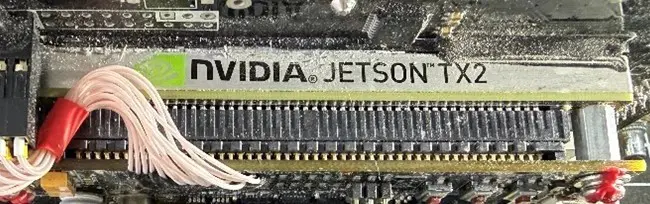
This is not the first time Nvidia hardware has found its way into Russian weapons of war. In the wreckage of a Klyn UAV (an attack drone with an explosive charge), the HUR already discovered an Nvidia Jetson TX2 in May of this year.
Limited effectiveness of sanctions
The findings demonstrate two things. First and foremost, Russia is apparently unable to obtain the necessary components to build its weapons domestically. Secondly, this does not seem to be much of a disaster (for Russia, at least). Despite sanctions, the country still manages to acquire American AI chips and incorporate them into the weapons it uses to target Ukrainians.
Ukraine provides detailed reports on components it finds in weaponry. By doing so, the country aims to publicize the use of Western materials, hoping to increase not only the sanctions but also the oversight of them.
Intel, AMD, and Broadcom as well
It is not just Nvidia chips that find their way into missiles and drones. Other chips are also being deployed. For instance, Russia relies on Altera FPGAs (Intel), some of which were produced as recently as 2024. Xilinx FPGAs (AMD) also play a role in the weaponry, as do Broadcom chips.
Ukraine therefore calls on manufacturers to act on these findings and investigate how chips, despite sanctions, still find their way into Russian missiles and drones.