

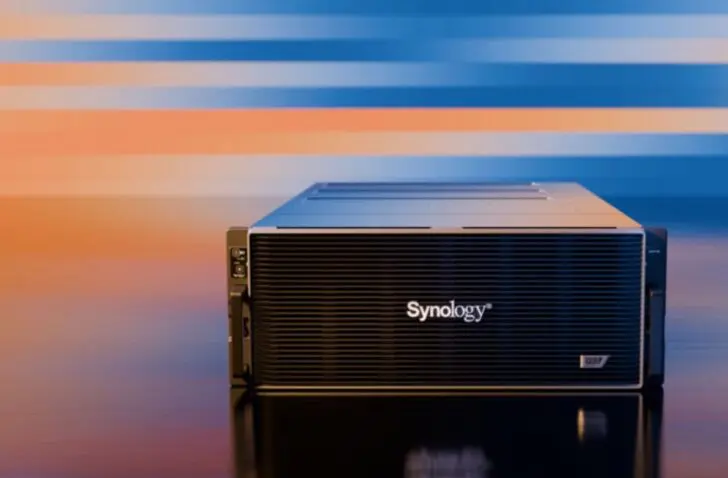
The Synology PAS7700 is now generally available, a year after the active-active NVMe storage system was launched at Computex.
Synology has officially launched the PAS7700 as an available product. This marks the general availability of a system that it already showcased at Computex last year, but which was not yet widely available at the time.
Synology positions the PAS7700 as an all-flash NVMe solution for enterprise environments where performance, scalability, and continuous operation are essential.
High performance
The PAS7700 is Synology’s first active-active, all-flash NVMe storage system. According to Synology, the system has been extensively validated beforehand through an enterprise proof-of-concept program. The company states that this allowed customers to test in practice how the platform performs under heavy loads and in environments where downtime is not an option.
The PAS7700 utilizes a dual-controller architecture in a 4U chassis with forty-eight NVMe SSD bays. The system can expand to 1.65 PB of raw capacity with up to seven expansion units and supports NVMe-oF, iSCSI, Fibre Channel, SMB, and NFS, among others.
Synology cites performance of up to two million IOPS, sub-millisecond latency, and throughput of up to 30 GB/s. The system supports up to 2,048 GB of total memory and 100 GbE networking, making it clear that Synology is targeting heavy enterprise workloads.
Redundancy and protection
Synology equips the PAS7700 with multi-layered redundancy. For instance, the device supports triple-parity RAID, synchronized write protection in memory, IP failover, and protocol-level failover.
In addition, data protection features are built-in, such as Self-Encrypting Drives, WORM, immutable snapshots, Snapshot Replication, and Hyper Backup. In a later phase, Synology also intends to add tiering, allowing cold data to be automatically moved to cheaper storage.
Enterprise focus
With this general availability, Synology takes the step from announcement to delivery just before a new edition of Computex. The PAS7700 is intended to secure the company a place in more demanding storage projects. This aligns with Synology’s shifting focus, leaving increasingly less room for entry-level solutions.