

Synology is discontinuing its range of free cloud-based services. The password manager C2 Password and file transfer service C2 Transfer will even disappear completely.
Synology is moving away from its offering of free cloud-based services. In an email to users, the company announced that C2 Password and C2 Transfer are being retired. The free tier of C2 Storage, which gave customers 15 GB of storage, is also disappearing.
C2 Transfer and Password
C2 Password is a password manager, and C2 Transfer is a service for the controlled and secure sharing of large files with external parties via the cloud. At launch, Synology positioned the service as a business alternative to platforms like WeTransfer.
Five years ago, Synology still positioned these solutions as key tools in its strategy. Synology wanted to attract new customers with an appealing free offering of targeted cloud solutions. The manufacturer is primarily known as a NAS builder and hoped to gain recognition among a wider audience with a password manager and a file transfer service.
Active Insight: paid for everyone
Synology is also cutting back on free management. The entry-level tier of Active Insight is disappearing. Active Insight allows customers to manage multiple NAS devices via a central portal. This is useful for those who want to keep an eye on several of their own devices, but also for service providers who need to monitor NAS devices at client sites.
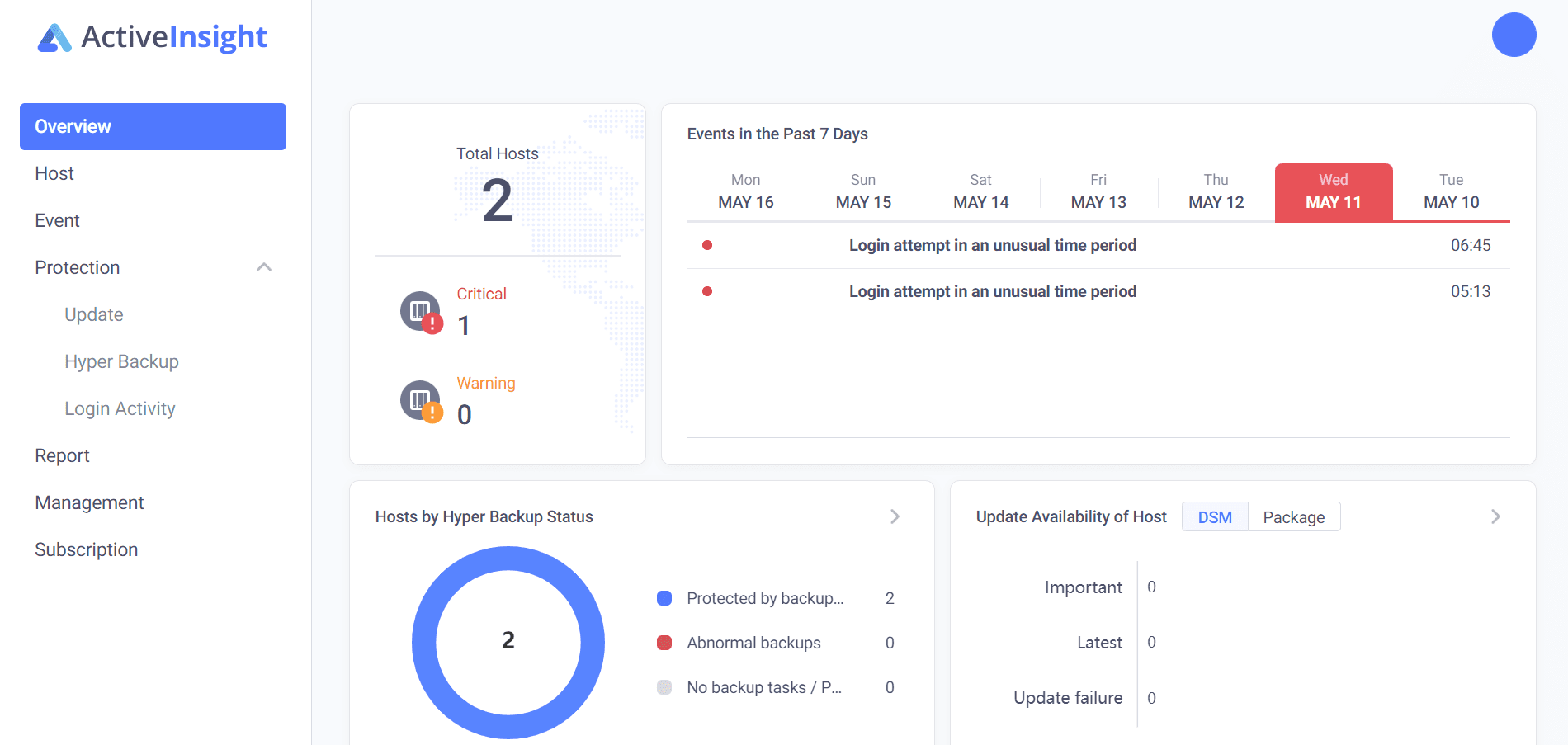
Synology used to give away three free licenses, but is now stopping that. With a price tag of $29.99 per NAS per year, the cost of monitoring three NAS devices goes from zero to nearly $90 annually. For providers, this isn’t an issue, but for enthusiasts and small businesses managing a few devices themselves, it’s a small extra cost that may or may not be worth it.
No more free storage
Synology also marketed C2 Storage via a free tier, where users received 15 GB of storage. That free storage is also disappearing. Synology is now combining C2 Storage and C2 Object Storage into a single entity (C2 OneStorage) for which no entry-level tier exists anymore. The minimum subscription includes 300 GB of storage for €29.99 per year.
Individual subscriptions are no longer available. Users must choose C2 OneStorage. Current subscriptions will continue to run until December 22, 2026. After that, users must switch. All subscriptions with auto-renewal will be transitioned automatically.
Transition period
Synology is also providing a transition period for the other changes. Those using C2 Password or C2 Transfer will have one year to switch to an alternative.
For Active Insight, licenses can be renewed until December 22, 2026. It is already no longer possible to create free licenses. Free licenses will be removed by June 22, 2027, at the latest. Synology will not automatically transition free users to paid versions.
Scrapping the previous strategy
It is striking that Synology is taking such an axe to its free services and entry-level plans. The announcement comes primarily on the eve of the Computex trade fair in its home country of Taiwan, where Synology traditionally has a strong presence.
With these announcements, the company is clearly drawing a line under its strategy from five years ago: recruiting new personal users is no longer a priority.
Enterprise first, at the expense of…?
Synology has been trying to profile itself as a brand for the large enterprise market for some time, aiming to compete at the enterprise level with storage and backup services from established players like HP, Lenovo, and Dell. It is notable that Synology not only wants to position itself this way by expanding its offering, but also by increasingly turning its back on the consumer segment.
Synology grew large as a NAS specialist among generally tech-savvy consumers. The company then gained a position in the business (SME) market because those consumers, in their roles as IT specialists, chose Synology. The realization that the company could conquer the business market thanks to enthusiastic consumers was still strongly present a few years ago.
In the meantime, that approach has almost completely vanished. Synology is focusing less and less on smaller end-users and recently sparked a small controversy in that segment by requiring HDDs with its own logo in NAS devices. The company eventually backed away from that after heavy criticism.
Most of the energy now seems to go toward the enterprise segment, including targeted backup solutions designed to convince IT managers of large companies. Synology itself claims to be making progress in that market. Synology does still have the BeeStation brand, which includes a very user-friendly light-NAS product.
For the traditional tech-savvy end customers and SMEs that helped Synology grow, the offering is becoming thinner. Entry-level plans like those mentioned above are disappearing, and this comes on top of a NAS lineup that hasn’t seen significant hardware updates under the hood in many years. Other manufacturers, notably Qnap, are eagerly capitalizing on this. For instance, that manufacturer’s myQNAPcloud Storage still has a free tier (good for 16 GB), and the CPUs in new NAS devices are much more up-to-date.