

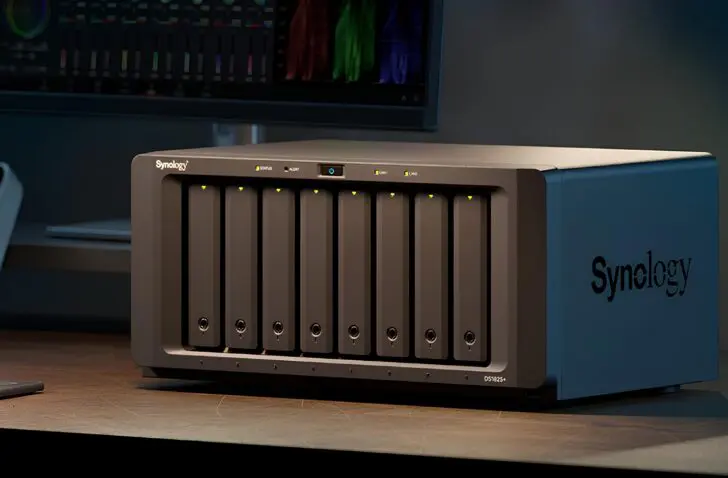
The Synology DS1825+ gives you exactly what you expect from a large DiskStation: plenty of storage capacity, a solid housing, and, above all, excellent management via DSM. At the same time, the hardware is functional and remarkably conservative, featuring a processor that is now clearly showing its age.
The Synology DS1825+ (€1,182 excl. VAT) is an eight-bay NAS for those primarily looking for high storage capacity in a desktop format. That says it all: anyone who has used a Synology NAS before knows roughly what to expect here. The manufacturer rarely makes radical changes to its formula, and this model is no exception.
This is both an advantage and a limitation. The DS1825+ looks and feels like a classic DiskStation, with the familiar build quality, a trusted layout, and an operating system that remains among the best in this segment. At the same time, Synology once again relies on hardware—and specifically a CPU—that fails to impress on paper.
Familiar housing, high capacity
The Synology DS1825+ is built around eight bays for 3.5-inch or 2.5-inch drives. As with other similar DiskStations, Synology uses the well-known and convenient click system to secure HDDs in the trays. This makes installing or replacing drives simple and accessible.
With DSM 7.3, Synology has completely removed software limitations regarding HDD models. This means you can install hard drives from your favorite manufacturer in this NAS, although Synology continues to offer its own models. According to Synology itself, using their own hard drives significantly reduces the chance of issues and ensures that support is much smoother.
Capacity is this device’s greatest asset. Synology provides space for eight drives, totaling up to 192 TB of raw storage with 24 TB drives (though in practice, you will opt for a RAID configuration). Via two expansion units, this can be increased to eighteen bays and 432 TB of raw capacity. For small and medium-sized organizations that want to store a lot of data centrally without resorting to a rack server, this is the primary argument. Furthermore, two M.2 NVMe slots are available for SSD cache.
Synology also equips the NAS with two built-in 2.5 GbE ports. This is a welcome addition, as such connectivity is gradually becoming the standard today. Synology ignored 2.5 GbE for a long time but now seems to have fully embraced the standard. Those needing more network bandwidth can scale up to 10 or even 25 GbE via an expansion card.
Conservative CPU
On paper, the DS1825+ remains a typical Synology product: adequately equipped but not particularly progressive. This applies first and foremost to the processor. Synology has once again chosen an AMD Ryzen Embedded V1500B, a chip that has been around for years and can hardly be called modern anymore. This AMD chip hit the market in late 2018 and is the same one found in the Synology DS925+.
This CPU is sufficient for classic NAS tasks, backups, file sharing, and lighter server functions. The housing has space for two DDR4 RAM modules, with Synology pre-installing one 8 GB module. It can be expanded to a maximum of 32 GB.
Synology explicitly positions the device for additional roles such as camera management, containers, and virtual machines. For the latter two scenarios, it is hard not to notice that the platform’s foundation is already old. This doesn’t make the DS1825+ unusable, but it does make it less attractive to those who place a high value on recent hardware.
After all, Synology does not exist in a vacuum. Competitors like Qnap do manage to bring new NAS models with more recent CPUs to market. Anyone wanting to use their device as more than just a storage server—for example, hoping to run containers or virtual machines—could use some extra horsepower.
DSM 7.3 remains convincing
Synology relies on its software to compensate for this, and it largely succeeds once again. DiskStation Manager (DSM) 7.3 remains the main reason to buy a Synology NAS. The operating system is clear, mature, and feature-rich without becoming unnecessarily complex. This is precisely where Synology has distinguished itself from many competitors for years.
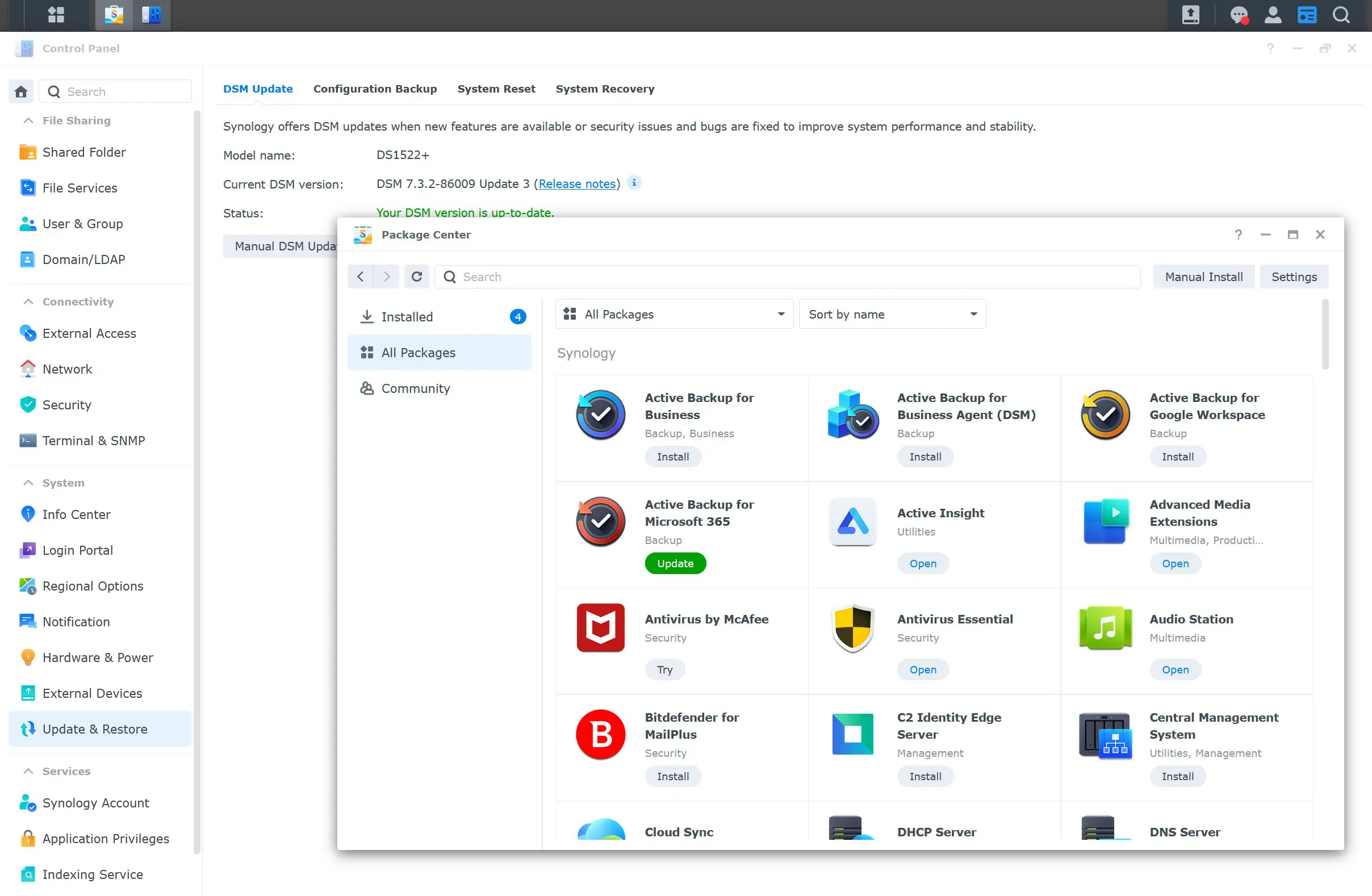
The possibilities here do not fundamentally change compared to other recent DiskStations. You can centrally manage and share files, set up synchronization between locations, link cloud storage, configure extensive backups, and use snapshots to better protect data. Additionally, there are applications for photo storage, collaboration, video surveillance, and centralized management of multiple Synology systems.
Other manufacturers may offer similar functionality, but in our opinion, no one comes close to the high level of refinement of DSM, which feels like a mature, user-friendly, yet powerful OS.
DSM also remains an asset for those who want to go a bit further than pure storage. Containers and virtual machines are supported, and Synology offers enough of its own applications to turn the NAS into a versatile server. Again, we must note that the software’s capabilities are more impressive than the underlying hardware.
A trusted choice
The Synology DS1825+ is a very predictable NAS, and that is not necessarily a negative thing. The build quality is good, the housing is practical, the storage capacity is high, and DSM 7.3 remains one of the strongest arguments in the entire NAS segment. For organizations primarily looking for a reliable and easy-to-manage storage server, this device does exactly what it needs to do.
At the same time, it is difficult to ignore the hardware criticism. With a price tag of €1,182 excl. VAT. VAT without storage, you certainly cannot call the DS1825+ a budget device. The processor is old and feels like a conservative choice for a device that otherwise aims for broad versatility.

For pure storage use, this doesn’t have to be a dealbreaker, but in this segment, it is a valid question to ask. Synology increasingly expects customers to see these devices as a total solution and not to poke around too much under the hood.
In summary, the DS1825+ is a typical Synology NAS: more convincing due to its software, ease of use, and finish than its raw specifications. Those who value that ecosystem and need many bays will get a solid device. If you can do with fewer HDD bays, the Synology DS925+ is the obvious alternative.
NAS stands for Network Attached Storage, and as a user-friendly and complete storage server, this device passes with flying colors. Those who see their NAS more as an all-in-one server and want to run VMs and containers alongside storage might consider a device with more powerful internals.
Tested: Synology DS1825+, €1,182 excl. VAT.
Pros
- Management via unparalleled DSM 7.3
- Wide range of useful apps
- Robust and reliable hardware
- Space for M.2 NVMe
- Dual 2.5 GbE connection
Cons
- Old CPU with limited performance