

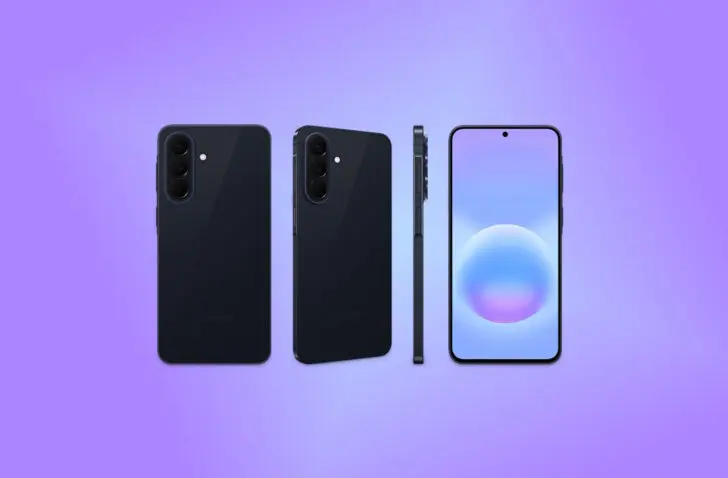
The Samsung Galaxy A57 doesn’t steal the show, but you can certainly rely on it. This smartphone knows its strengths and its limitations.
For years, the Galaxy A-line has been comfortable sitting in the shadow of Samsung’s premium devices. But make no mistake: it is thanks to a strong range of budget-friendly devices that Samsung can call itself the largest smartphone manufacturer. The Galaxy A57’s predecessors played a major role in that. Furthermore, the A-series has claimed a prominent spot in almost all corporate webshops.
With the Galaxy A57, Samsung continues its established line. For an affordable price tag of 429 euros incl. VAT, you get a very well-balanced device. The mid-range devices from the South Korean brand don’t need to excel in any particular area, as long as they offer value for money.
S26 writ large
Samsung has not skimped on the finish and build quality of the Galaxy A57. The stacked lenses make the A57 closely resemble the S26, which is a compliment. The device is also equipped with the same material (Gorilla Glass Victus). As a result, you do not feel like you are holding a cheaper device; furthermore, it benefits the smartphone’s sturdiness.
If you place the A57 next to the S26, the difference in size will be noticeable (6.7 inches vs. 6.3 inches). The difference with the equally sized S26+ would not even be that striking from a distance.
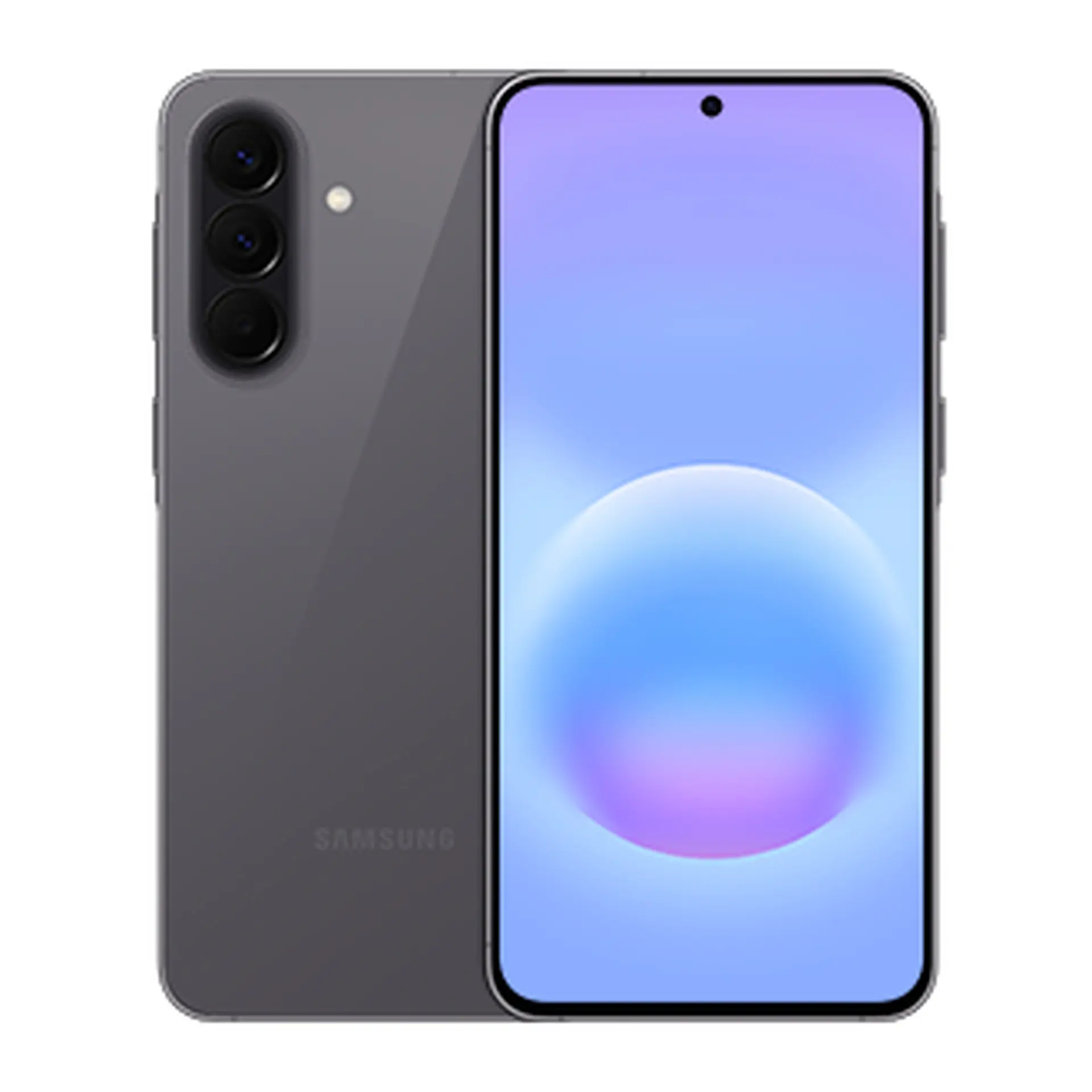
The 6.7-inch screen accommodates 1,080 x 2,340 pixels, providing a sharp image. At 1,100 nits, the peak brightness is not high, but also not much lower than the S26 devices. You therefore do not have to worry about readability in various lighting conditions. With a measured peak brightness of 2,520, the Google Pixel 10a remains the nit champion.
Home-grown chips
As a smartphone manufacturer with its own chip division, Samsung is in a luxury position. Where many other manufacturers have to scramble to get the necessary parts, even Apple, Samsung can produce its chips, including expensive memory, entirely by itself. The Galaxy A57 comes equipped with 8 GB of RAM and an Exynos 1680 processor from its own factory.
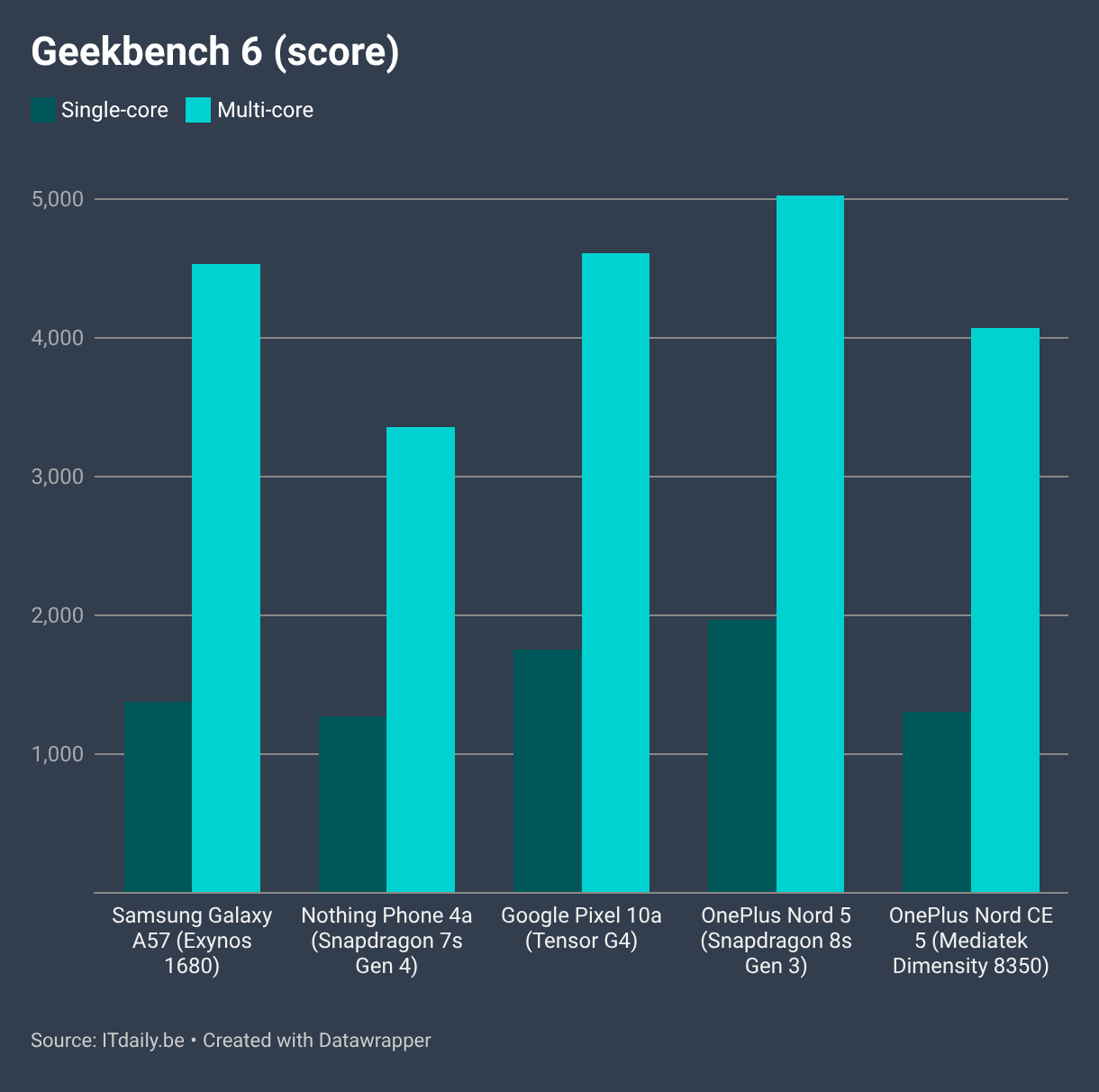
In the premium segment, Qualcomm’s top processors are invincible, but Google proves with the Pixel a that you can go far in cheaper segments with your own processor. The Exynos processors often prove to be inconsistent, though the Exynos 1680 does its job. Peak performance isn’t top-tier, but acceptable for this segment. The OnePlus Nord 5 does perform better with an ‘older’ Qualcomm processor.
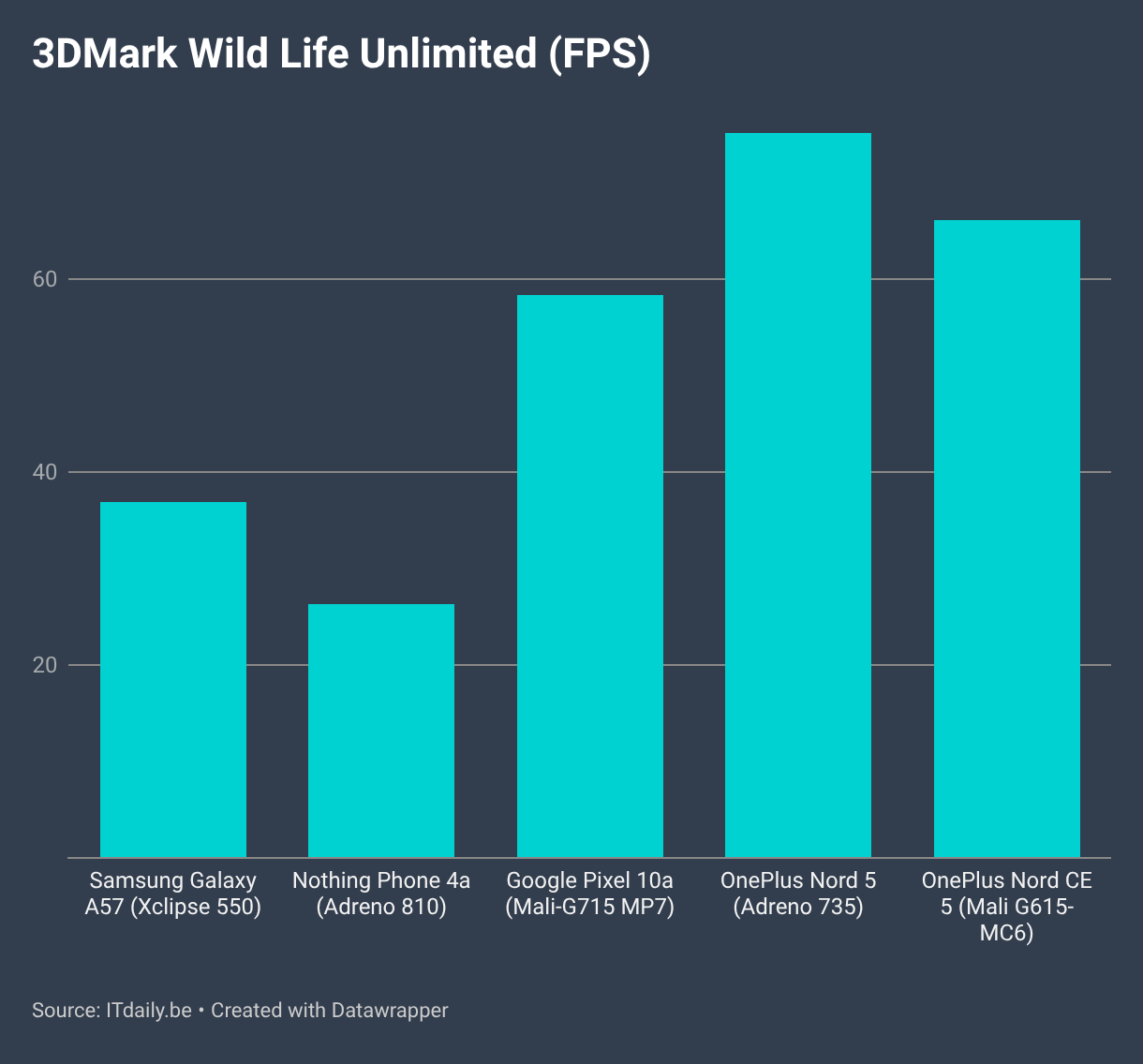
Graphically, the processor is more limited. In a simulation, we achieved an average of 36.9 fps. For heavier applications such as games, the device thus hits its limits. Price-matched rivals from Google and OnePlus easily reach an average of 60 fps or more. It's not yet as dramatic as the Nothing 4a, which barely meets the minimum bar for gaming.
Battery & charging
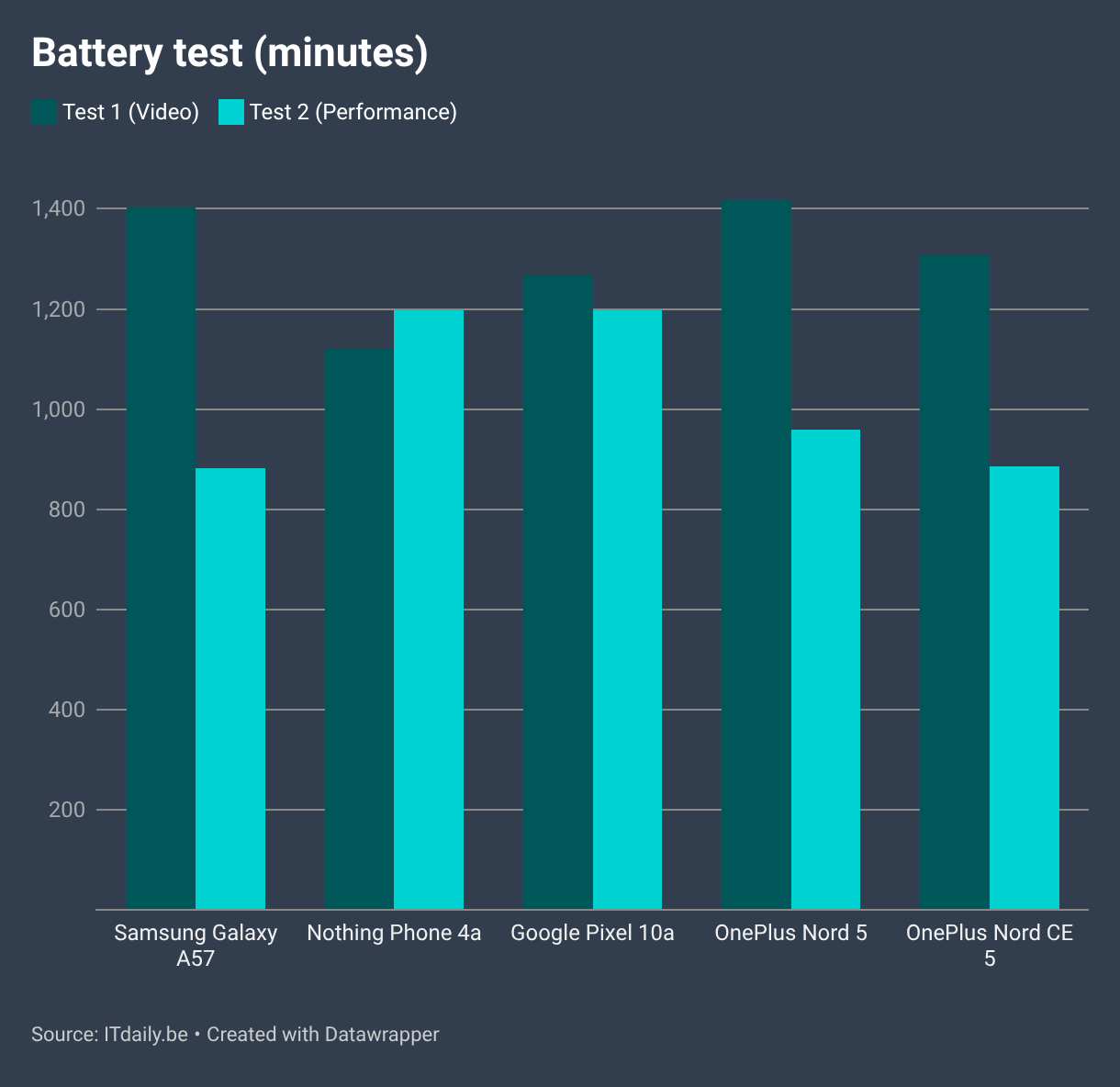
The battery has a standard capacity of 5,000 mAh. In our tests, the battery shows two faces. In the video test, the Galaxy A57 performs better than most of its tested price-matched rivals and even better than the Galaxy S26 Ultra. You could play video for almost a full day before the battery gives out, though we can imagine much better ways to spend the day.
In the performance test, where we put the device under constant high load, the Galaxy A57 runs out of breath much faster and suddenly lets itself be outperformed by cheaper devices like the Nothing Phone 4a and the OnePlus Nord CE 5. It is therefore advisable to give it a rest every now and then. Based on 'average' use, you'll easily last a day.
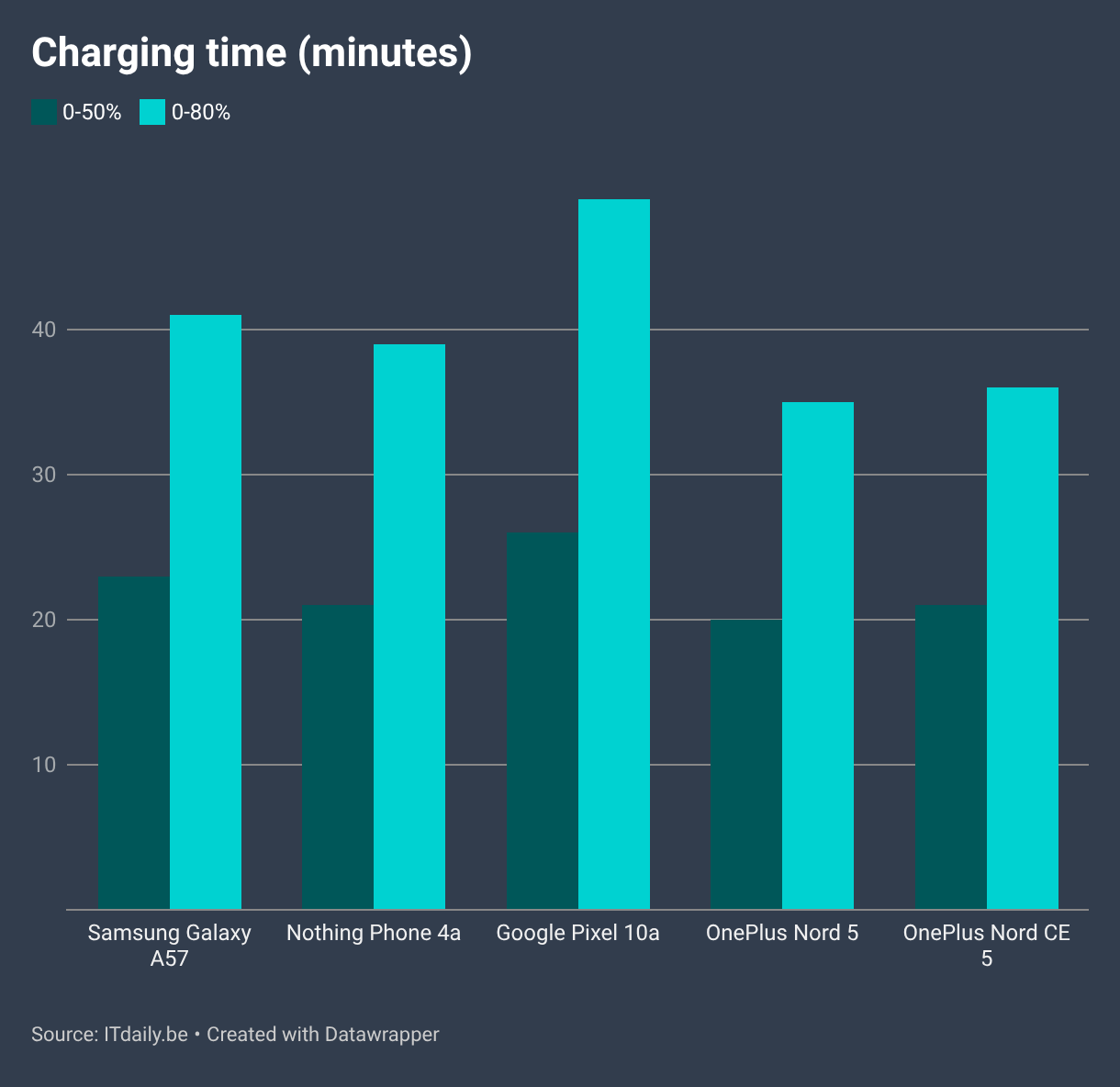
Charging has been a pain point for Samsung smartphones for years. In almost all price segments, it is eclipsed by the competition in this regard. Samsung has made strides, and for the Galaxy A57, the gap compared to price-matched rivals is still under control. The A57 needs 'only' five minutes longer than the Nord 5 to charge to eighty percent, with the difference being that the latter has a larger battery to fill.
Cameras: more isn't always better
Samsung isn't changing anything regarding the A57's cameras. The camera trio is identical in specs to that of the A56: a 50 MP main camera is accompanied by a 12 MP wide-angle camera and a 5 MP macro camera. On paper, these aren't specs that will blow you away, and in practice, it yields mixed results.
It's important to know that the main camera takes images in a 12.5 MP resolution by default because pixels are 'binned' to improve light sensitivity. This results in more consistent performance in various lighting conditions, although colors are sometimes a bit dull. In the absence of a telephoto lens, the main camera also has to handle zoom photos. As long as you don't zoom in too far, it does so to the best of its ability, but you shouldn't expect miracles.
The other two cameras play a more subordinate role. The wide-angle camera can be useful in certain situations, but if you put the photos under a magnifying glass, you'll quickly notice that details are much less sharp. The 'stretched' effect cannot be ignored. The macro camera is redundant and even slightly embarrassing. A camera trio might sound nice for the sales pitch, but we'd rather give up a lens for an equivalent wide-angle or telephoto camera alongside the main one.









Stubborn software quirks
Samsung's OneUI software has its proponents and detractors. Keep in mind that Samsung, much like Apple, views its software as an ecosystem. The manufacturer sometimes assumes a bit too easily that you aren't just buying a smartphone from the brand. If that's not the case, OneUI can sometimes feel a bit annoying because it constantly wants to push you toward an account.
The Galaxy A57 also doesn't escape AI features. However, you don't get the full Galaxy AI package found in the S26 devices. A positive evolution is that AI features on smartphones are becoming less intrusive and are shifting more into the background.
Samsung further promises six years of updates. The manufacturer is often praised for its extensive support policy for mid-range devices. Nowadays, six years of security updates is nothing more than the norm, and we'd like to know why Samsung can't simply extend seven-year support to the A-series.
One man's loss is another man's gain
All things considered, the Samsung Galaxy A57 does exactly what you can and should expect from a mid-range smartphone. The device doesn't excel at anything, but it doesn't do anything wrong either. If you can live with minor limitations, you have a balanced and reliable device. Those who have a budget of around 400 euros to spend through work are making a safe choice here.
The Galaxy A57 has an extra advantage that previous generations didn't have. With OnePlus's departure from Europe, a significant competitor in the mid-range disappears. The Galaxy A57 loses out in many benchmarks against the Nord 5, but for those who need to make a choice for the long term today, Samsung is the better bet.
OnePlus's departure is a blessing for the Samsung Galaxy A57.
One man's loss is another man's gain, Samsung must think. Samsung took this loaf out of the oven at just the right time, though the Galaxy A57's dough mixture could have used a pinch more salt.
Tested: Samsung Galaxy A57, 8 GB RAM, 128 GB storage, six years of support, eco-label A, 429 euros incl. VAT
Pros
- S26-like design
- Decent screen
- Good battery
- Reliable performance
Cons
- Mediocre GPU
- Useless macro lens