

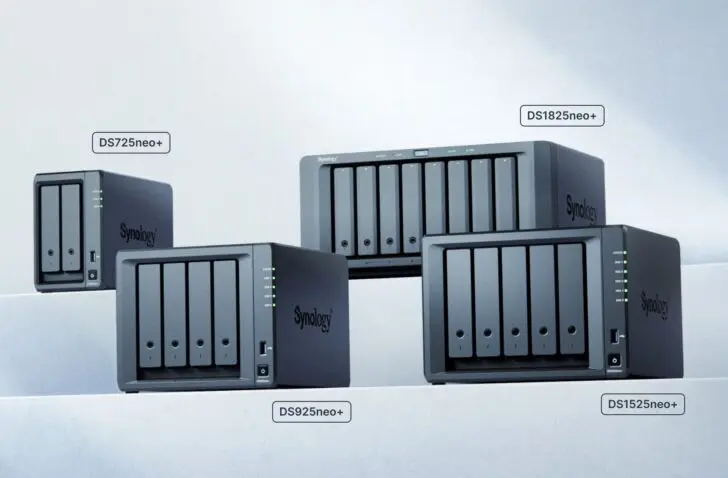
Synology neo+ is a series of four existing Plus NAS models that come standard with 4 GB of regular DDR4 memory instead of ECC memory. The entry-level price drops, and the error-correcting memory can be purchased separately later.
The new series consists of the Synology DS1825neo+, DS1525neo+, DS925neo+, and DS725neo+. “Desktop models still form the core of our NAS ecosystem,” says Bie-I Chu, Executive Vice President of the Synology NAS Group. “As dynamics in the memory market change, the neo+ Series underlines our commitment to accessibility.”
The press release speaks of “a more accessible memory configuration” without specifying exactly what is changing. The specification sheets on Synology’s website do, however. The processor, network ports, M.2 slots, expansion ports, and housing are identical to those of the DS725+, the DS925+, the DS1525+, and the DS1825+. The difference between Synology neo+ and Plus lies entirely in the included memory.
Synology neo+ halves memory on large models
The Plus models come with ECC memory: 4 GB in the DS725+ and DS925+, 8 GB in the DS1525+ and DS1825+. Each neo+ receives a single 4 GB DDR4 module without ECC. For the two- and four-bay models, only the type of memory changes; the five- and eight-bay models also lose half the capacity. The processors remain the same: an AMD Ryzen R1600 with two cores in the DS725neo+ and a Ryzen V1500B with four cores in the three others—chips we already called outdated in our review of the DS925+.
ECC memory detects and corrects bit flips in the RAM, which is particularly important for a server running 24/7 and hosting virtual machines or containers. For file sharing and backups, it makes little difference in practice.
Synology keeps the upgrade path to ECC open, up to 32 GB. According to a footnote in the press release, combining ECC and non-ECC modules is “not officially supported,” meaning the included 4 GB module must be removed during such an upgrade. On its product pages, Synology adds that third-party memory voids the warranty and technical support.
Prices follow the memory market
Synology does not mention prices in the press release. However, three of the four neo+ models are now listed in Dutch webshops, where they can be compared alongside the Plus models, including what they cost at their launch in 2025.
| Model | Memory Plus / neo+ | Plus at 2025 launch | Plus lowest ever | Plus today | neo+ today |
| DS725+ / DS725neo+ | 4 GB ECC / 4 GB non-ECC | 503 euros (June 2025) | 469 euros | 679 | not yet in stores |
| DS925+ / DS925neo+ | 4 GB ECC / 4 GB non-ECC | 642 euros (April 2025) | 499 euros | 785 euros | 649 euros |
| DS1525+ / DS1525neo+ | 8 GB ECC / 4 GB non-ECC | 786 euros (June 2025) | 724 euros | 1,059 euros | 929 euros |
| DS1825+ / DS1825neo+ | 8 GB ECC / 4 GB non-ECC | no listing | 1,049 euros | 1,361 euros | 1,169 euros |
A DS925neo+ currently costs 136 euros less than a DS925+, and a DS1825neo+ costs 192 euros less than a DS1825+ with half the memory. Compared to 2025, there is no saving: the DS925+ was in stores for 642 euros in April last year, while the DS925neo+ now costs 649 euros, and the DS1525neo+ is 143 euros above the launch price of the DS1525+.
In between lies a year of rising memory prices and Micron’s warning that the RAM shortage will persist until 2028. Furthermore, DDR4 is a phasing-out standard that is becoming increasingly difficult to find, as we already noted in our review of the DS925+.
The neo+ Series appears alongside the Plus models, which remain in the range. Both run DSM with Synology Drive, Active Backup Suite, and Surveillance Station, and since DSM 7.3, again with third-party hard drives. According to Synology, the devices are now available through its distribution channels.