

At the Snapdragon Summit, Qualcomm is launching ‘personal AI’ as a new category: AI agents that guide you throughout the day via earbuds, glasses, and wearables, without a screen. The Snapdragon Sound Elite Gen 2 provides the silicon, while a Personal AI Health Alliance including US companies such as Optum Health, Scripps Health, and Merck KGaA is intended to turn it into a healthcare market.
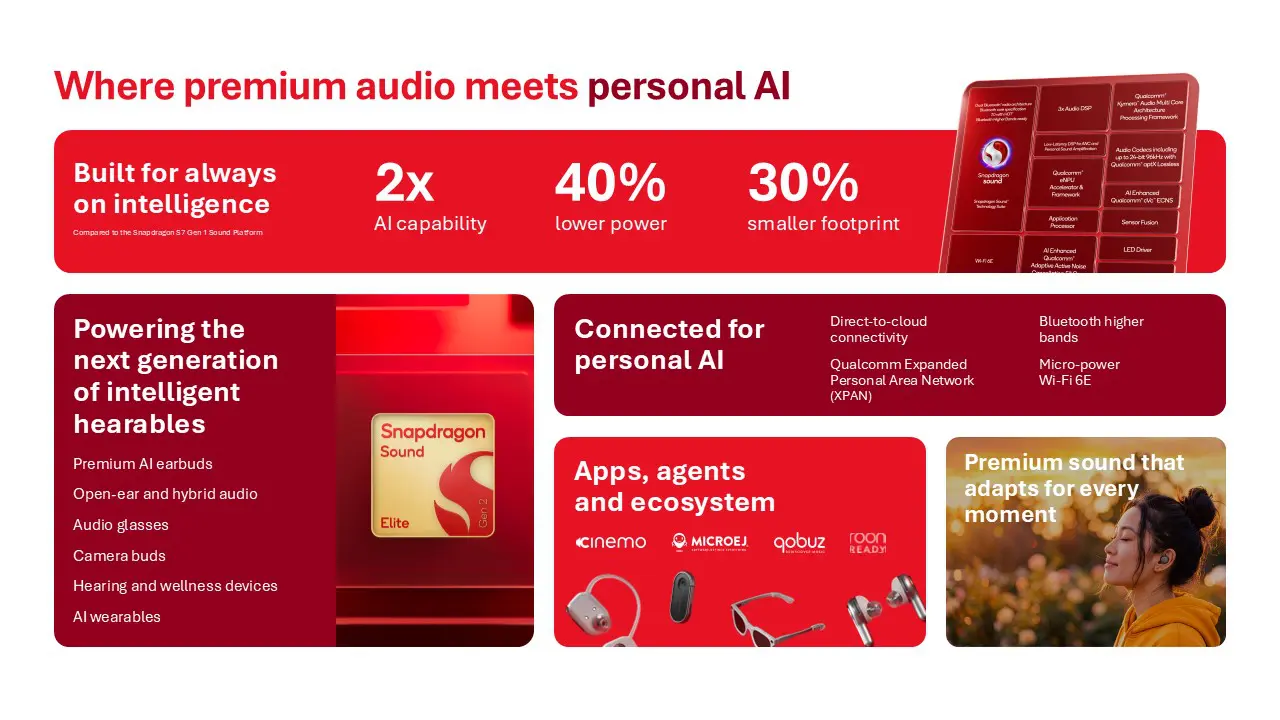
The most relevant feature of the Sound Elite Gen 2 is not the sound, but the connectivity. The chip contains an integrated micro-power Wi-Fi 6E radio that allows wearables to communicate directly with cloud services, bypassing the smartphone.
Qualcomm is building its own ecosystem around this, Snapdragon Sound Apps & Agents, featuring assistants, translation, and transcription. The chip claims double the AI computing power of its predecessor (128 GOPS), up to 40 percent lower power consumption, and a 30 percent smaller footprint. Note: the consumption figure comes from simulations and is still awaiting final silicon.
From gadget to healthcare market
Ziad Asghar, responsible for XR, wearables, and personal AI at Qualcomm, cited his own research during Snapdragon Summit 2026 in Hawaii, which reportedly shows that 70 percent of users want AI in wearables. More interesting for businesses is the Personal AI Health Alliance that Qualcomm is establishing together with Global Health Connector, with Optum Health, Scripps Health, Merck KGaA, the Digital Medicine Society, and Biocom as its first members.
The ambition: AI wearables that measure continuously between doctor visits—using on-device processing as a privacy argument—to get them to market and into clinical studies faster. There are no concrete products or results yet. The alliance promises proofs of concept via PAIHealth.org.
A camera in your ear
The Sound Elite Gen 2 also supports earbuds with a camera, which according to Qualcomm “collect context instead of taking photos.” Following the privacy discussion surrounding Meta’s smart glasses, this is a distinction that European regulators will examine closely. Cleer showed an initial concept featuring audio, camera, and AI. Reference designs should allow other manufacturers to follow more quickly.
After the PC and the smartphone, Qualcomm is looking for a third growth market and is opting for the screenless narrative that previous AI gadgets failed to sell. With its own app store on the chip and a healthcare alliance, it is laying the foundations; whether consumers and hospitals want to join in is another question.