

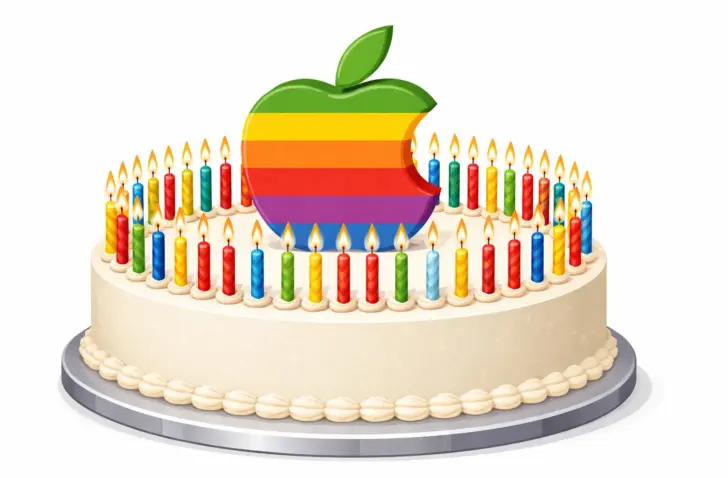
Two men started their tech startup Apple fifty years ago, which has since grown into a massive and world-renowned company.
Fifty years. It’s an age where people often pause to reflect: what have I done, where do I stand, and what’s next? Apple is blowing out fifty candles today, on April 1st no less. Although the company has existed for half a century, it still acts as if the next revolution is just around the corner.
The past: messily rebellious
Apple was founded in 1976 by Steve Jobs and Steve Wozniak, a story told so often it has become almost mythical. Yet there is a core of truth in that myth: Apple was a rebellious underdog from day one. While other computer companies like IBM focused on businesses and governments, Apple wanted to make technology personal.
The Apple II brought computers to a wide audience, and the Macintosh made graphical interfaces mainstream. But it wasn’t always smooth sailing. In the ’90s, Apple even seemed headed for the abyss: too many products, too little focus, and no clear direction.
The return of Steve Jobs and a new team, including designer Jonathan Ive, changed everything. With the iMac, iPod, and later the iPhone, Apple redefined not just its own course, but entire industries. Music, telephony, computing: Apple rewrote the rules.
The present: a persistent ecosystem
Today, Apple is no longer an underdog, but one of the most powerful tech companies in the world. Its strength lies not just in individual products, but in the whole. According to the company, the iPhone works seamlessly with the Mac, the Apple Watch with AirPods, and together everything forms a functioning ecosystem.
At the same time, Apple is no longer just a hardware company. Subscriptions, cloud storage, streaming: these have since become equally important pillars. This provides stability but also raises questions. Is Apple still the revolutionary challenger of the past, or has it become an established power primarily defending its position?
The downside: control and closedness
As Apple grows, so does the criticism. The closed ecosystem that works so well for users often feels restrictive to developers and competitors. The App Store rules, the commissions, the control over hardware and software: these are subjects increasingly coming under the microscope.
Apple is treading on thin ice here. Too much control can stifle innovation, but too little control undermines the very quality the company is known for. The coming years will show whether Apple can continue to maintain that balance.
The future: exploring new territories
What will the next fifty years bring? Looking at Apple, we see a company cautiously exploring new territories. Mixed reality, wearables, AI; these aren’t new interests, but rather logical extensions of what Apple already does. Albeit steadily, as competitor Google is already miles ahead in terms of AI with Gemini…
The big question isn’t whether Apple can still innovate, but how. The iPhone, now at model 17, was a clear leap forward at the time, and such moments are rare. The future will likely revolve less around one revolutionary product and more around refining and connecting existing technologies. Hopefully, the superlatives during new announcements will also be used more sparingly.
Think of devices that work together even better, software that adapts to your behavior, and technology that increasingly fades into the background. Apple’s ideal world has shifted to one where technology becomes almost invisible and fewer product revolutions are sparked.
Fifty years young
There are fifty candles on Apple’s birthday cake today. On one hand, it’s a tech giant that still wields great influence, but on the other, it continues to search, test, and sometimes fail. The company hasn’t had another ‘iPhone moment’ or ‘iPad revolution,’ but who knows, it might still surprise us, as it did recently with the MacBook Neo? That makes it, even after fifty years, still interesting to follow.