


With the Googlebook 14, Acer introduces its first device in Google’s new laptop category. According to the manufacturer, it is also the first Googlebook with a convertible screen.
Acer has announced the Acer Googlebook 14. This is Acer’s first laptop running on the new Googlebook OS. Google revealed this Chromebook successor in May and immediately relied on established PC manufacturers, including Acer, for its construction.
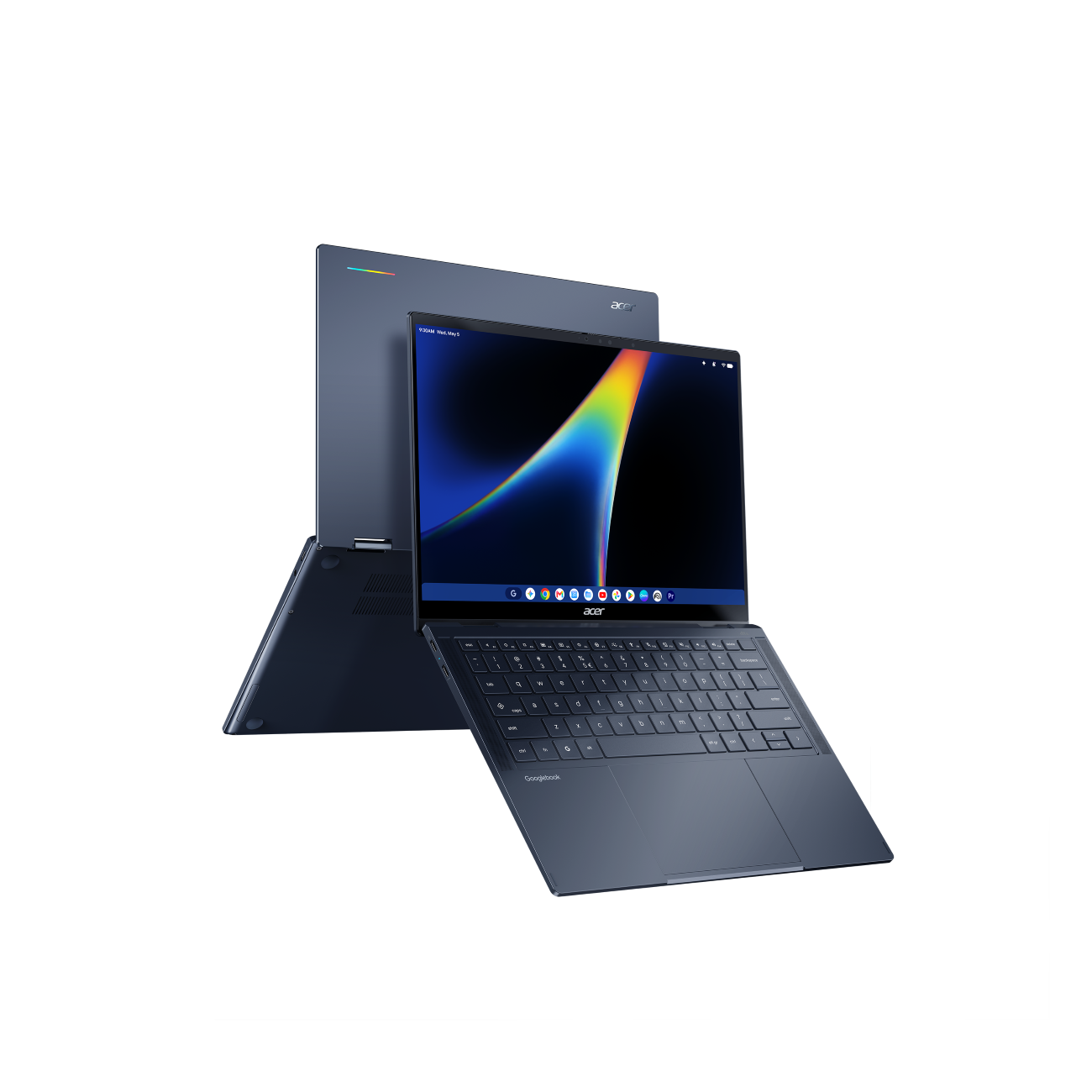
The Taiwanese manufacturer claims to deliver the first convertible in the category with this model: 360-degree hinges enable four positions, from classic clamshell to tent and presentation modes, and finally tablet mode.
The concept is not new; Acer gives these hinges a lifespan of 20,000 open-and-close cycles and mentions a MIL-STD 810H certification. It is notable that Acer immediately chose to emphasize flexibility for its first Googlebook.
Intel Core Ultra
Under the hood, we find a chip from the Intel Core Ultra Series 3. Acer mentions two options: a Core Ultra 5 325 and a Core Ultra 7 355. Graphically, it relies on integrated Intel Graphics. For memory and storage, Acer only communicates maximums: up to 32 GB LPDDR5X at 7,467 MT/s and up to 512 GB on a PCIe Gen 4 NVMe SSD.
That half-terabyte ceiling is meager for a device being marketed as a flagship. On the other hand, Googlebooks, like Chromebooks, are highly integrated with the cloud, which reduces the importance of local storage.
12-inch and OLED
The display consists of a 14-inch OLED panel with a resolution of 2,880 by 1,800 pixels in a 16:10 ratio. The panel is touch-sensitive, supports a USI 2.0 stylus, and is protected by Corning Gorilla Glass. Acer specifies a more than respectable 500 nits of brightness, along with 100 percent DCI-P3 coverage, VESA DisplayHDR True Black, and EyeSafe 2.0. The 71 Wh battery should achieve up to sixteen hours of browsing or fourteen hours of local video playback and supports fast charging.
1.14 kg and a Glowbar
The chassis consists of an aluminum-magnesium alloy, measures 13.9 mm thick, and weighs 1.14 kg. The lid features a so-called Glowbar: a light strip that displays battery and charging status using colors and patterns. The palm rest and underside feature Acer’s Comfort Touch finish, the keyboard is backlit, and the touchpad is moisture-resistant and covered with Gorilla Glass.
For connectivity, there is one Thunderbolt 4 port and two USB-C 3.2 Gen 2 ports (10 Gbps, with DisplayPort and power delivery) distributed across both sides, plus a 3.5 mm jack. Wireless options include Intel Wi-Fi 7 and Bluetooth 6.0. The webcam reaches 5 MP and features a physical privacy shutter, flanked by a triple digital microphone array and two stereo speakers.
A fingerprint reader in the power button and a Google Titan C security chip handle security. Acer also reports 49 percent circular materials, 99 percent plastic-free packaging, an EPEAT Climate+ designation, and an Energy Star 9.0 certification.
Gemini at the core
Just as with Google’s own announcement of the Googlebook category, Gemini is central to the communication. Continue On allows tasks started on an Android phone to continue on the laptop, Cast My Apps provides access to phone apps without installation, and Magic Pointer summons Gemini with a cursor movement. Additionally, there are proactive suggestions based on what is on the screen. Acer provides twelve months of Google AI Pro with the device, including access to Gemini, Flow, and Gemini Notebook, and 5 TB of cloud storage.
This may mask the fact that the Googlebook category is, at least in part, a vehicle for Google to introduce AI and Gemini to users. A strong affinity for AI, and specifically Google’s bundled AI, is a prerequisite for considering this laptop.
The Acer Googlebook 14 is expected to be released in the Benelux in December 2026, with a suggested retail price starting at 1,299 euros including VAT for the entry-level model. Google aimed for the first devices in the autumn during the category announcement; with a December release, Acer just misses that mark.