


At ITF World, imec is showcasing the quantum dot qubit device manufactured with High NA EUV lithography. This breakthrough is a major step toward the industrial scaling of reliable qubits for quantum computers.
Imec is the first to present an integrated hardware device that utilizes High NA EUV lithography for the production of quantum dot qubits. This development was presented at ITF World using ASML’s High NA EUV machine.
Quantum computers are capable of performing significantly more powerfully than classical computers for specific, complex problems, such as drug development and physical simulations. To make this power practically applicable, scaling up to millions of interconnected, reliable qubits is necessary. Imec’s demonstration brings this vision one step closer.
Silicon quantum dot spin qubits as an industrial candidate
Among the various approaches to quantum computing, silicon quantum dot spin qubits stand out as promising candidates for industrial scale, according to imec. Their production aligns with existing CMOS technology, allowing existing infrastructure and knowledge to be utilized. According to imec, this compatibility offers a clear advantage for large-scale deployment.
These qubits use an electron trapped in a nanostructure on silicon, where the electron’s spin state is used to store quantum information. Using High NA EUV lithography, imec has been able to realize precise structures with gaps of just six nanometers between the gates. This minimizes environmental noise and makes the integration of millions of qubits on a single chip theoretically possible.
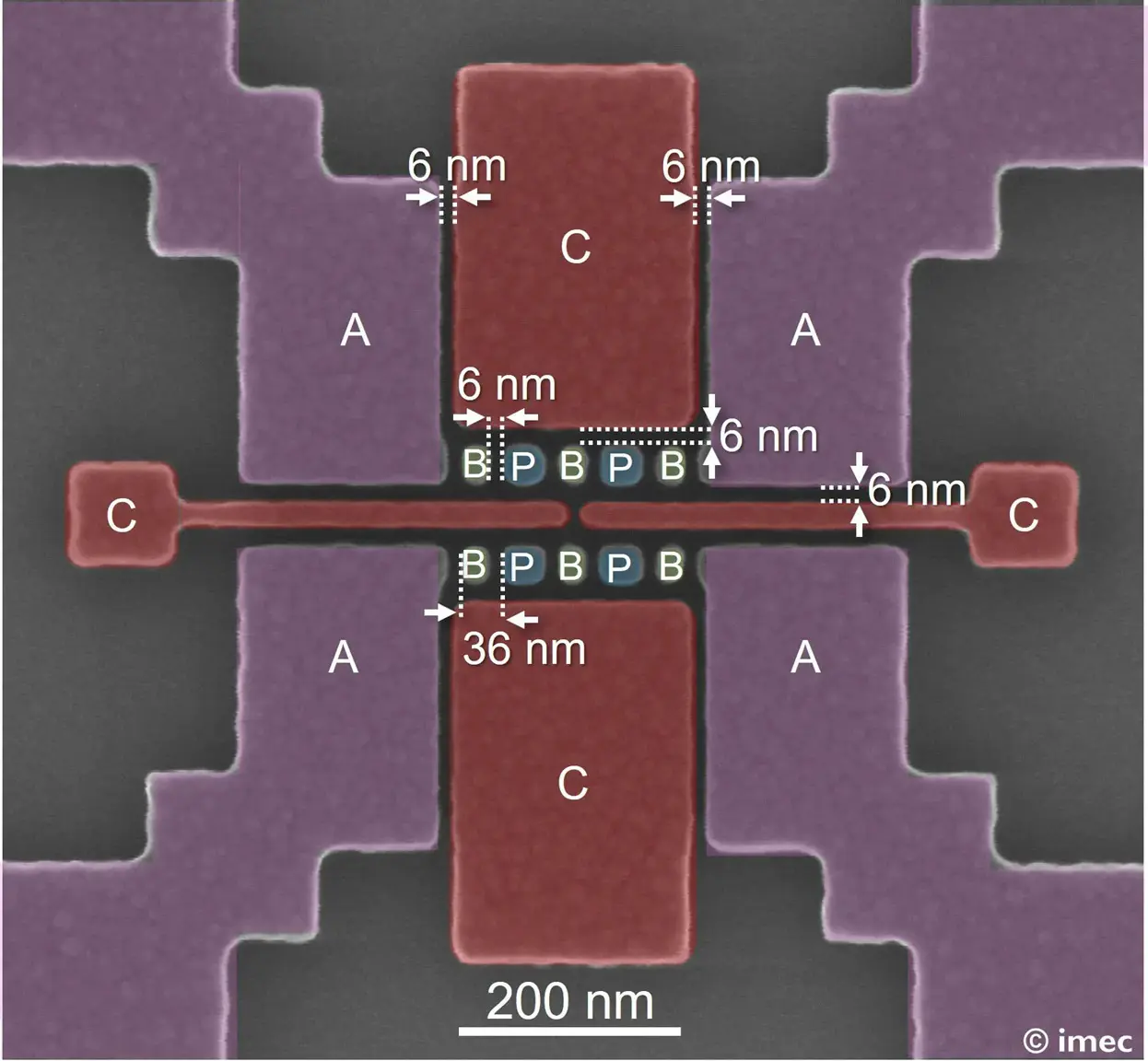
High NA EUV lithography as a driving force
According to imec, the use of High NA EUV lithography is crucial for accurately shaping the tiny patterns required for quantum dot qubits. After all, the distance between the control electrodes directly determines the coupling strength of the qubits.