

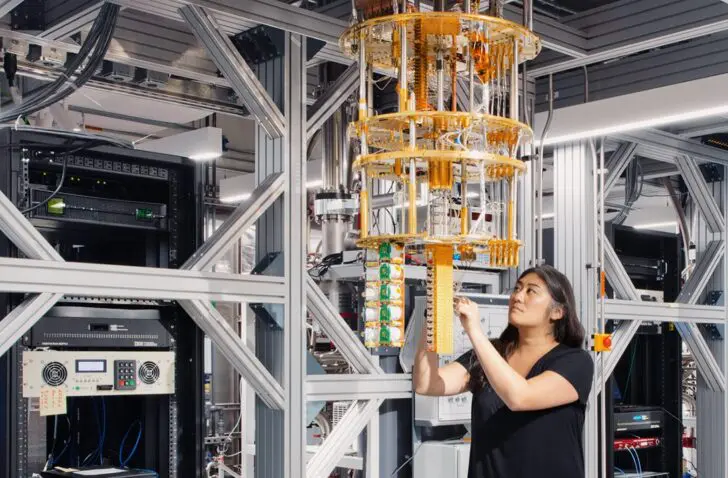
IBM is aiming for a fault-tolerant quantum computer by 2029, but those who wait for that milestone risk missing the boat. Why should companies start with quantum computing now?
Quantum computers have been hot, then not, and are now somewhere in between. It is beyond doubt that a powerful, fault-tolerant quantum computer is coming soon and will turn the world upside down. Petra Florizoone, Director of Global Partnerships & Business Development at IBM Quantum, walks us through the opportunities and risks of quantum computers.
Three key challenges
According to Florizoone, the challenges in quantum computing are threefold:
- Chip quality: quantum processors are inherently sensitive to noise, making error correction and error mitigation crucial.
- Speed: a quantum computer must be fast enough to run sufficient simulations.
- Scalability: a quantum computer cannot be compared to a traditional server and still faces challenges in terms of expandability.
“In those three things—quality, scaling, and speed—we are constantly looking for the right balance.”
Another challenge, error correction, is on the verge of a breakthrough according to Florizoone. “We are past the pure research phase and are now much more in the engineering phase. Furthermore, at the end of 2025, IBM proved that it is possible to decode errors in real-time in less than 480 nanoseconds—a milestone achieved a full year ahead of schedule.”

Just get started
“Anyone who thinks quantum computing is only for physicists with a PhD is wrong,” Florizoone emphasizes. “A background in mathematics or data science is sufficient.” With Qiskit, IBM offers an open-source software development kit that allows users to build and run quantum circuits. The SDK is not limited to IBM hardware; quantum computers from competitors are also supported. This is a deliberate choice. “We think it’s so important to keep that open.”
Individual developers can gain ten minutes of access per month to an IBM quantum computer via a free plan. Combined with the online learning materials, that is enough to get a first feel for the technology. At the same time, Florizoone warns: “Expect it to take about two years to truly build up algorithmic knowledge.”
Expect it to take about two years to truly build up algorithmic knowledge.
Petra Florizoone, Director Global Partnerships & Business Development bij IBM Quantum
That sounds like a significant investment. But the alternative is worse. She refers to a BCG study stating that early adopters will capture 90 percent of the value in the market. “That is enormous. And that is exactly why you cannot afford to wait.”
Still, as a company, you have to remain realistic. All existing use cases are still in the prototype phase—none are running in production. Financial institutions such as HSBC are showing promising results based on historical data, but the step to production hasn’t happened yet. Florizoone expects the chemical sector to be the first to demonstrate quantum advantage, partly thanks to the collaboration with the Japanese research center RIKEN.
Europe is starting to move
Internationally, Florizoone sees clear differences in the pace of adoption. Japan is the undisputed leader, partly due to the RIKEN ecosystem. Within Europe, Germany, Spain, and the UK stand out. Spain opened a Quantum Innovation Center that now collaborates with companies like BBVA and Repsol. But the Nordics and Eastern European countries like the Czech Republic and Romania are also gaining momentum.
The dynamic is recognizable: as soon as one major player in a region starts, others quickly follow. “The fear of missing out is also a major driver,” Florizoone admits. “It’s an organic growth process, but it’s noticeably accelerating now.”
Key terms
A potential pitfall is the confusion between quantum safe and quantum computing. Companies claiming to be ‘working with quantum’ are often primarily focused on making their security quantum-proof. That is obviously important, but it isn’t quantum computing—it’s a consequence of it.
Florizoone sees the two tracks as complementary rather than competing. Quantum computing focuses on innovation leaders and researchers; quantum safe focuses on the CISO and the security department. One reinforces the other: those who delve into quantum safe naturally become curious about the possibilities of quantum computing. And vice versa.
Is it for tomorrow?
Florizoone’s message is clear: quantum computing is no longer science fiction, but the step toward concrete business value still needs to be taken. With the expected quantum advantage at the end of 2026 and a fault-tolerant quantum computer by 2029, major breakthroughs are in sight.
At the same time, the learning curve is steep and the lead time is significant. “Those who start now will be ready in 2029 to be the first to reap the rewards. Those who wait risk a backlog that will be difficult to overcome.”
As far as we’re concerned, quantum is still a tricky business. Florizoone says 2029, but it could just as easily be 2031, or 2035, or even 2027. Quantum safe is the priority today, but don’t put quantum computers on the back burner from a business perspective. Learning the technology today means being able to accelerate when it arrives. If you only start when it’s already here, you’ll be lagging behind.