

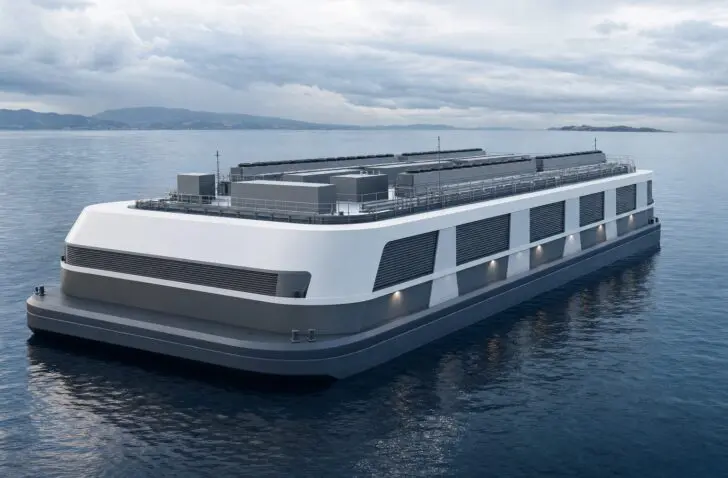
Samsung plans to open its first floating data center by 2028. Are floating data centers a solution for capacity issues on land?
Looking for extra data center capacity but there’s no more room on land? Samsung has come up with an original solution: floating data centers at sea. This is no strange whim: the South Korean tech giant announced via the local newspaper Seoul Economic Daily that it wants to open its first ‘floating’ data center for commercial use by 2028. In June, Samsung signed an agreement in principle with an investment and certification partner to realize the project.
The data center will float on a vessel specifically designed for it, which looks like a giant air cushion in the first concept images. That vessel is being designed by Samsung itself through its Heavy Industries arm, one of the largest shipbuilders in the world. In addition to server space, the onboard data center contains electrical and mechanical installations, a power generator, and tanks for natural gas storage.
In 2028, Samsung wants to open a first floating data center as a proof-of-concept with limited capacity (50 MW). It will stay close to the coast to be able to use land-based energy sources. Seawater will be used for cooling.
By land, by sea, or by air?
You might now be wondering why you would float a data center at sea. In the long run, it could offer a solution to capacity problems for data centers on land. New gigawatt data centers continue to spring up to satisfy the data hunger of AI models. These investments require not only a lot of money but also land, power, and water, which are no longer infinite. The energy issue is also a topical theme in Europe.
Samsung is not the only one seeing a solution in the oceans: similar initiatives are underway in China and Japan. Japanese companies Mol and Hitachi want to convert used ships into data centers. A Chinese research project even wants to sink a data center to the ocean floor. Whether these projects can prove themselves in the long term remains to be seen. A previous Microsoft project to bring a data center to sea was shut down in 2024 due to high costs.
If a data center at sea isn’t strange enough yet, the American company SpaceX is looking to space. There are even more economic question marks surrounding Elon Musk’s megalomaniacal plan. It does illustrate that building data centers will require original solutions in the long run.