

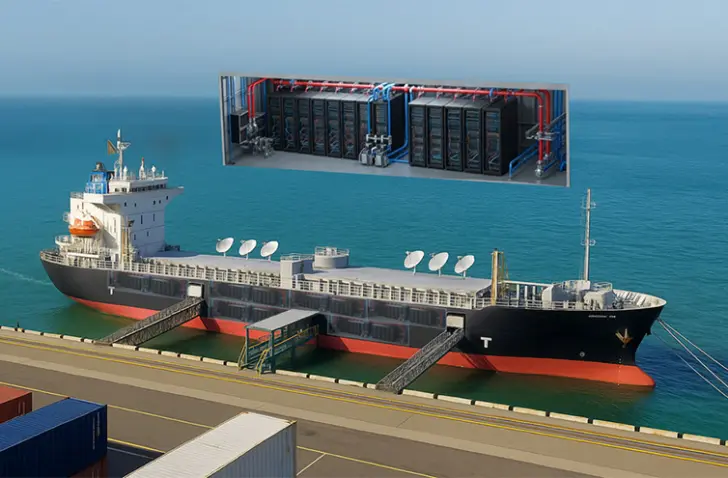
Mitsui O.S.K. Lines and Hitachi are launching a joint initiative to convert second-hand ships into floating data centers.
The growing popularity of generative AI is leading to a rising global demand for data center capacity. However, in many urban areas, securing suitable land for new data centers is becoming increasingly difficult due to spatial constraints and local regulations. Mitsui O.S.K. Lines (MOL) and Hitachi therefore intend to use decommissioned ships as floating data centers (FDCs).
The partnership includes a Memorandum of Understanding (MOU) between MOL, Hitachi, and Hitachi Systems for the development, operation, and commercialization of FDCs. The first operational floating data centers are expected in 2027 or later, with a focus on Japan, Malaysia, and the United States.
Floating data centers
According to the companies, floating data centers offer solutions to challenges regarding location, infrastructure, power supply, and environmental pressure. Because FDCs can be deployed in ports or on rivers, it is no longer necessary to purchase large plots of land. This makes it possible to expand digital infrastructure even in areas with strict construction restrictions.
An additional advantage is the shorter construction period: converting an existing ship into an FDC takes about a year, which is up to three years faster than traditional data center construction. Furthermore, floating data centers can use seawater or river water for cooling, reducing energy consumption and operational costs.
Feasibility studies
MOL is taking the lead on maritime aspects, including ship conversion, consultations with port authorities, and maintenance. Hitachi and Hitachi Systems are responsible for the technical development, design, and operation of the data centers, including IT infrastructure and security.
Whether this project is effectively feasible will be investigated over the coming years. The commercial rollout is planned from 2027 onwards.
If you think data centers on the water are innovative, know that Google announced plans last year to send data centers into space.