

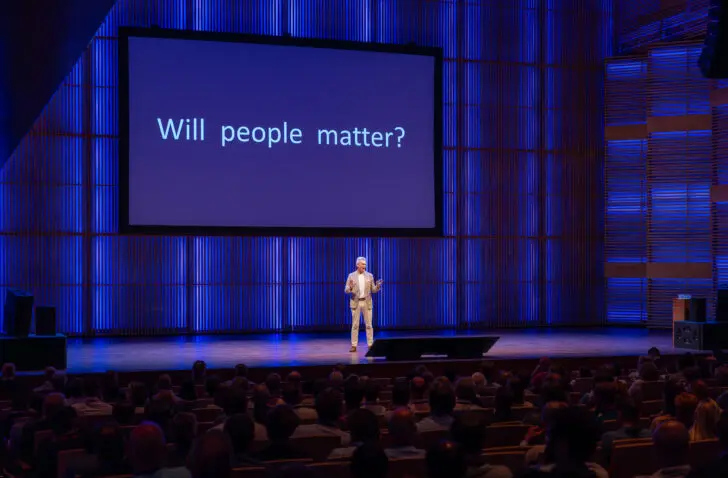
AI agents are becoming increasingly autonomous, but human judgment remains irreplaceable, especially when decisions have consequences. SAS therefore advocates for governance as the foundation for reliable AI.
“Will people matter?” appears in large letters on the screen during SAS Innovate on tour 2026 in Amsterdam. That question is not rhetorical. Now that AI agents can consult data, make decisions, and perform actions without human intervention, concerns about control, responsibility, and trust are also growing.
SAS’s answer is as simple as it is significant: governance. Not as a bureaucratic hurdle, but as the system that brings human judgment to scale, thereby keeping humans in the driver’s seat.
In the Hands of AI
AI agents are becoming increasingly powerful and independent, but how far should that autonomy go? It is a question that arises more frequently now that companies are deploying AI for processes that were previously exclusively in human hands. According to Véronique Van Vlasselaer, Head of AI & Data Science EMEA at SAS, there are limits to autonomous AI agents. “Autonomy requires automation, and automation requires standardization.” According to her, we are currently still at the standardization stage.
“You cannot automate without standardization. Agents must be designed to ask for human input, especially in uncertain or ambiguous situations. That is the only way you can build safe agents.” In her view, fully autonomous agents are not a realistic scenario because the AI has only learned within the context of its training data. “Humans are more dynamic and resilient in atypical situations,” she says.
Human Judgment Prevails
Reggie Townsend, Vice President of AI Ethics, Governance, and Social Impact at SAS, agrees with Van Vlasselaer’s position and adds a philosophical touch. “Human judgment is irreplaceable in decisions involving ambiguity and competing values.” He warns of a creeping shift that he believes is already underway: “AI systems are designed to expand human capabilities, but they are gradually displacing human judgment.”
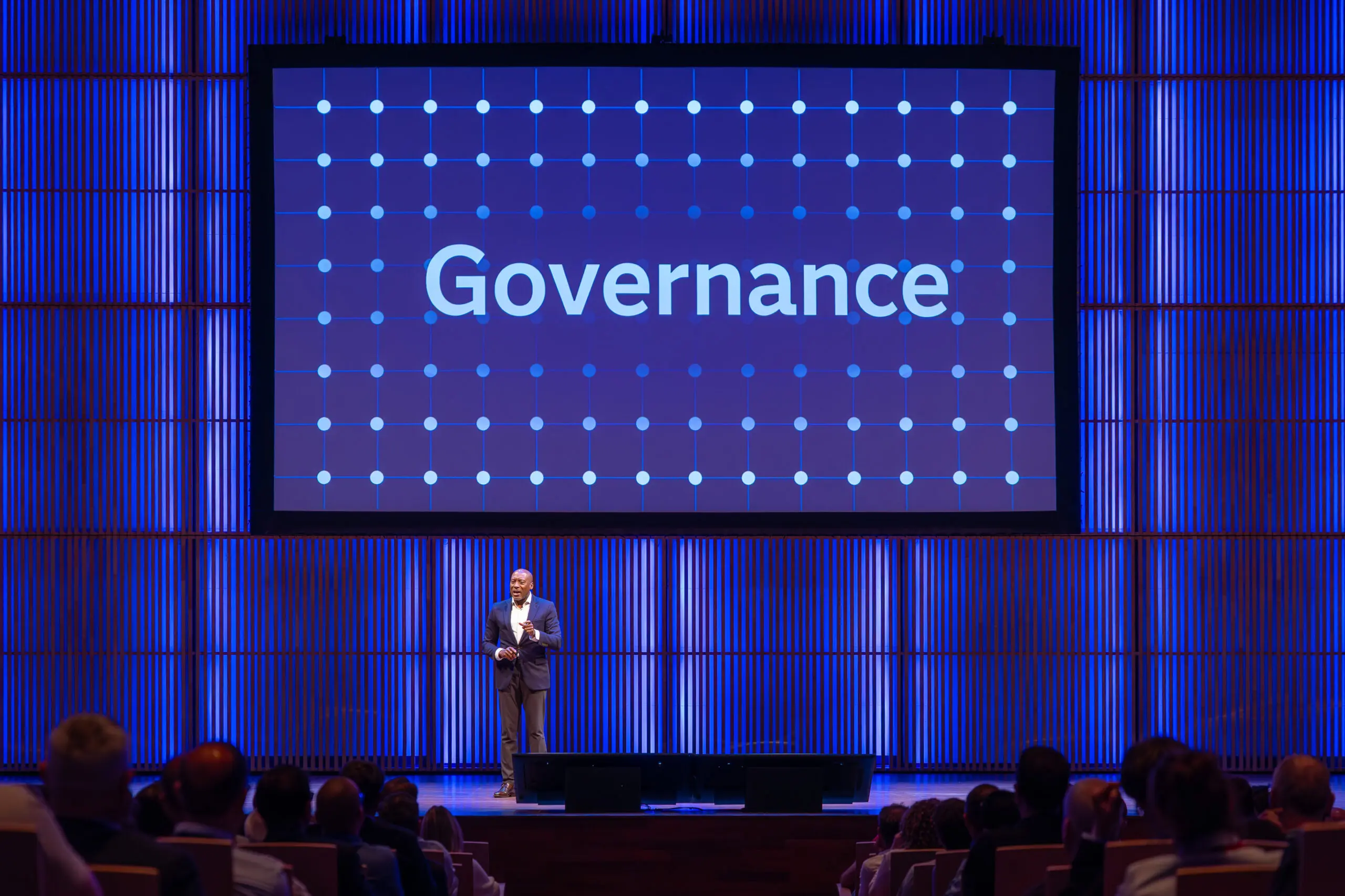
His answer to that shift is governance. For many companies, this feels like a brake on innovation, but Townsend sees it differently: “My goal is to make managing AI easier, more convenient, and more intuitive through governance.” The importance of governance for SAS translates in practice to the AI Navigator, which was announced during SAS Innovate in April.
AI Act
The AI Navigator provides a handy overview of all AI models, their interdependencies, and supporting policies within your company, which can be a plus for upcoming regulations.
The implementation of the EU AI Act is currently scheduled for August 2026, provided that no delays emerge. “This means that companies must create an inventory of all AI systems they use in line with the legislation,” Townsend explains.
“Simply listing models or agents, such as ChatGPT or Copilot, is not enough. The same tool can be used very differently by a marketer than by a data scientist.” According to him, the SAS AI Navigator can help with this.
“It is not the models themselves where the business value and risk lie, but in their concrete application,” says Townsend. “That is why the AI Navigator puts the use case at the center: the specific way AI is deployed within a business process.”
AI Stands or Falls with Data
SAS has believed in the power of data since the very beginning. The Viya platform is the practical translation of this. Viya is SAS’s cloud-native analytics platform that supports the entire data and AI lifecycle and was built for AI from the start.
Models and agents are only as good as the data behind them.
Véronique Van Vlasselaer, Hoofd AI & Data Science EMEA bij SAS
“Models and agents are only as good as the data behind them,” says Van Vlasselaer. According to her, the biggest hurdle for AI is not talent or tooling, but data.
The platform runs on public clouds from Azure, Amazon, and Google as well as on European alternatives and on-premises environments, which also makes it relevant in the sovereignty debate.
Sovereignty
When we talk about data and AI, it is often accompanied by a hint of concern regarding sovereignty. That concern goes further for European customers than just the question of where their data is located, says Mathias Coopmans, Country Leader Belgium at SAS. “It is also about who has access to it and how tightly they are tied to a single vendor.”
“Large American cloud providers like Azure, Amazon, and Google offer an extensive catalog of services, but those who step too deep into them find it difficult to break free,” he says. European alternatives currently have a more limited offering but are growing rapidly according to Coopmans.
Human Creativity
The challenge for organizations is not the technology itself, but how you maintain a grip on what the technology does: what data is behind it and what decisions it makes. According to SAS, governance should not be an additional concern, but one of the foundations on which reliable AI is built.
SAS’ vision in this is not entirely unique. We are now hearing from other major technology players that control, insSht, and governance play an essential role in the rollout of safe AI at the enterprise level. Think of SAP, which wants to claim a central role in the rollout of AI from the ERP side, Snowflake which follows the same calling as a data platform, and also ServiceNow and Salesforce which hope to be the center of gravity for AI implementations.
AI works fine for optimization and creativity, but for decisions with real impact, it must always be the human who has the final word.
Reggie Townsend, Vice President of AI Ethics, Governance, and Social Impact at SAS
To the question that appeared at the beginning of the presentation, we can certainly answer with a resounding ‘yes’ based on SAS’s vision: people will matter. “It is your human creativity and ingenuity that drives AI,” Van Vlasselaer concludes.