


SAP wants to be more than just a software company, taking its customers on an AI-supported transition toward autonomous operations. This requires more than just a transformation to S/4HANA, though SAP also aims to convince legacy customers using both a carrot and a stick.
At Sapphire 2026, SAP presents its vision for the future: deep AI integration within the ERP system and the entire SAP environment should open the door to the ‘autonomous enterprise’.
No guessing allowed
It’s a catchy term that hides concrete capabilities. Curated, informed, and orchestrated AI agents are set to automatically take over numerous complex tasks. Two frequently cited examples: the closing of a financial quarter and maintenance planning for complex machinery like offshore wind turbines.
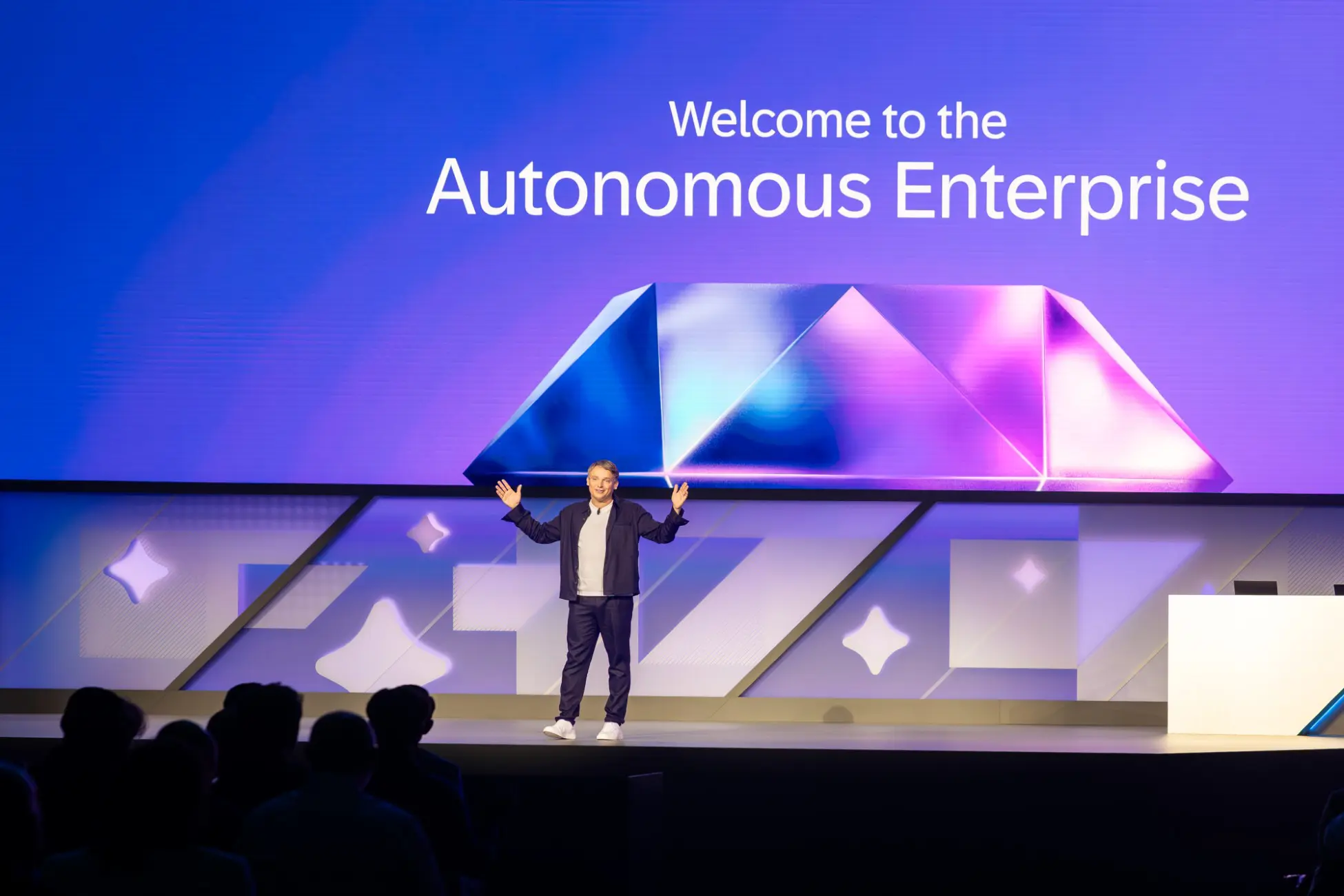
In Madrid, CEO Christian Klein reiterates this vision during his keynote before nearly 10,000 attendees. “AI is changing everyone’s life, including mine,” he says, stating the obvious. Then he gets more specific: “An image of a unicorn with three ears is 80 percent correct, and that’s good enough for my daughter. In critical processes, 80 percent is not enough. AI must not guess; it must provide reliable, accurate answers.”
Not groundbreaking
SAP aims to deliver that accuracy and reliability from its core position as an ERP specialist. This isn’t a groundbreaking vision. Other software vendors handling significant aspects of business operations, including ServiceNow (from an ITSM perspective) and Salesforce (from a CRM perspective), have reached the same conclusion.
An image of a unicorn with three ears is 80 percent correct, and that’s good enough for my daughter. In critical processes, 80 percent is not enough.
Christian Klein, CEO SAP
SAP’s solution aligns with what those other companies have already introduced: SAP wants to enable management for AI agents and is doing so with the AI Agent Hub. This provides a complete overview of all agents running within an environment, as well as what they do. You can also monitor KPIs here. The comparison with, for example, ServiceNow’s AI Control Tower is not far off.
Grounding
Furthermore, SAP wants to ensure that LLMs process prompts within the context of the enterprise. This happens via two key systems. On one hand, SAP links the operation of AI agents to a customer’s process architecture. This can be done via Signavio.
Next, there is the knowledge graph. This bundles important business information into an AI-readable web that serves as a guide for the tasks an LLM must perform. As a result, LLMs always execute a prompt with knowledge of an enterprise’s processes and best practices.
This grounding of AI’s reasoning with business operations is reminiscent of functionality found in Salesforce’s Einstein Trust Layer. It is striking that the giants in the world of enterprise software are largely agreeing on the architecture needed to support AI at the enterprise level.
S/4HANA and more
Furthermore, SAP naturally links AI to the data in the ERP system itself. AI agents can easily work with S/4HANA. External data is also brought into the fold thanks to the Business Data Cloud (comparable to Salesforce’s Data Cloud or the ServiceNow Data Fabric).
When SAP talks about AI, the emphasis isn’t necessarily on the models. The company takes a model-agnostic approach, supporting LLMs from OpenAI and Anthropic, as well as the French Mistral.
Context, not the LLM, scores points
Models have become interchangeable: the greatest value comes from context. To illustrate this, Manos Raptopoulos, SAP’s Global President of Customer Success in Europe, talks on stage about an internal experiment.
The app built entirely externally scored three out of ten; the app where the prompt was enriched with context scored nine out of ten.
Manos Raptopoulos, Global President Customer Success Europe, SAP
“We asked an LLM to create a simple business application,” he explains. “And then used the same prompt with the same LLM, but within the SAP environment. Afterward, we asked the LLM externally again to analyze and rate the code of both tools. The app built entirely externally scored three out of ten; the app where the prompt was enriched with context scored nine out of ten.”
Joule as intermediary
That doesn’t mean SAP allows just any AI agent on its platform. On the contrary: everything runs through its own AI layer, Joule. While Joule is model-agnostic, the AI system is SAP through and through. External agents wanting access to the context of the knowledge graph or Signavio must do so via the agent-to-agent protocol, with Joule acting as a virtual intermediary. SAP thus offers openness, but in a restricted way.
Joule is no longer just a chatbot, but a full-fledged system consisting of various agents. These agents can be ready-made AI implementations, but organizations can also create them themselves using Joule Studio.
Building AI with AI
Joule Studio is SAP’s version of Salesforce Agent Builder or ServiceNow Agent Studio. Even non-technical users can get started with it. Building agents can be done with a simple statement of intent: “I want to be able to see the five most important open orders right now with the click of a button.”
Joule Studio takes that prompt, adds context and process knowledge, builds a full technical document, and ultimately creates an AI agent itself that is deployed in a container. Verification can be done via the AI Agent Hub, after which the agent is immediately available as a component for other agents to work with. Connect these building blocks together, and you get the autonomous workflows SAP is aiming for.
Not just accessible to anyone
You don’t get all these features just like that. SAP customers must be on board. This doesn’t just mean having an S/4HANA ERP system, as that isn’t enough. S/4HANA remains untouched via the clean core paradigm. Extensions run through the BTP platform, which users must therefore implement. Only with BTP in place can BAIP provide the AI capabilities.
That requires a bit of explanation: SAP expects its customers to adopt an architecture centered on a modern version of its ERP in the form of a standard S/4HANA installation. Around that sits the Business Technology Platform (BTP), which allows for functional extensions. Those who have integrated BTP can activate the Business AI Platform (BAIP) on top of it.
Even on a clean core, deploying BTP isn’t a given. “It is indeed an investment that takes time and effort,” says Kenny van Sleuwen, ERP System Architect at shipbuilder Damen.
He expects it will be worth it now that BTP is running alongside a clean core S/4HANA installation that includes all the company’s shipyards, but after the sowing, the harvesting is yet to come. “Now that the ERP can become more autonomous, we eventually want to further automate production at our shipyards as well,” van Sleuwen illustrates.

Damen is a model customer for SAP: after about six years, the company completed a migration from an old non-SAP ERP to a completely legacy-free S/4HANA. Such customers are rare.
Who is actually ready?
This becomes clear when we ask CTO Philip Herzig for an indication of how many customers are technically ready today to enable the Business AI Platform and make the transformation to an autonomous enterprise together with Joule.
“I can’t give you figures,” he sighs. Even a target percentage isn’t possible, and we can’t even get a sense of whether the order of magnitude is closer to a handful, dozens, hundreds, or thousands. “But sometimes companies are completely on board in certain departments without being on board organization-wide,” he deflects.
It seems obvious that only an absolute minority is ready to enable BAIP on BTP at the touch of a button. In March of this year, the German SAP user group DSAG shared figures indicating the reality on the ground: barely 27 percent will complete the migration from legacy SAP ECC systems with custom code to S/4HANA before the 2027 deadline.
ECC, short for ERP Central Component, is the legacy on-premises version of SAP ERP, which has typically been heavily modified in its source code over the years to meet the needs of specific companies. Most customers still struggling with legacy are aiming for 2030, and four percent even fear that 2033 is more realistic.
Fresh vision for the future
This shows that the vision SAP is preaching at Sapphire is still mostly a thing of the future. This isn’t surprising: SAP itself has only really geared up in the past year to start preaching the gospel of the autonomous enterprise. The AI story was present last year, but under the influence of CTO Herzig’s AI-native strategy, it was only promoted to a core strategy this year.
The company suddenly positions itself (like almost every other tech company) as an AI specialist rather than a software vendor, but that doesn’t mean customers’ current IT landscapes are suddenly ready for that vision.
Concession
SAP is not blind to this reality. In fact, ECC customers can also get started with AI without a clean core, BTP, or BAIP, but only within the framework of a RISE or Grow with SAP trajectory. These are contractual migration paths where a company commits to migrating to S/4HANA. In that case, SAP wants to help organizations derive value from AI now, rather than waiting until the long and costly migration is complete.
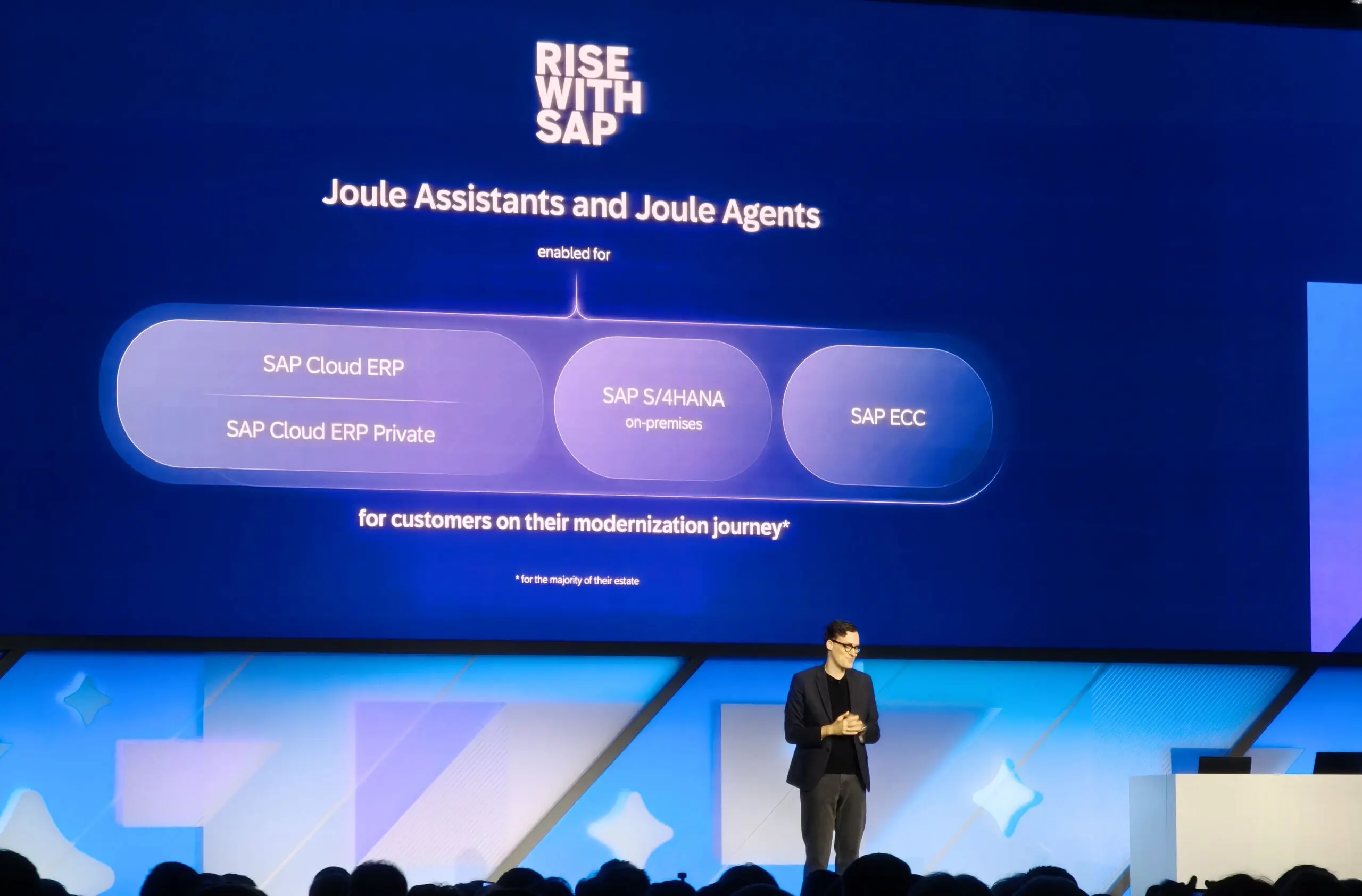
The fact that it’s possible seems to contradict the strict migration requirements SAP preaches elsewhere. Herzig disagrees. “Just because it’s possible doesn’t mean it’s easy,” he explains. “Because make no mistake: implementing AI in a legacy environment involves a lot of extra effort, and the result is much less scalable.” That extra work also leads to higher costs, meaning the investment in an AI solution doesn’t pay for itself as easily.
AI could potentially help solve the problem as well. For example, an AI-driven migration assistant can help translate ECC customizations into BTP extensions. SAP claims that the duration of a migration, which typically takes years, could be accelerated by up to thirty percent. That saves years and millions.
Joule Work
At Sapphire, SAP wants to derive value from AI together with its customers, and according to the company, this happens within the context of a clear architecture with a clean core S/4HANA ERP, BTP, BAIP, and Joule. Those who join this journey can quickly begin with deep, context-sensitive automation.
SAP’s entire appearance is changing because of it: gone are the endless legacy ECC screens that earned the company the mocking nickname Software Against People. In their place comes Joule Work: a central workspace where users interact with Joule in natural language, immediately seeing what they want to see and adjusting what they need to adjust, all in one place.
Legacy knot
It sounds good and looks good. SAP is embracing the customer zero approach, proving internally that it works and delivers measurable added value. AI agents within existing systems, guaranteed at an enterprise level, also appeal to ServiceNow and Salesforce customers. At Sapphire, SAP is showing a clear strategy with a concrete technical foundation and visible added value, building on half a century of expertise.
Organizations do want this. However, they probably want to get rid of ECC first, and the reality that no shiny Sapphire conference can obscure, is that many customers still need years to untangle the legacy knot they tied together with SAP decades ago.