

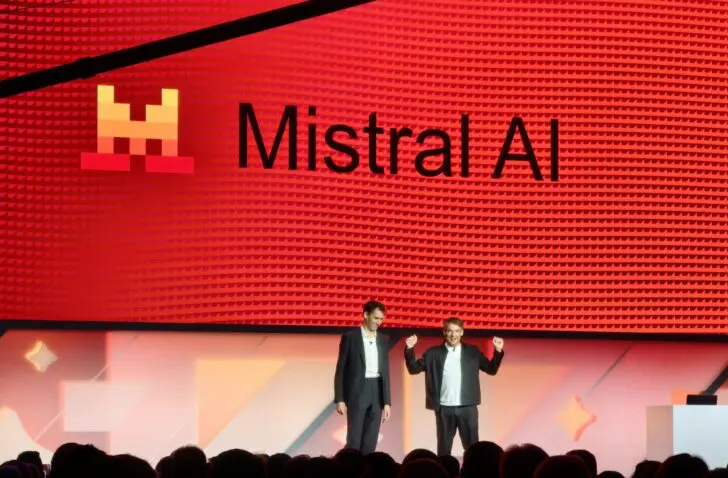
The combination of SAP’s AI framework and Mistral’s LLMs creates an AI tandem that can confidently be called entirely European. This is a good first step, but it also immediately illustrates how much work remains to be done to realize a truly European AI ambition.
SAP CEO Christian Klein’s eyes almost sparkle like sapphires on the stage of the Sapphire conference in Madrid. Standing alongside Arthur Mensch, CEO of Mistral AI, Klein notes that together the two companies have brought a fully European AI stack to market.
“From developing agents to running and managing them, we have a truly European stack in our hands,” he says. This didn’t just happen: Germany’s SAP and France’s Mistral AI form a tandem where close collaboration is central. “We talk so often, and our teams work so intensely together,” says Klein. “I am very proud of our partnership.”
Sovereignty is key
Mensch is undoubtedly also pleased with all the praise Mistral is receiving. While the AI specialist is Europe’s largest player in the segment, in terms of scale and financial valuation, the company still plays in a lower league than, for example, OpenAI and Anthropic. Nevertheless, Mistral has a suite of fully European foundation models: LLMs such as Mistral Large 3 that compete with GPT 5.5 or Claude Opus.
However, it is not the quality of the models that is central, but sovereignty. With Mistral AI’s LLMs, you can perform inference entirely within a European context.
Many customers, especially in regulated sectors, are concerned about the geopolitical situation in the world
Christian Klein, CEO SAP
There is a demand for this. “Many customers, especially in regulated sectors, are concerned about the geopolitical situation in the world,” Klein says after the keynote. “You no longer know what will happen tomorrow, and whether sanctions might prevent you from extracting data from one country to another.”
Controlling what you can
Klein also realizes that complete independence from entities outside the EU is impossible. It’s no coincidence that Jensen Huang, CEO of Nvidia, shares his enthusiasm for the integration of SAP and OpenShell via a video message during the keynote. At the hardware level, chips from Nvidia, AMD, and Intel are indispensable for running AI (or other) workloads.
Fortunately, organizations have control over other aspects of the IT environment. “You can choose which code you run,” says Klein. SAP responds to this without abandoning the American market. In Madrid, the company rightly highlights interoperability as an asset for sovereignty.
SAP provides the framework
At the conference, SAP is selling its vision of the autonomous enterprise: a company with deep AI automation assisted by managed, defined, and, above all, well-informed AI agents.
To this end, SAP provides the entire framework, and it is extensive. Data, both internal and external, is available via the SAP Business Data Cloud; the SAP Knowledge Graph provides context in the form of best practices, process knowledge, relationships between data, available APIs, and more. The AI Agent Hub offers orchestration and management.
Joule is no longer just an AI copilot, but the collective name for an AI layer consisting of curated assistants. Joule Work is a completely new interface from which users interact with processes via AI agents; Joule Studio allows organizations to build new agents based on an intent description (or code). All this AI goodness runs via the SAP Business AI Platform on SAP BTP.
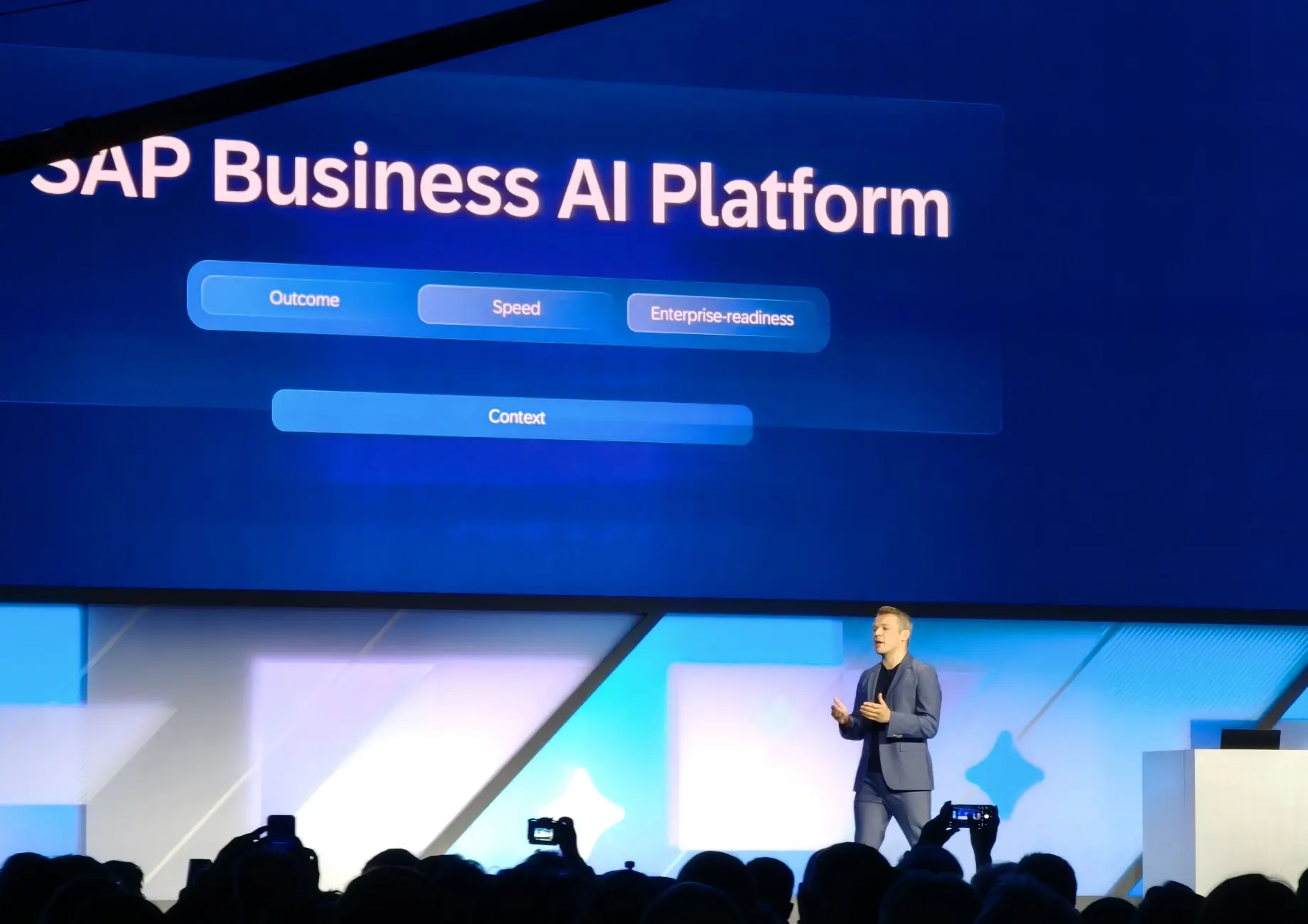
The entire collection of interfaces, knowledge layers, and tools is LLM-agnostic. Customers can choose which LLM provider they use to power the AI-based intelligence.
But what is being framed?
This can, of course, be done with models from Anthropic or OpenAI. “But there is no sovereign option to run OpenAI or Anthropic models at the moment,” says Philipp Herzig, CTO of SAP. “That simply doesn’t exist. But we can switch to Mistral.”
Armed with Mistral’s LLMs and SAP’s AI stack, companies can theoretically infuse their entire business operations with reliable AI without involving software from non-EU parties. However, the choice is not vast.
For example, Herzig refers not only to Mistral but also to Cohere. That company also builds LLMs and is based in Canada. After all, the demand for sovereignty does not only come from the EU and often has more to do with flexibility and options.
Much talent, few alternatives
It does show that European alternatives are limited. Mensch and Mistral AI are an exception, and the EU AI stack mentioned is quite unique. Herzig does not want to deny that either.
Much of the innovation regarding LLMs in Silicon Valley comes from European researchers
Philipp Herzig, CTO SAP
“There is a lot of talent in Europe,” Herzig observes. “And much of the innovation regarding LLMs in Silicon Valley comes from European researchers, but it is true that there are no organizations as large as OpenAI and Anthropic.”
He does see signals regarding a more EU-oriented AI future: “I think we in Europe are slowly but surely getting our house in order as well.”
The role of SAP
As the Union’s largest technology company, SAP can play a role in this, and that ambition is there. SAP is leveraging its fifty years of experience. “All the code we have, from S/4HANA, Ariba, SuccessFactors, and more, we put into models,” explains Michael Ameling, President of SAP BTP. “Also all our best practices, all notes, our problem knowledge, internal documentation—we process all that knowledge into a knowledge graph.”
That graph is a representation of that knowledge, linked together in a kind of network that an LLM can work with. The graph includes navigable context on which AI agents can base their behavior. By linking AI to it, answers instantly become much more relevant within the context of an enterprise.
This is of great value and an argument on SAP’s side for companies looking for a reason to run AI via the AI platform and BTP within the SAP environment. The graph augments the capabilities of LLMs, European or not.
EU and sector knowledge
However, more is possible, but SAP is cautious. Various voices are heard from Europe, including from Parliament and Gaia-X, to focus on sector-specifically trained AI. Companies from, say, the chemical or manufacturing sectors sit on a wealth of data on which very relevant AI models could be trained, if the companies could find a way to pool their data.
In theory, SAP could lead the way in building such a project from its large customer base, but it does not. In a way, it makes sense: the company does not want to appear in any way to be profiting from intellectual property belonging to its customers.
“We are allowed to use some data from customers,” says Herzig. “But we don’t train models with it. We do use the data to validate existing models. We have petabytes of data to do that.” In this way, SAP provides a better framework for LLMs.
No sector-specific SAP LLM
The company stays away from the models themselves. The exceptions are SAP-RPT-1 and now RPT-1.5: these are also AI models, but they are built on structured data, which still plays a very large role within enterprises. SAP describes them as tabular foundation models.
SAP does not create foundation models for generative AI itself. Ameling does leave the door ajar for future projects: he agrees with the potential relevance of LLMs trained on sector-wide data, within a context where everyone’s IP remains safe, and hints at projects evolving in that direction, but that’s all we have to go on.
A single EU stack
This means that on stage, Klein can only be happy with the European AI stack thanks to Mistral. Although LLMs are becoming increasingly commonplace, and the framework might be more important than the exact model an organization uses, you can’t have (generative) AI without an LLM, and currently, Mistral is the only serious European provider of one.
Conversely, Mistral also needs SAP. To be more than just a chatbot, an LLM must live within a controlled environment like the one SAP offers. Other parties do something similar: think of ServiceNow, Salesforce, or even Snowflake, all of which are AI-agnostic. All three are also not European.
Thanks to SAP and Mistral AI, we now have a European AI stack, and that is indeed something to celebrate. On the other hand, its existence makes it painfully clear how limited the options are for large enterprises that want to roll out AI at the Enterprise level and hold sovereignty in high regard.