

A product that would have taken DataCore two years and twenty engineers to build without AI was completed in two months, according to CEO Dave Zabrowski. DataCore has been AI-first since March, although that AI is currently primarily utilized in support and sales.
Dave Zabrowski, CEO of DataCore, stated in his keynote that DataCore began serious work on AI a year ago and went all-in in March. “We have fundamentally transformed DataCore into an AI-led, AI-first company.” He calls AI “easily the most significant technological innovation in the history of technology.”
In an interview with ITdaily, he provides an example of the pace. The product behind the demo in Palma was only finished the Friday before. “That product required about two months with two to four engineers. Without AI, that’s two years with a team of twenty.”
Said Boukhizou, VP of Products at DataCore, notices that pace in his planning. “We used to create a roadmap for a year. Today, I can no longer do that. Roadmaps change from day to day.”
According to Zabrowski, DataCore has spent 34 percent of the AI budget it had allocated for this year so far. Reports that 80 percent of AI projects fail and cost an average of 4 million dollars, he dismisses. “That is simply nonsense. If you do it right, it is much more efficient.”
Zabrowski’s figures
The strongest moments of his keynote had little to do with AI. In a year marked by war in the Middle East and rising interest rates, annual recurring revenue grew by seventeen percent and revenue from new customers by 39 percent. This year, 229 companies chose DataCore for the first time, customer retention rose from 94 to 98 percent, and the company has been profitable for sixteen consecutive years.

Zabrowski also admitted that Swarm struggled as a backup target alongside Veeam, which holds the bulk of that market. After adjustments on both sides, DataCore is relaunching it.
Where DataCore is deploying AI today
“The focus of all things AI is actually more supportive towards partners and the helpdesk,” says Pieter van de Burg, Senior Solutions Architect Benelux at DataCore. “Therefore, it is not yet so much in the products themselves.” Since May, AI has been searching a single knowledge base with twenty years of SANsymphony experience for every support ticket, and resolution time has decreased by 33 percent, according to Zabrowski.
Across all products, the gains are smaller than in that single demo. Since March, product releases have been 50 percent faster, according to Zabrowski. Developers are writing code using Claude, among other tools. The QA process with pre-releases at partners remained unchanged, according to Van de Burg, and performance tests are conducted via a proprietary tool without AI.
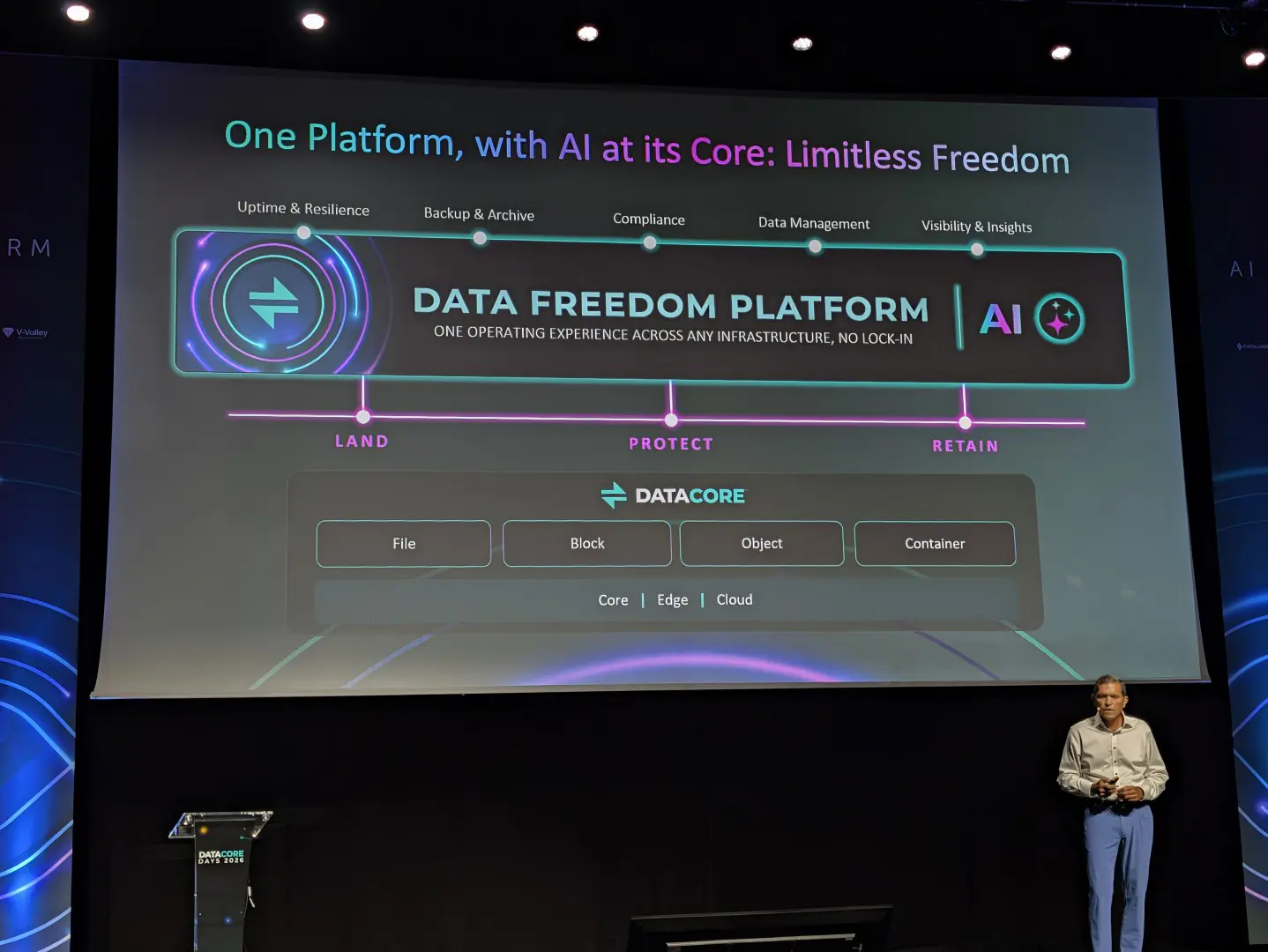
The AI agent for customers, which Abhi Dey (CPO at DataCore) introduces under the name DataCore AI, has been designed cautiously. Boukhizou explained to ITdaily in early September that the agent correlates logs and events, suggests interventions, and only acts after approval. There are three levels of permissions, and the agent cannot look into the switches. “AI still hallucinates and must still learn before it can manage storage fully autonomously.”
If the agent cannot resolve the issue, it escalates to Atlas, the internal code name for an agent in support. In Palma, Boukhizou mentioned that a number of partners are currently testing the agent.
Zabrowski sees the agent gradually taking over more. After the phase where SANsymphony suggests an intervention and executes it after approval, the agent will be given prior authorization. “The administrator comes in on Monday morning, drinks his coffee, and sees what the AI model did over the weekend. You need to order more capacity? I’ve already ordered it; the lead time is sixteen weeks.” According to him, DataCore is now in phase two, with three more to follow.
When asked about maintaining control at that pace, Zabrowski warns: “Those who do not use AI to secure and protect themselves become vulnerable to AI.” According to him, there will “always” be a human in the loop.
Van de Burg expects banks and hospitals to follow more slowly, hospitals “perhaps in two years.” There will be “all kinds of safeguards to prevent accidents.” According to Zabrowski, everything runs on the enterprise version of Claude, with Anthropic guaranteeing privacy and GDPR compliance. “That takes that burden away from us.”
AI in sales and slides
A large part of the AI enthusiasm was directed toward DataCore’s own sales. Eliot Johnson, who has led marketing for four months, cites a study by 6sense in which 94 percent of buyers already have a shortlist before the first contact with a supplier. Johnson is therefore working on answer engine optimization, so that DataCore appears when someone asks ChatGPT, Claude, or Gemini how to get rid of VMware.
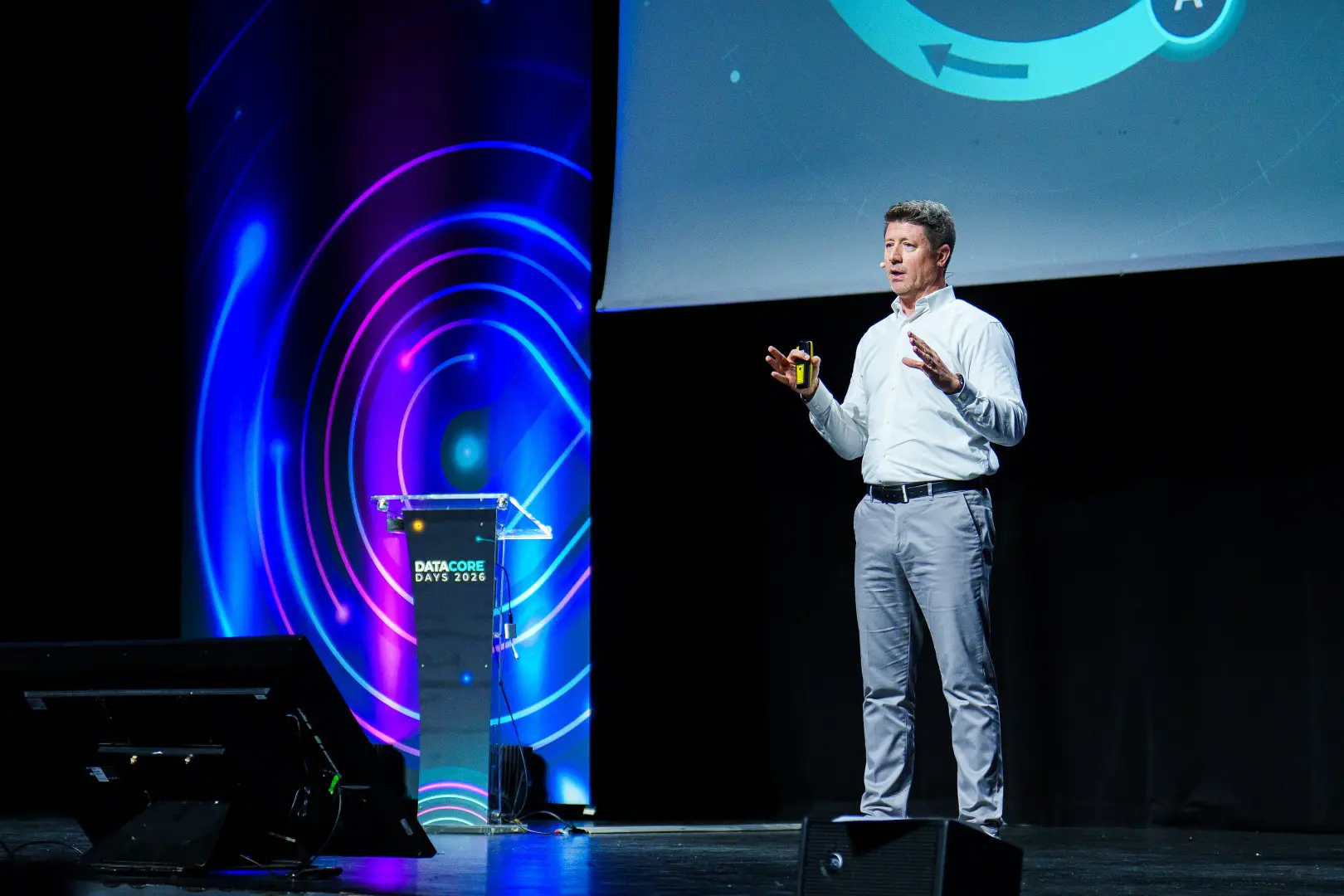
An AI system searches for prospects, researches them, and makes the first contact before a salesperson takes over. “If we don’t keep up, our customers or our competitors will,” Johnson said. Van de Burg describes the goal of AI for resellers as a shorter sales cycle, “which obviously allows more deals to be closed.”
The shortage caused by AI itself
Until October last year, supply and demand for hardware were in balance, says Zabrowski. Then, according to him, Anthropic, OpenAI, Meta, Amazon, and Google secured hundreds of billions of dollars in non-cancellable orders. “The majority of the supply goes to AI data centers. What remains is for the rest of the industry.” When he asked who had seen projects postponed, scaled back, or canceled, almost the entire room raised their hands.
DataCore’s strongest selling point this year thus stems from the same AI wave the company is now embracing. “Don’t buy. Use,” was Zabrowski’s advice. Ekrem Koç, Sales Director Benelux at DataCore, expects that customers can “very easily stretch the lifespan of their hardware from three to five, or five to seven years.” Van de Burg is already seeing Benelux customers working longer with the same servers. “For us, the functionality is in the software.”
What DataCore still has to deliver
During the DataCore Days last year, Zabrowski still called DataCore.next “complete.” This year, that changes to “not the end of our journey,” and the Data Freedom Platform is the result. According to Van de Burg, that platform already exists as an overarching layer for monitoring and management. The AI agent is being tested with partners; a date for general availability has not yet been set.
Zabrowski sees AI as a triangle of technology, society, and politics, and expects headwinds. Socially, it involves fear “of Big Brother, of robots, of job losses”; politically, it involves Americans who do not want a data center in their backyard. This fear, according to him, will become “a negative cloud and a headwind for adoption.”
Next year, Zabrowski wants to ask the audience again who is using AI to transform their company. Those who do not raise their hand then can expect a reprimand. At DataCore, they have already dived deep into AI development with positive internal developments. It remains to be seen whether customers will also appreciate the AI agents in the unified platform.