

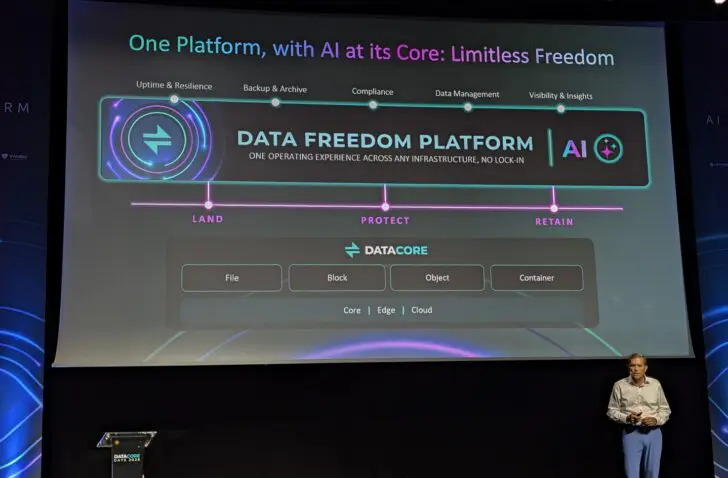
DataCore is bringing its five storage products together into the Data Freedom Platform, featuring AI agents that monitor the environment and suggest interventions. The company presented the platform at its partner conference, DataCore Days, in Palma de Mallorca.
The Data Freedom Platform aims to provide a single management experience across block, file, object, and containers, on-premises, at the edge, and in the cloud. DataCore is deploying five services on top of it: uptime and resilience, backup and archive, compliance, data management, and environmental insights. Under the hood run SANsymphony, StarWind, Swarm, Nexus, and Puls8, which DataCore largely acquired through acquisitions.
Abhijit Dey, Chief Product Officer at DataCore, looks back at the previous edition in Avignon during DataCore Days in Palma de Mallorca. “Last year, we talked about products and asked you to cross-sell. This year, we decided from a product engineering perspective to house all our products within a single platform.”
AI agent in the Data Freedom Platform
Said Boukhizou, VP of Products at DataCore, already explained to us in early September how the AI agent works. The agent observes the environment, correlates telemetry and events, suggests an intervention, and only executes it after approval. There are three permission levels: read-only, read-write, and a third level reserved for DataCore support for high-impact actions. “We manage critical data. I am not going to delegate everything to AI,” Boukhizou said.
Customers choose the language model themselves. DataCore primarily tests with models from Anthropic, Google, and OpenAI, but Mistral or a local model is also possible. According to Boukhizou, a model with about 80 billion parameters is sufficient because the agent is trained on knowledge of its own products. A separate variant will be available for isolated environments without internet access. However, the agent only sees what passes through the storage: it can detect network latency, but DataCore does not have an agent for the switches themselves.
CEO Dave Zabrowski outlines what is next in his keynote: connections via MCP, guided troubleshooting, automation by AI agents, and headless operations. DataCore already uses AI in its own support. All support knowledge is contained in a single knowledge base that AI searches for every ticket, and according to Zabrowski, this reduces resolution time by 33 percent.
Partners also receive AI tools
DataCore is also deploying AI for its partners. Boukhizou announced a go-to-market tool that allows partners to analyze an RFP, size a solution, and draft the accompanying documentation. According to him, this tool is available today. Marketing manager Eliot Johnson also outlined an AI system that searches for prospects and establishes initial contact before a salesperson takes over.
Licensing remains the same
According to Pieter van de Burg, Senior Solutions Architect Benelux at DataCore, the platform already exists as an overarching layer for monitoring and management. It was demonstrated live during DataCore Days. The licenses for individual products remain the same, and each product also retains its own console. In the long term, AI should move data between products, for example, from block to object.
The DataCore Freedom Platform will be generally available starting in early 2027.