

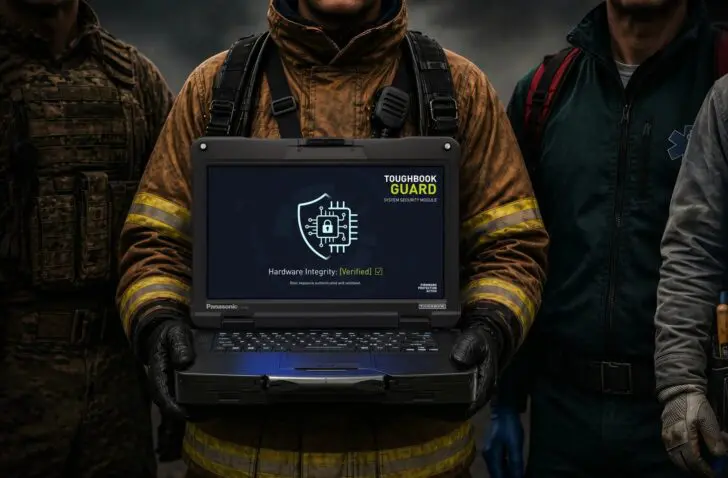
Panasonic has launched Toughbook Guard in the Benelux. This functionality allows customers to verify the integrity of their device’s hardware from the factory through to daily use.
Panasonic is introducing Toughbook Guard. Previously announced internationally, Toughbook Guard is now also available in Europe and the Benelux. The functionality allows customers to check the integrity of their device at the hardware level throughout all phases of its lifecycle.
Currently, “a device” refers to a Panasonic Toughbook 56, where the service is being introduced at launch. New computers from the manufacturer will also support Guard, while older models will not. Guard is available as a per-device license.
From factory to use
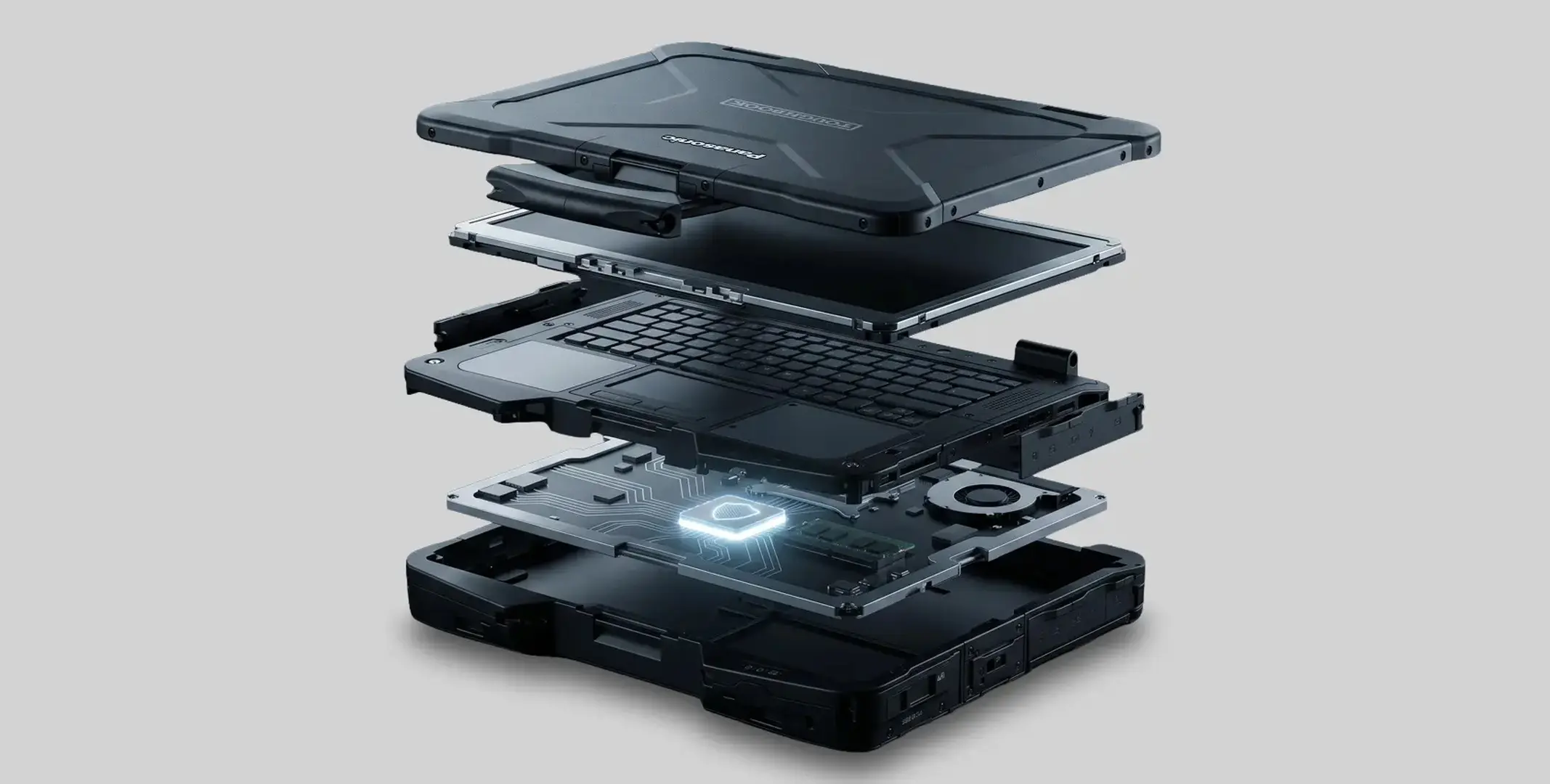
A laptop equipped with Toughbook Guard is protected against hardware tampering. To achieve this, Panasonic integrates a security mechanism into the devices’ BIOS. The BIOS compares the current hardware configuration with an approved benchmark before the OS boots. Components have a verifiable footprint; if a part is (secretly) replaced, Guard will signal it.
The system already takes effect during assembly in the factory. Through Panasonic’s Custom BIOS Services, a secure configuration is implemented during the laptop’s construction. This is intended to protect Toughbooks against so-called supply chain attacks, where laptops might be tampered with between manufacturing and arrival at the customer.
Toughbook Guard also remains active during daily use. The solution works on the device itself, independent of external connectivity. This means the hardware remains verified even in air-gapped environments.
External hardware too
Furthermore, administrators can set an approved hardware profile that also accounts for external components. For instance, Toughbook Guard can object when an unauthorized dongle or USB stick is connected to a device.
IT administrators can decide the outcome of a detected problem. For example, it is possible to completely prevent the device from booting further.
Panasonic expects Toughbook Guard to be relevant for organizations active in critical sectors. The company mentions governments, defense, public safety, and companies operating critical infrastructure.
HP, Lenovo, and Dell
The launch fits into a context where laptop manufacturers are trying to differentiate themselves by adding extra security to their devices that is independent of the operating system. Panasonic is not the only one to note that it can provide security in a layer below the operating system. Other manufacturers such as Lenovo (with ThinkShield) and HP (with Wolf Security) present stories with a similar approach.
For example, Lenovo has ThinkShield Build Assure, which maintains a record of the BIOS and critical components of a device during assembly. Customers can then check their delivered devices against that record to detect any potential tampering.
Within its Enterprise Security Edition, HP offers a solution with a similar setup to Toughbook Guard. That solution can also check whether essential components are intact. Additionally, HP focuses heavily on firmware control, including the BIOS itself (via Sure Start). HP Tamper Lock, on the other hand, relies on sensors to determine if someone has opened a device and potentially gained access to internal components.
For Dell Technologies, the most comparable option is Secure Component Verification. In this case, the internal configuration is again compared with a certificate, but this time one that is explicitly not stored on the device. Dell relies on a cloud connection for its variant.
Different implementation
The implementation of these solutions varies in each case. For Panasonic, the focus lies on BIOS-integrated security that invariably and relentlessly checks whether a hardware profile remains unchanged, regardless of connectivity and immediately accounting for peripherals.
Other manufacturers integrate hardware protection in their own way, whether or not as part of broader security suites or connected solutions. The common thread, however, is that every business laptop builder now sees it as their mission to offer some form of hardware verification. In this way, laptop manufacturers are taking responsibility for protecting devices against supply chain attacks.
Furthermore, the integration of security at the hardware, firmware, and BIOS levels can be seen as differentiation in the competitive struggle. Once Windows boots, the functional difference between laptops is not that significant. With extra security options, such as the new Toughbook Guard, a laptop builder can approach a potential customer with a unique value proposition.