

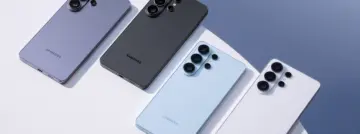
The smallest update in years, and yet the Samsung Galaxy S26 Ultra manages to steal the show with its unique privacy screen. On paper, it looks like an upgrade, until you see that Samsung had to make compromises. Has this flagship overplayed its hand?
Four years ago, Samsung established a solid blueprint with the Galaxy S22 Ultra as a Note replacement, which the competition has struggled to beat for years. This year, with the OnePlus 15 and Oppo Find X9 Pro, we notice that the competition has taken a significant step forward. It’s the ideal timing for Samsung to come out with something no one else can replicate: an integrated privacy screen in the Galaxy S26 Ultra (starting at 1,449 euros incl. VAT).
In theory, this sounds brilliant: you can toggle the privacy view on or off via software whenever you want. You can even exclude specific zones on your screen from prying eyes. The only downside is that the overall screen quality has been affected, making the cheaper Galaxy S26 Plus or the previous generation Galaxy S25 Ultra better to look at.
Cut and paste
After two generations of titanium, Samsung is returning to aluminum for the frame. In practice, you hardly notice it — it still feels premium. The S26 Ultra is slightly thinner (7.9 mm versus 8.2 mm) and slightly lighter (214 grams versus 218 grams) than its predecessor. That thinner profile is quite pleasant in daily use.

The dimensions are otherwise unchanged: you’re looking at a 6.9-inch AMOLED screen that remains difficult to operate with one hand. The camera island on the back protrudes more than before, meaning the device doesn’t lie flat on its back. It’s a small detail, but you notice it every day. The S Pen slides away into the chassis as always, though you now have to be a bit more careful to align the curve of the pen with the rounded corner — otherwise, it doesn’t tuck away perfectly.
Notably, the Samsung Galaxy S26 Ultra has slightly thicker bezels than its predecessors. If you compare them side-by-side, you’ll see the difference, but in practice, you’ll hardly notice it.
Brilliant privacy screen technology
The showpiece is the integrated privacy screen. Samsung has integrated technology that directs the light from the screen in specific directions, so that onlookers next to you cannot distinguish anything.
You can choose between a mild effect and a maximum privacy mode. To achieve this, Samsung switches between different AMOLED pixels in the panel that only shine straight ahead, and traditional pixels that are visible from a wide angle. An extra coating is applied on top of the screen to make the whole system work even better.

In practice, it works incredibly well. Anyone who commutes daily on public transport or works in an open-plan office will benefit immediately. The fact that you can activate specific parts of your screen (notifications, password fields, etc.) is brilliant. You can also link the function to specific apps so that the privacy screen automatically turns on, such as your banking app.
Unfortunately, all these perks come with downsides. The maximum privacy mode changes the way the screen looks to you. Some find it unpleasant to look at for long periods. Due to the coating, the screen’s viewing angles are also no longer as wide, even with the privacy function turned off.
It is an impressive technological achievement, but those sensitive to it will have to turn it off. If you know you are sensitive to certain screen types, it’s better to test the phone in the store first.
Performance and 7 years of Android OS updates
Under the hood is the Snapdragon 8 Elite Gen 5 (slightly tuned for Samsung), combined with 12 or 16 GB of RAM and up to 1 TB of storage. The CPU is about 15 percent faster than last year, the GPU about 20 percent, and the NPU (for integrated AI functions) is 39 percent more powerful. In Geekbench 6, this results in a multi-core score of approximately 11,458 (compared to 9,943 for the S25 Ultra) and a GPU score in 3DMark of 31,674 (compared to 26,413).


In daily use, you'll notice little difference from the previous generation — which was already lightning fast. Samsung promises seven years of OS and security updates, which is excellent and guarantees support until 2033.
Samsung is explicitly positioning the S26 Ultra as an 'AI phone'. You have access to the full Gemini suite of AI functions, supplemented by new features such as task automation that allows the phone to independently operate apps like Uber. Additionally, there are the traditional AI functions: translation, summarization, photo editing with generative AI, and more.
It's either a major asset or an annoying distraction — depending on how you feel about AI on your smartphone. Samsung is pushing it hard, but everything is optional. If you ignore it, it won't bother you.
Plenty of camera options
The camera setup is largely unchanged: the same sensors as last year, but with improved image processing. Samsung has managed to get more out of the same hardware. The main camera delivers slightly sharper details and less noise, especially in challenging lighting conditions. In a direct comparison with the Google Pixel 10 Pro, the differences are small, but the S26 Ultra consistently scores slightly better in backlit photos.
A notable detail: the 3x telephoto lens has a smaller sensor than last year, the same as in the regular S26 models. This is a downgrade that Samsung isn't shouting from the rooftops. Whether it's noticeable in practice depends on the circumstances.


Battery lags behind, charging power gets a boost
And then there's the battery. Or rather: the disappointment. Samsung is sticking with the same 5,000 mAh as last year, while competitors like OnePlus are now cramming batteries of over 7,000 mAh into thinner and lighter devices thanks to new technologies. We're not saying the battery performs poorly, absolutely not, but the competition has moved the goalposts here, while the Oppo Find X9 Pro (from 1,299 euros incl. VAT) and the OnePlus 15 (1,099 euros incl. VAT) are also cheaper.

Where the Samsung Galaxy S26 Ultra does score points is by boosting the charging speed. For years, we've mocked Samsung for what they call 'fast charging', but we can't complain anymore. The S26 Ultra supports up to 60-watt charging, which can certainly be called fast. You don't need specific brand-locked technology for this like with OnePlus or Oppo. As long as you use a charger that is Power Delivery compatible — a universal standard — you're good. No charger is included in the box.

One striking point: the previous Galaxy S25 generation was certified in Europe to handle 2,000 charging cycles without significant battery capacity degradation. From the S26 generation onwards, that has dropped to 1,200 charging cycles, which is more in line with the competition. Is the brand playing it safe due to the higher charging speed? Hard to say.
Conclusion
The Samsung Galaxy S26 Ultra (starting at 1,449 euros incl. VAT) is no longer the best Android smartphone you can buy today. OnePlus and Oppo now hold that title. The privacy screen is a technologically impressive addition that may be interesting for certain users, but keep the downsides in mind.
This year, Samsung is leaning too heavily on a proven formula: the same battery capacity, the same camera sensors (with even a downgrade for the telephoto lens), and a design that hardly changes.
If you haven't missed a privacy screen in recent years, you're better off buying the S25 Ultra. That screen is better, and the generous update guarantee means you'll still enjoy security and Android OS updates for another six years. For those who commute a lot or work in an open office, the Samsung Galaxy S26 Ultra is a unique device. Just double-check beforehand whether the screen technology doesn't have too much of an impact for you outside of those privacy-sensitive moments.
Tested: Samsung Galaxy S26 Ultra, 12 GB RAM, 256 GB storage, Energy Label A – 1,449 euros incl. VAT.
Pro's
- Technically brilliant privacy screen
- Lightning-fast Snapdragon 8 Elite Gen 5 processor
- Seven years of software updates
- Improved camera image processing
- Thinner and lighter than predecessor
Contra's
- Still only a 5,000 mAh battery
- Privacy screen impacts screen quality
- 3x telephoto lens has a smaller sensor than the S25 Ultra
- Camera island protrudes significantly in the corner, noticeable on a table
- Most expensive models have increased in price