

Why settle for one fold, when you can also make devices that fold twice. At CES, Samsung is showing new concepts for foldable devices, though practical question marks remain.
Samsung is showing at CES that folding twice is more interesting than once. The manufacturer is busy commercializing foldable phones with the Galaxy Z Fold and Z Flip series, but clearly wants to go a lot further. The Z Fold 3 and the Z Flip 3 each have one fold and so seem fairly modest compared to what the Korean smartphone giant is presenting at the show.
Accordion Screen
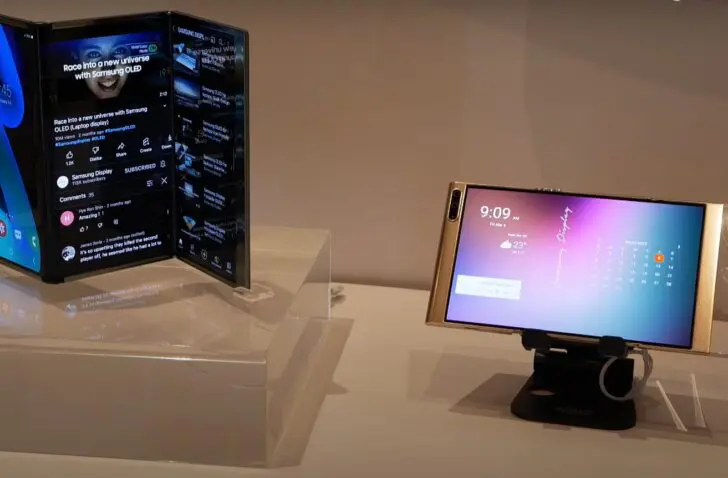
First is the Flex S, which comes in two variants. Both phones follow the same concept. They fold in two places and work like an accordion. So in closed mode, you have one display on the front, which increases in size three times when you open the device. The other two-thirds of the screen sits protected on the inside. The approach has the advantage that the device actually has only one screen, which can serve in both phone mode and tablet mode.
The large variant of this double folding device offers a lot of screen. Closed, this device is a big (and also fat) phone, when you open it you get a solid 16:10 tablet in your hand.
Kleiner
The small variant unfolds from a portable cube to an out-of-print phone. For this device, the screen does not extend all the way to the end. Samsung instead opts for a translucent cube that folds over the middle part of the display in closed mode. This gives you a protected second screen when closed, the added value of which is unclear.
The Flex G is a third variant, with no part of the screen on the outside. The device does not fold like an accordion, but has a tight fold and a slightly wider one that allows you to fold the thing all the way closed. The letter “G” is a stylized version of that folding concept.
Foldable laptop
Who says pliable screens are only suitable for tablets and smartphones? Not Samsung: the Flex Note is a laptop without a keyboard. The screen runs all over the inside. The thing looks like a 13-inch laptop but is a 17-inch screen at the same time. Controls come via variable buttons on one side of the screen. The concept looks nice, but seems to us to have limited usefulness due to the lack of a keyboard.
This approach is not new. Just before the pandemic, Lenovo already demonstrated the ThinkPad X1 Fold, which follows the same principle. Lenovo commercialized the product, which otherwise could never really break through.
Other ideas
Finally, Samsung is showing another phone with a screen that is rolled up for a piece so you can slide it out, and a smart speaker under which a display is folded in a cylindrical shape. That screen straightens with the push of a button.
How relevant are all these prototypes now? The Galazy Z Fold and Flip show that pliable hardware is indeed in demand. The new concepts capture the imagination, yet also come with drawbacks. For example, in folded mode, the phones do tend to be very thick. The ideas at CES do show the direction Samsung wants and can take with foldable screen technology.