

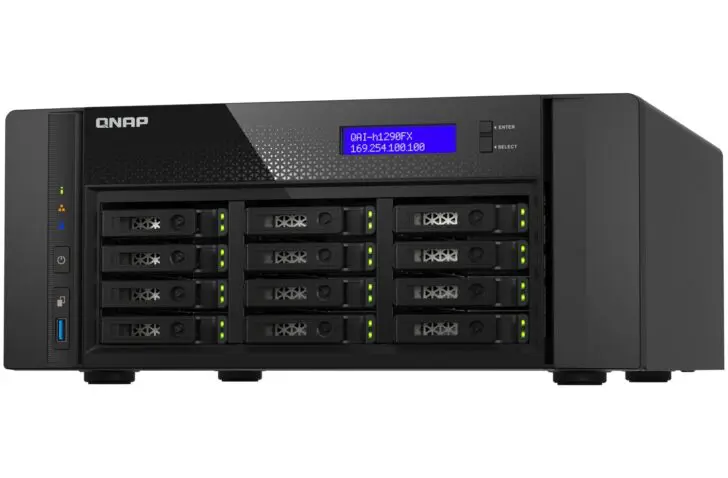
Qnap introduces the QAI-h1290FX. This is a NAS that can serve as a server for private LLMs, RAG search engines, and generative AI. The device combines all-flash NVMe storage with an AMD Epyc processor and optional Nvidia RTX GPUs.
Qnap is launching the QAI-h1290FX as an edge AI storage server for companies that prefer not to host AI workloads in the cloud. The system is built with a focus on local inference, data sovereignty, and control over the entire environment.
Hardware and AI capabilities
The QAI-h1290FX is equipped with an AMD Epyc 7302P processor with sixteen cores and 32 threads. For storage, there are twelve U.2 NVMe/SATA SSD slots. Qnap has opted for an all-flash architecture to deliver high I/O performance. This is a logical choice given the focus on AI models and associated data streams.
Qnap provides 128 GB of built-in RAM but surprisingly chooses DDR4. This likely has something to do with the CPU, as the chip was launched back in 2019. That choice is surprising, considering the device’s focus.
The server supports GPU acceleration via up to one Nvidia RTX Pro 6000 Blackwell Max-Q Workstation GPU. This card features up to 96 GB of GPU memory and supports CUDA, TensorRT, and Transformer Engine, among others. The GPU is in line with what you would find in a more traditional AI server. The integration is intended to accelerate local LLM inference, image generation, and other deep learning workloads.
On the networking side, the QAI-h1290FX features two 25 GbE ports and two 2.5 GbE ports. Upgrades to 100 GbE are possible via PCIe. The system is also compatible with Qnap JBOD expansion enclosures for additional storage capacity.
QuTS Hero
The ZFS-based QuTS Hero is the operating system of choice. It brings features such as data integrity, snapshots, and inline deduplication. For AI environments, the system also supports native GPU access in containers via Container Station and GPU passthrough for virtual machines via Virtualization Station.
Furthermore, Qnap pre-loads several AI tools, including AnythingLLM, OpenWebUI, and Ollama. Integrations with Stable Diffusion, ComfyUI, n8n, and vLLM are also provided.
True AI NAS
Qnap aims to lower the barrier for organizations looking to build an AI platform on-premises with this device. The integration of true AI capabilities into a NAS is striking. Manufacturers are often quick to throw around the term AI: as soon as a small NPU is present, something is supposedly optimized for AI. However, the ability to install a real GPU ensures that this device plays in a different category.
With this device, Qnap caters to organizations that want to get started with local AI but prefer a relatively user-friendly NAS environment as a foundation. The price is steep: the AI server costs €17,655 (excl. VAT), and you still have to purchase the SSDs and the GPU separately.