


The transition from Microsoft Configuration Manager to Intune is progressing slowly. Most organizations manage their devices with a combination of both, and a large portion has no concrete migration plans or timeline.
Intune is struggling to take over the role of Configuration Manager, according to the study The State of Intune in 2026, conducted by Recast among 890 IT professionals worldwide. The figures depict a market in a prolonged transitional phase. A fully modernized management model remains elusive.
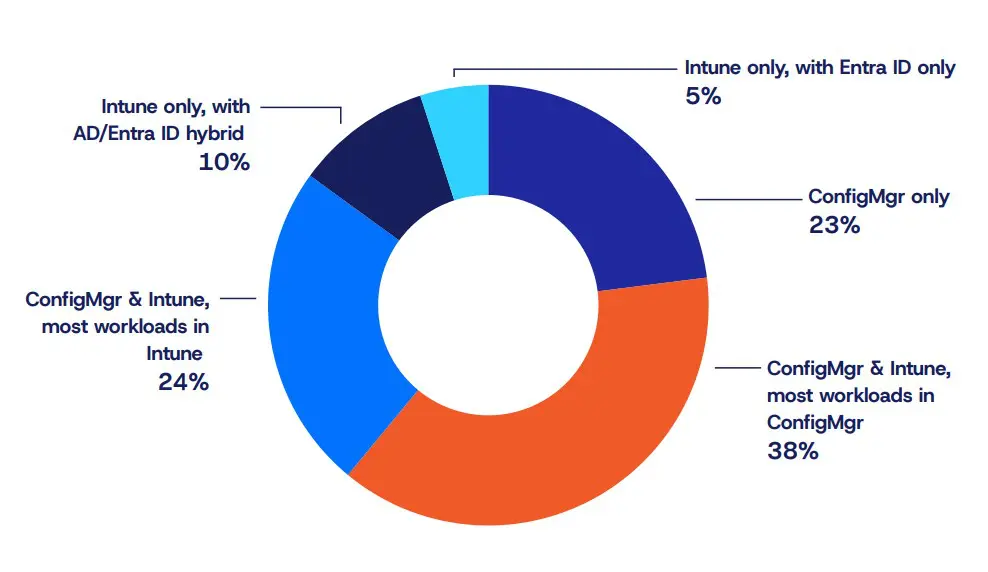
Configuration Manager, formerly known as SCCM, is Microsoft’s classic endpoint management tool that runs on its own on-premises infrastructure. Intune is the cloud-native counterpart, allowing organizations to manage devices across various platforms via the cloud. Many companies combine both in a so-called co-management state.
Hybrid model dominates
That hybrid approach clearly dominates. 62 percent manage devices with both Intune and Configuration Manager, with the largest group (38%) still keeping most workloads in Configuration Manager. Management based entirely on Intune remains a minority position.
It is striking that the phasing out of Configuration Manager is proving difficult. 55 percent of users have no plans or timeline to retire the platform. Even among those who only use Configuration Manager, the majority sees a permanent hybrid model as a good end state, rather than a full transition.
High satisfaction
Nevertheless, satisfaction with Intune is high. 81 percent indicate they are satisfied with the platform, and a similar proportion feels confident about troubleshooting. This appreciation contrasts with the operational burden: according to the survey, 65 percent lose six to fifteen hours per week to manual work. The biggest pain points are application packaging and deployment (37%) and third-party patching (33%). However, satisfaction remains high, indicating that organizations see value in Intune despite the manual work.
For the next twelve months, priorities lie with the rollout of Windows 11 (23%), followed by security hardening (21%) and full cloud migration (19%). Small IT teams are thus trying to modernize and secure their systems simultaneously.
The migration to Intune is therefore well underway, but is progressing gradually. For many organizations, Configuration Manager remains a permanent part of management for the time being, and the hybrid intermediate state is the norm rather than a temporary phase.