

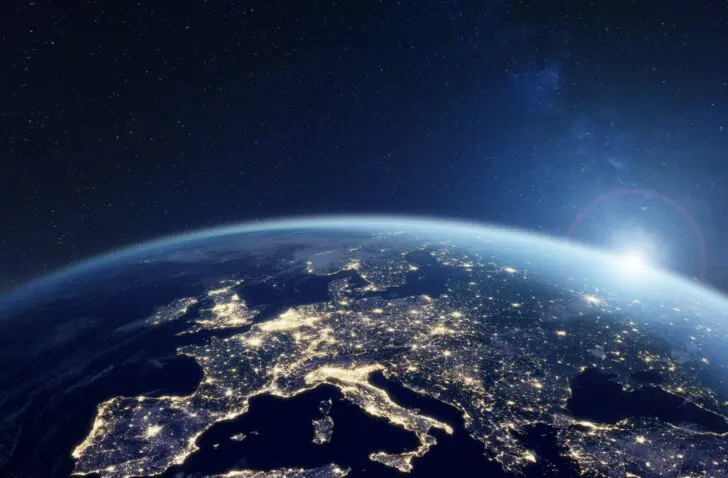
SAP wants to deploy its AI model SAP-RPT on the International Space Station (ISS) by early 2027 at the latest. The model runs on HPE’s Spaceborne Computer-2 and analyses sensor data on site.
SAP wants SAP-RPT on board the ISS by early 2027 at the latest, running on HPE’s Spaceborne Computer-2. It is one of the most important practical tests to date in which an AI model for business environments processes data directly on location, also known as edge computing.
Radiation, space debris and solar storms can cause problems for the space station at any moment. The sensors and systems on board continuously produce large volumes of data, and sending all of it to Earth takes too much time. The systems on board therefore have to spot problems quickly on their own.
SAP-RPT on board
SAP-RPT is designed to make predictions based on structured data, such as measurements and other information in tables. The model can handle missing data and needs no extensive additional training for new applications.
On the ISS, the model analyses data from sensors and systems. It detects anomalies, predicts technical problems early and reconstructs missing measurements based on historical data. It also compiles reports on the technical condition of the station, so that astronauts and staff on Earth gain faster insight into potential risks.
SAP-RPT also calculates an overall risk score for the mission and assesses whether human intervention is needed. According to SAP, the model is roughly 50,000 times more energy-efficient than the most advanced large language models, which matters in space because available energy is limited.
SAP’s tabular AI
Large language models (LLMs) are particularly strong at language and reasoning. With so-called tabular foundation models (TFMs), SAP focuses on structured data from ERP systems, financial records and production environments. The ISS sensor data is a comparable data source.
SAP-RPT is part of that portfolio, as is TabPFN from Prior Labs. With SAP AI Core, organisations can manage, steer and monitor the models, their predictions and the associated workflows.
Mayank Shrivastava, Vice President of Generative AI and Foundation Models at SAP SE, calls space “the ultimate stress test for AI”. According to him, the same model can predict supplier risks, cash flow anomalies and equipment failures. Scott Wiest, Vice President and Global Sales Chief Technologist and HPE Fellow, speaks of real-time detection and predictions in “the ultimate edge environment”.
Applications on Earth
The demands of space are also relevant on Earth: locations with limited power supply, unreliable network connections or systems where failures have major consequences. SAP sees uses for tabular AI in, for example, disaster relief, farming in remote locations, multi-site factories and international supply chains.
SAP will use the experience gained on the ISS to further develop edge AI. The company wants to support organisations with analytical and operational processes in places where computing power, energy and connectivity are limited.