


Amazon introduces CloudWatch Omni as the AI-driven successor to CloudWatch, offering a single observability experience for AI agents, applications, and infrastructure.
CloudWatch Omni builds upon Amazon CloudWatch but reimagines the experience around AI and open standards. Instead of separate dashboards and fragmented tooling, teams gain a single view of their entire environment, including AI agents. The solution works within the development environment or via a separate Omni web interface with enterprise single sign-on.
According to Amazon, CloudWatch Omni aims to bring observability closer to developers without requiring the AWS console. The service integrates existing CloudWatch telemetry and new signals via open protocols, ensuring organizations do not have to overhaul their current stack.
A single environment
CloudWatch Omni brings infrastructure and agent observability into one environment. Automated topology detection maps services, dependencies, and so-called golden metrics across accounts and regions without manual configuration. This map illustrates how AI agents, applications, APIs, and underlying infrastructure relate to one another.
Instrumentation occurs once via the OTLP protocol, after which both new and existing CloudWatch telemetry become available. End users no longer need to navigate the AWS console, as all relevant information is accessible via the IDE or Omni interface. This is intended to streamline the work of developers and SRE teams.
Evaluation
A central innovation is evaluation-driven observability. CloudWatch Omni assigns a quality score to every agent call, based on factors such as correctness, thoroughness, and choice of tools. These scores appear as first-class signals alongside traditional metrics and traces, rather than in a separate evaluation tool.
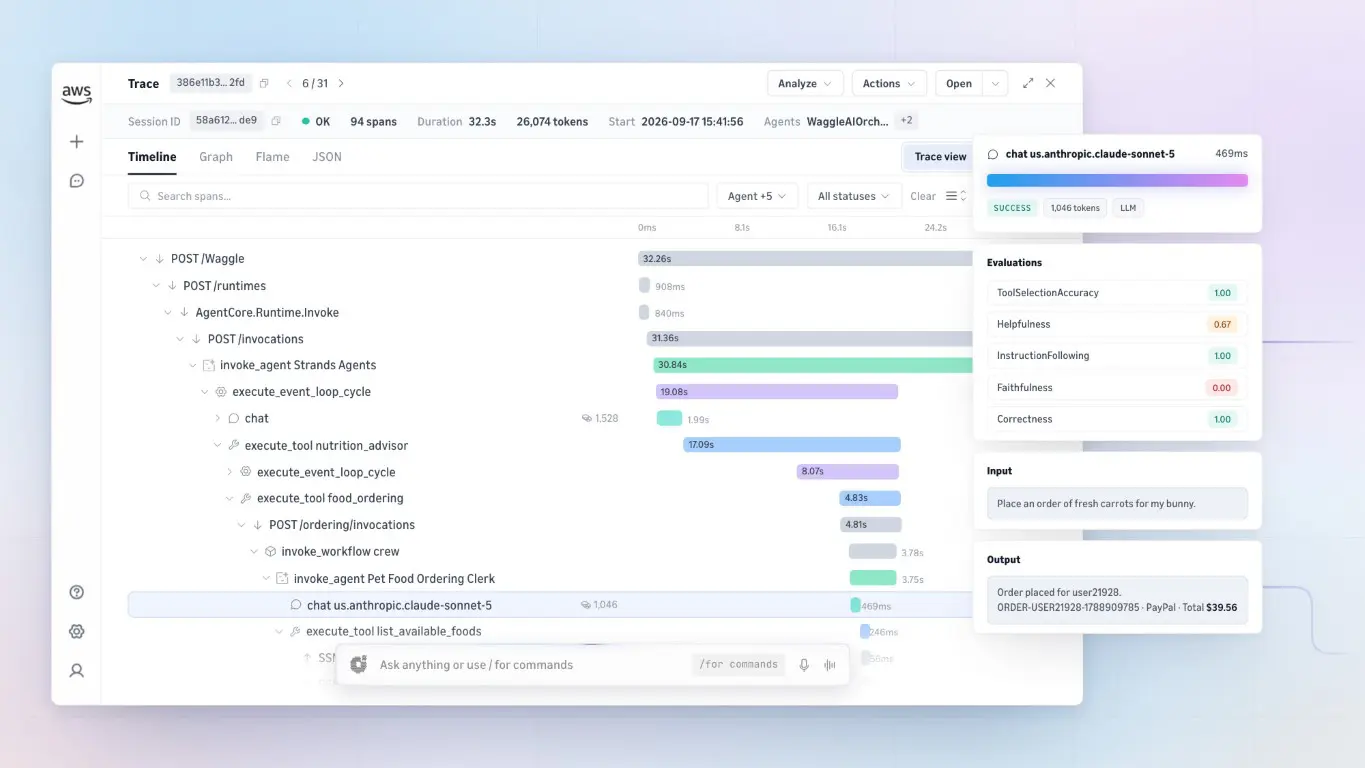
Teams can run online evaluations on production traffic and offline evaluations on versioned datasets with edge cases. This allows for the detection of silent regressions before customers experience issues. Amazon Bedrock Agentcore provides built-in evaluators, but organizations can also integrate their own evaluation models.