

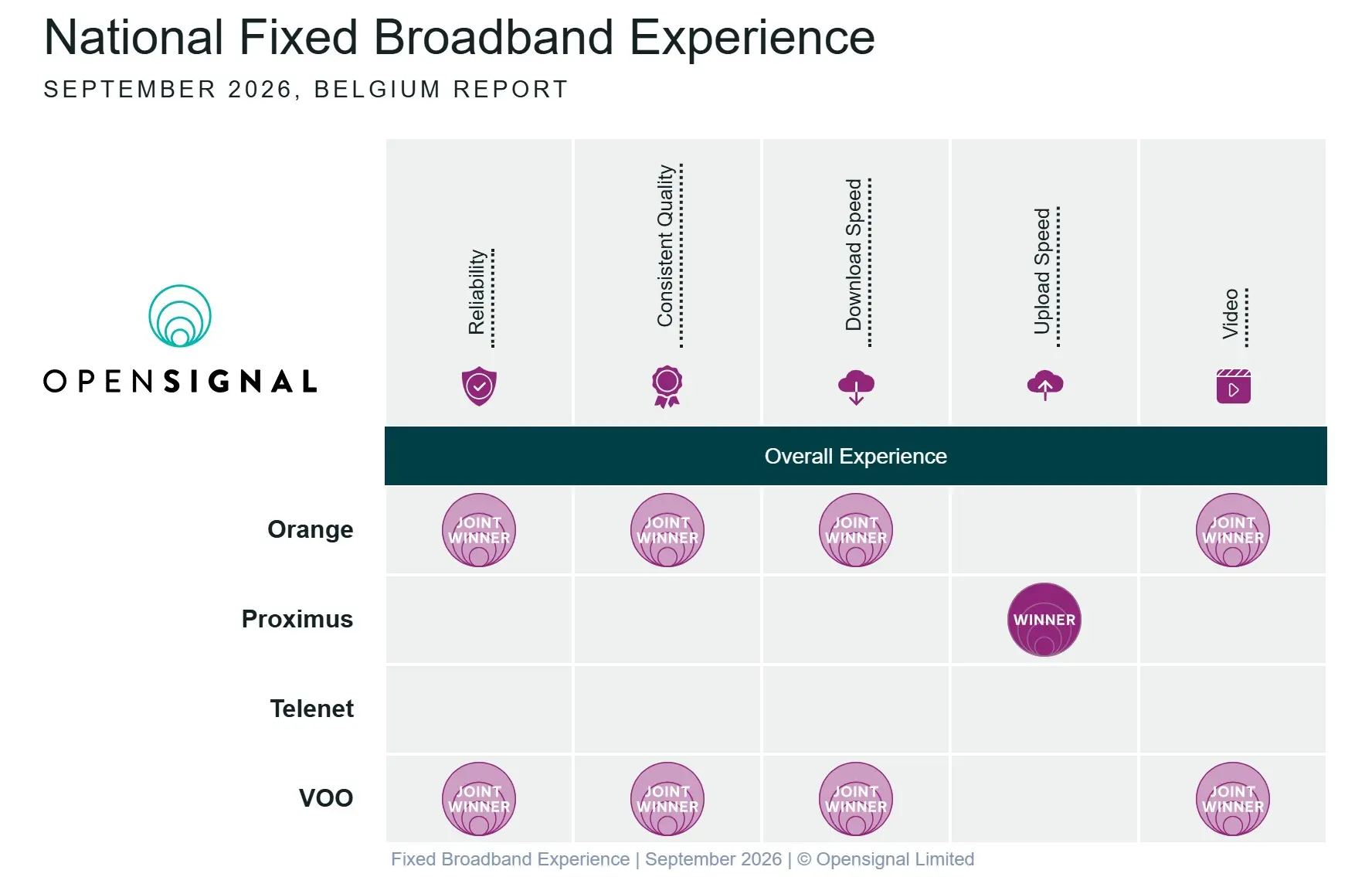
Belgian telecom operators Orange and VOO score best in four out of five categories, according to research by Opensignal. Proximus takes the remaining category and is the master of upload speeds. What does this say about the Belgian telecom landscape?
Belgian telecom operators Orange and VOO win four out of five national awards in the latest Fixed Broadband Experience report from Opensignal, the independent global standard for analyzing consumer connectivity experiences. Yet the real story lies in the only category they didn’t clinch. In terms of download speed, all Belgian operators are within ten megabits of each other; in terms of upload, the difference is a factor of three.
Four out of five for Orange and VOO
According to Opensignal, Orange and VOO provide the best experience for Download Speed, Consistent Quality, Reliability, and Video. The report, authored by principal analyst Andrey Popov, is based on measurements from real users between April 1 and June 29, 2026.
For now, the two brands are still reported separately, even though they are migrating to a single identity since Orange Belgium acquired the Walloon cable network and a third of Brussels through the VOO takeover, together some 1.8 million homes passed and by now more than one million fixed broadband customers.
King of upload speeds: Proximus
Proximus wins in the Upload Speed category, and not by a narrow margin: 39 Mbps, almost double that of runner-up Telenet and nearly three times as much as VOO. That gap is structural. Fiber delivers symmetrical capacity, whereas DOCSIS cable does not. Proximus has therefore made fiber the core of its fixed strategy, reaching approximately 42 percent of Belgian buildings by the end of 2025, accounting for 2.5 million homes and businesses, partly through the open-access vehicles Fiberklaar and Unifiber.
For IT managers, that is the most relevant line in the report. Cloud backups, video conferencing, remote desktops, and uploading large datasets rely on upstream capacity, not peak downloads.
Telenet left empty-handed
Telenet does not win any category, but the speed deficit is minimal: 102 Mbps download compared to 104 to 112 Mbps for the winners. More painful is the stability, where the operator lags behind on both Consistent Quality and Reliability. These are precisely the metrics that measure whether a connection is consistent enough for HD video, group calls, and gaming. Telenet serves Flanders and most of Brussels via hybrid fiber-coax, managed by network company Wyre, and is working on an upgrade to FTTH.
Cable country with a fiber problem
The ranking reflects a structural peculiarity of the Belgian market. According to the European Commission’s DESI 2026 figures, FTTP coverage in Belgium stands at 35.5 percent: the lowest of all member states and less than half the EU average of 74.1 percent. Extensive DOCSIS 3.1 cable more than compensates for this, with VHCN coverage of 96.3 percent compared to 85.5 percent EU-wide.
However, that coverage barely translates into gigabit subscriptions: only 8.7 percent of Belgian fixed broadband lines run at 1 Gbps or more, compared to 27 percent in the EU. That figure did grow by 54.6 percent in one year. Cable thus keeps Belgium comfortably in the leading group today, but the asymmetry of that technology is exactly where Proximus secures its only victory, and where the competitive battle will shift in the coming years.