

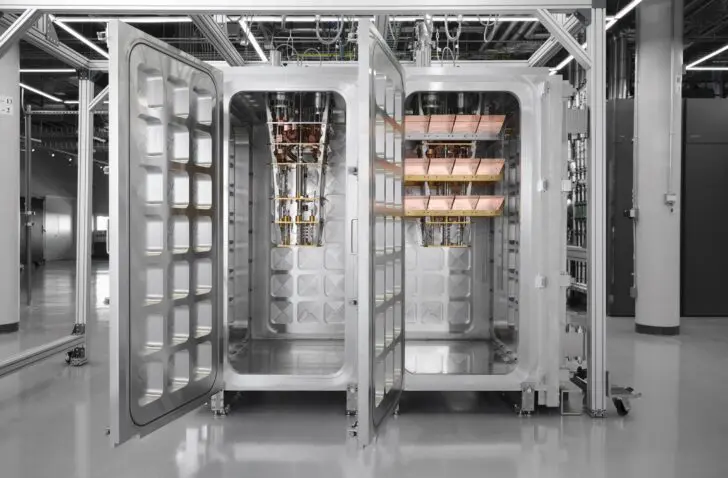
IBM has successfully linked two modular cryogenic systems for the first time, a significant step toward fault-tolerant quantum computing. The new architecture should make it possible to bring hundreds of quantum chips together.
With the merging of two operational cryogenic modules, IBM is taking a next step in the development of scalable quantum computers. The modules are specifically designed to create a shared, ultra-cold system that can link hundreds of quantum chips. This initiative is part of IBM’s broader strategy to deliver a fault-tolerant quantum computer by 2029.
Initial tests with the new modules show they could be cooled to four Kelvin in less than five days, eventually reaching a temperature below fifteen millikelvin. These extremely low temperatures are necessary for quantum chips to function stably and to maximize connectivity between chips.
Expansion of capacity and connectivity
Each cryogenic module is more than two and a half meters high and over two meters wide. The vacuum housing of each module provides up to twelve times more wiring than previous IBM quantum systems. This allows for many more connections to be made between quantum chips, both within a module and between different modules.
With the new box-shaped design, the modules can be placed tightly next to each other, enabling larger systems. IBM is also introducing L-coupler technology, which allows individual quantum chips to communicate directly with each other as part of a larger whole.
1,000 programmable qubits
IBM plans to connect multiple processors using L-couplers by 2027 to build a quantum computer with at least 1,000 programmable qubits. Later this year, IBM Quantum Nighthawk processors will be installed in the cryogenic modules for further performance testing. In the long term, IBM wants each cryogenic module to support thousands of qubits. The development of Quantum Starling, including a more efficient error correction code, remains on schedule according to the company.