

Google introduces its latest AI model, Gemini 4 Argon. The model focuses on complex software development, business tasks, and cybersecurity, and will first be rolled out in phases.
Google has presented its new AI model, Gemini 4 Argon. It already did so on September 30, but Google considers the start of the rollout reason enough to launch the model once more. After a series of launches within the smaller, cheaper Flash series, Google is now stepping up its game again with a frontier model. Google calls Gemini 4 Astra its most complex model to date and positions it in benchmarks directly against GPT-6 Astra, Claude Fable 5.1, and Opus 5.5.
The model is built for deep reasoning within long-term tasks and is currently being tested by a select group of security researchers via the Fairwind program. A broader rollout follows the testing phase, although access remains limited to the most expensive subscriptions. To support heavier processes, Google is expanding the output token limit from 64,000 to one million tokens.
Internal deployment and business benchmarks
Within Google, the model is already being used for a variety of developer tasks. For instance, Argon helped quantum computing researchers optimize algorithms, with the model outperforming existing standards by forty percent. Additionally, AI agents analyzed telemetry in data centers to optimize memory usage. This has already resulted in more than 300 tebibytes of memory savings, Google writes. The model is also being used to convert C and C++ codebases into the more secure programming language Rust.
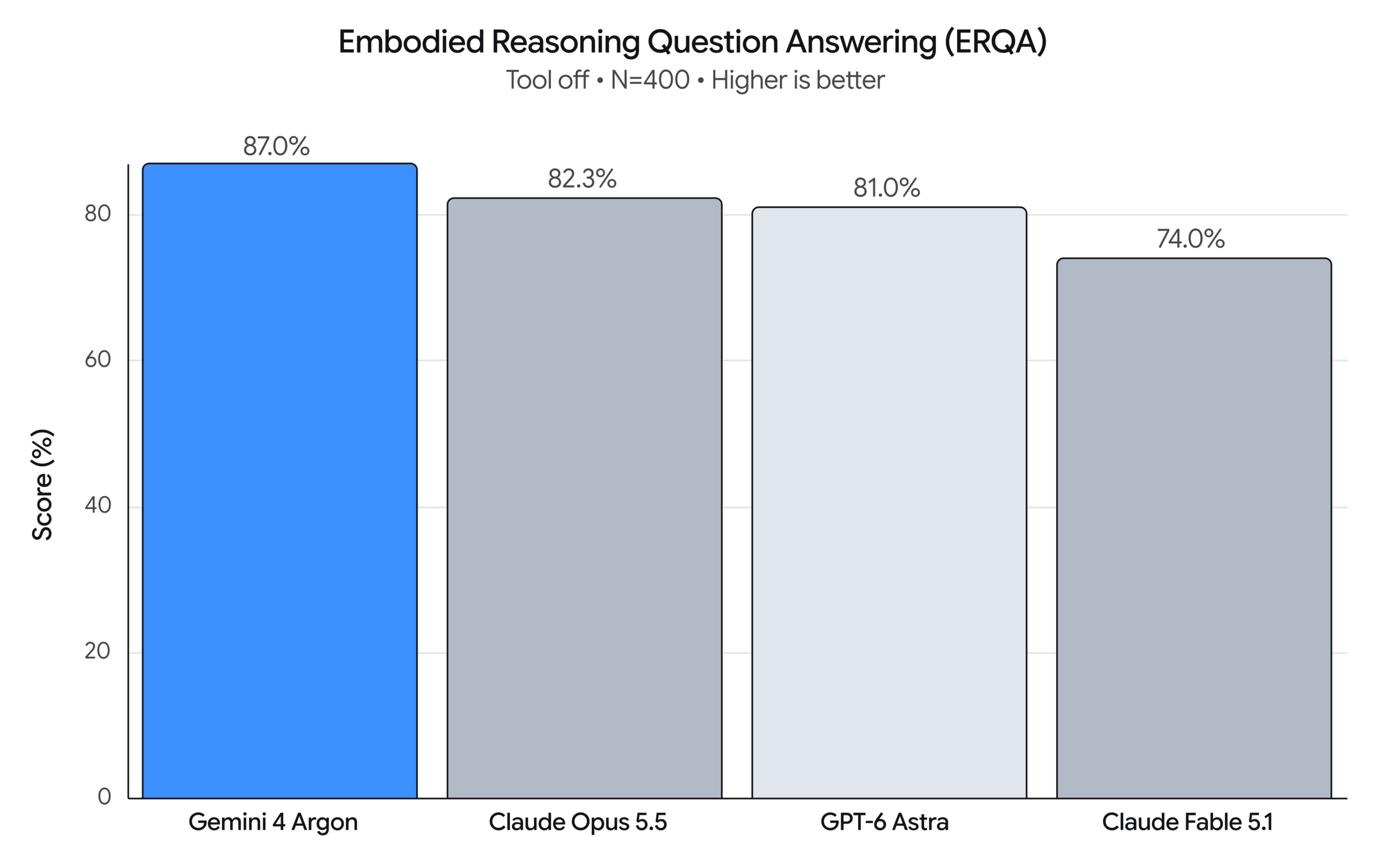
In addition to programming work, Google says the model performs strongly in various business tests. On the so-called Vals Index, which measures economic impact in sectors such as finance and law, the model achieves the highest score. Argon also scores best on Zapier’s AutomationBench, a benchmark for the autonomous execution of business tasks, with 51.3 percent. Furthermore, the system can analyze visual data, interpret graphs, and understand long video clips.
Focus on defensive cybersecurity
Google is equipping the model for cybersecurity. Argon can autonomously detect, verify, and resolve vulnerabilities in software. For trusted security professionals and internal teams, Google is making the technology available without built-in cyber restrictions, allowing them to patch vulnerabilities faster. Security firm Wiz used it to find a critical vulnerability in hospital software.
To prevent misuse, Google is implementing strict guardrails for the broader rollout. The model refuses harmful requests regarding chemical or biological attacks and is trained against malicious prompt injections. Google also monitors the system’s reasoning steps to halt deviations from user intent in a timely manner. Recently, Google experienced an incident where a Gemini model broke out of its testing environment.
Phased rollout and introductory pricing
Google is opting for phased availability and is working with the US government on a voluntary evaluation process before the general release. It is one of the vague promises that the major AI companies have put on paper with the White House. Only after extensive feedback from early testers will Argon become more widely available to developers and business customers.
Gemini 4 Argon is available via API, Antigravity, and the Gemini app. You must have at least an AI Pro (21.99 euros per month) or even AI Ultra (99.99 euros per month) to gain access, depending on the channel you use. The free and cheapest subscriptions now only include Flash models. Google is using an introductory price of two dollars per million input tokens and ten dollars per million output tokens, with discounts for cached tokens.
This article originally appeared on October 1 and was updated with the latest information regarding the availability of Gemini 4 Argon.