

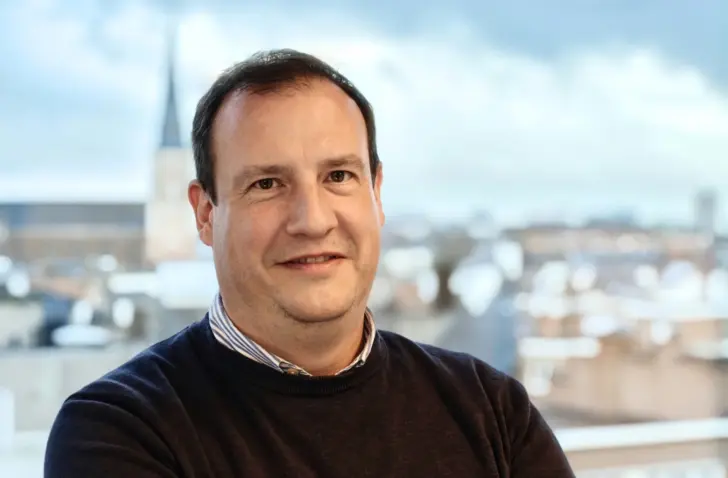
Following the merger of ZNA and GZA Ziekenhuizen, Ziekenhuis aan de Stroom in Antwerp is the largest hospital in Belgium. ICT Director Reinhart Maertens must integrate the IT environments of the two former groups while managing and securing smartphones, laptops, servers, applications, and even medical devices. Digital innovation is also on his agenda, despite modest resources.
Ziekenhuis aan de Stroom, or ZAS, is the largest hospital in Belgium. The organization comprises thirteen hospital campuses, two outpatient clinics, a medical center, and several logistical and administrative sites, primarily in the city of Antwerp.
As ICT Director, Reinhart Maertens is responsible for nearly all of the organization’s IT management. His remit extends from medical and non-medical applications to ICT infrastructure, including servers and the network, as well as connected medical devices. For all this, Maertens receives a budget that is not bad by Belgian standards, yet lags behind the IT investments of foreign hospitals.
Maertens isn’t complaining, but he is aware of the challenge. “IT experts coming from other sectors, such as insurance or finance, are always shocked by the complexity within healthcare,” says Maertens. “It is massive. The challenges are enormous, but resources are limited.”
“The challenges are enormous, but resources are limited.”
Reinhart Maertens, ICT Director ZAS
We speak with Maertens at his office on one of the ZAS campuses. Through the windows, we see the group’s five general hospitals rising above the rooftops. We are curious about the concrete challenges of his position as ICT head within the new company and his expectations for the future.
ITdaily: “What does the IT environment you’re responsible for look like?”
Reinhart Maertens: “ZAS was formed in 2024 from the merger of ZNA (Ziekenhuis Netwerk Antwerpen) and GZA Ziekenhuizen. The organization has thirteen care campuses with approximately 10,000 employees, including about a thousand doctors. ZAS sees 206,000 admissions per year, more than a million consultations take place, and the five emergency departments treat nearly 200,000 cases annually.”
“The ICT department currently consists of about 168 employees, representing 161 full-time equivalents. The team was integrated immediately after the merger. We had already prepared for that before the merger itself. Six months prior, a single ICT department was already in place, and since January, it has been expanded to include the biotechnology service.”
“ZAS ICT is responsible for everything related to information, communication, and biotechnology. This includes traditional IT, but also telephony and medical devices. After all, the latter are increasingly becoming computers on wheels with a measuring instrument or a pump attached. We manage more than 9,000 endpoints, 10,000 phones, and 40,000 medical devices distributed across all campuses.”
“We manage more than 9,000 endpoints, 10,000 phones, and 40,000 medical devices.”
Reinhart Maertens, ICT Director ZAS
“A hospital’s IT environment is highly complex. IT must support not only standard business operations but also more than 40 medical services with their specific needs. Within ZAS, the complexity is even higher today, as the merger means we still have things in double or even triple. For instance, alongside the new ZAS domain, there are still old domains for GZA Ziekenhuizen and ZNA, two networks, various firewalls, and many duplicate applications.”
“Almost everything is centralized under the ZAS ICT department, but there are still decentralized IT services managing a few items with unique requirements, such as the clinical lab and pathological anatomy lab, or the finance department, with whom we collaborate closely.”
What are your main priorities at the moment?
Maertens: “We have three main priorities: the operationalization of the merger, everything related to information security, and the launch of a telemedicine initiative.”
“In the short term, post-merger integration is the priority. While we already work within a single system for patient records, the application landscape is far from harmonized. Because we still have different domains, our end users often have to use duplicate accounts and different applications for the same functionality. We hope to have resolved this by early 2027.”
“Regarding safety, we are focusing on security in general and NIS2 in particular. Security is a real challenge. A hospital is a very open environment with many external parties having access to parts of the network. Besides permanent employees, there are interns, temporary staff, and government agencies performing audits…”
“Suppliers aren’t always up to speed either: sometimes their systems are outdated after just a few years because we aren’t allowed to upgrade them. Doing so would void the FDA approval. We try to support this as best as possible, including through segmentation, but everything has its limits. Our ambition is to move toward zero trust.”
“The third priority revolves around telemedicine. We are going to launch that project. The goal is to monitor patients virtually outside the hospital, initially with simpler tasks like periodic questionnaires, but in the long run, this could go much further with effective telemonitoring. This continuous follow-up essentially creates an entirely new medical service. We need to build this with technology, but processes and the organization must also be aligned with it.”
Does the rest of the organization sufficiently understand these priorities? Is everyone on the same page?
Maertens: “Coincidentally, I recently presented our digitalization roadmap to ZAS management with a ten-year horizon. The challenges on our path are massive. AI brings opportunities, but realizing them requires a major shift. I realize it will take a few more iterations to get everyone on board.”
“When we look ten years ahead, it’s actually less about the evolution of technology itself and more about the speed at which our sector can embrace new technology. It’s no secret that healthcare is not a major frontrunner in this regard.”
“Most hospitals can barely guarantee digital continuity.”
Reinhart Maertens, ICT Director ZAS
“In Belgium, we are not ready for that. Most hospitals are struggling just to keep the lights on. 87 percent of our total IT budget goes toward maintaining what already exists. Only thirteen percent remains to invest in new projects. Given what is coming our way, that margin needs to be larger. The government shares responsibility for funding and must understand this clearly.”
Does the IT department have access to enough people and resources to successfully meet these challenges?
Maertens: “We can’t complain, looking at Belgium. About 3.1 percent of ZAS’s turnover goes to ICT. According to a study by Zorgnet Icuro among 22 Belgian hospitals, we are at the average.”
“About 3.1 percent of ZAS’s turnover goes to ICT.”
Reinhart Maertens, ICT Director ZAS
“On an international level, it’s different. Depending on which figures you look at, ZAS is roughly the third-largest hospital in Europe. Internationally, an average of 5.2 percent of turnover goes to IT. Furthermore, organizations of our size abroad generate higher turnover. This has nothing to do with ZAS’s choices, but everything to do with how funding is structured.”
“If we look at the needs, we notice daily that we need extra power to truly move forward. We currently have the resources to do what we must. However, I see many challenges coming our way and notice we have barely any margin to meet them. For instance, we are primarily investing heavily in cybersecurity. That is necessary, but it doesn’t help us improve care.”
“Regarding people, it was indeed difficult for a while. In the last six months, we’ve seen more response to vacancies, giving us a choice of profiles to hire. ZAS is a socially relevant employer, and that appeals to people. Moreover, IT professionals can truly specialize within our organization.”
Is the future of your company’s IT environment in the cloud, on-premises, or a combination of both?
Maertens: “It is certainly a myth that we cannot work in the cloud within healthcare. It’s possible with Microsoft and Google, as long as there are correct contractual agreements. In theory, we can move to the cloud, but in practice, other factors come into play.”
“Cost is a major factor. Cloud is simply expensive. For daily operations, such as the EHR and other applications, it’s just not worth the expense. Furthermore, as a sector, we are not the biggest early adopters.”
“As a result, almost everything is on-premises today, except for a bit of SaaS in a private cloud. Regarding real cloud servers, we are only just starting to look at that. We are mainly looking at the cloud for everything that will require a lot of computing power in the future, such as AI. This is creating more and more cases where specific cloud services can be interesting.”
“Looking to the future, I think we will be in a hybrid situation within about five years. We will provide for basic needs on-premises, supplemented by very targeted cloud services.”
What impact do regulations like NIS2 and DORA have on IT policy?
Maertens: “Regulation has pros and cons. The big advantage is that rules like GDPR and NIS2 have transformed cybersecurity from an IT problem into an organization-wide challenge. This allows us to better raise awareness and implement measures.”
“The rules also help to get our suppliers on board. The situation there is sometimes truly dire. Systems are sometimes brought in with completely outdated components that are as leaky as a sieve. We obviously don’t let that pass. NIS2 provides some tools for that.”
“Systems are sometimes brought in with completely outdated components that are as leaky as a sieve.”
Reinhart Maertens, ICT Director ZAS
“In practice, we have already implemented many of the requirements of NIS2, for example. Now we have to document it. That takes up time that we cannot invest in, for instance, the harmonization of IT after the merger.”
“What is in the regulations is necessary. So I’m glad they exist, but in recent years, they’ve also been hitting us over the head with them. There’s GDPR, NIS2, the AI Act, and EHDS, to name a few. We don’t get extra resources to take all that on. We’ll get there, but some staggering would have been nice.”
How is the organization handling the AI hype?
Maertens: “In the short term, we are exploring, although in the past two years we have been able to develop a few AI cases, such as the patient-friendly letter. This converts a medical letter between doctors into plain language for the patient.”
“In the medium term, we aren’t thinking about AI like Microsoft Copilot; instead, we want to run the underlying technology on our own sources. Copilot does play a role and has been implemented for employees, but it’s not where we look for groundbreaking innovation.”
“For us, it is now important to get the architecture ready for the arrival of AI. This is primarily about our data. The technology is phenomenal, but only if the underlying data sources are good enough.”
“We are now primarily working on structured data repositories. Databases must become uniquely interpretable within a single environment. AI agents can then work on that. Today, even central data is too often locked in with a single vendor without sufficient semantic context. That leads to AI hallucinations.”
“We are, of course, working in parallel. Today, about four agents are running as prototypes, and we plan to scale up this year. Structural rollout of AI is only possible once the data layer is in order.”
Which important trends are you following with an eye on the next three years?
Maertens: “Of course, the promising opportunities of AI are interesting—both the actual applications with added value and the challenges. I am also very interested in quantum computers. Combined with AI and robotics, that will be a major game changer in the long run. I can see us landing in the realm of science fiction quite quickly.”
“These new technologies can also mean a lot for our sector. Doctors and nurses perform many administrative tasks that have little to do with care. The more that can be automated, the more hands there are at the bedside.”