Peliqan is an all-in-one data platform, developed to fit the knowledge and budget of SMEs. The Belgian company, headquartered in Ghent, has high ambitions, focusing not on large enterprises but on European SMEs.
Piet-Michiel Rappelet is not a pure IT professional. The mathematician by training stumbled into IT and perhaps that’s why he cherishes the dream of making IT more accessible to less technical profiles. This plan forms the basis of Peliqan: a company headquartered in Ghent that Rappelet co-founded.
Existing Promise
“The promise of Peliqan has been alive in the sector for decades,” says Rappelet. “Companies possess data and want to do something with it. That’s not unique, but what we do is.”
He clarifies: “To activate data and use it for alerts, reports, or AI, you need a full battery of technical solutions. This starts with access to the data, wherever it is, and goes through transformation and modeling to management and more. The modern data stack needed for this has become very complex. Despite the promises of a performant stack with best of breed solutions, you need extensive qualifications. In an enterprise environment, this requires a lot of tooling, energy, time, and budget. The average SME doesn’t have that.”
From Improvisation on Loose Sand to Solid Foundation
“Business owners have long gotten away with implementing BI solutions ad hoc,” Rappelet observes. “It might work to create a dashboard once a month, but with the AI wave that’s coming now, a real foundation is necessary.”
Business owners have long gotten away with implementing BI solutions ad hoc
Piet-Michiel Rappelet, co-founder Peliqan
SMEs feel that gap between what they need and what’s possible: “There’s a lot of data in Excel and other loose systems or improvised solutions. Companies don’t have the data tooling to deal with this. That’s where Peliqan flies into the story. “Peliqan makes the entire stack user-friendly. We create a managed environment where everything happens to prepare the data for consumption.”
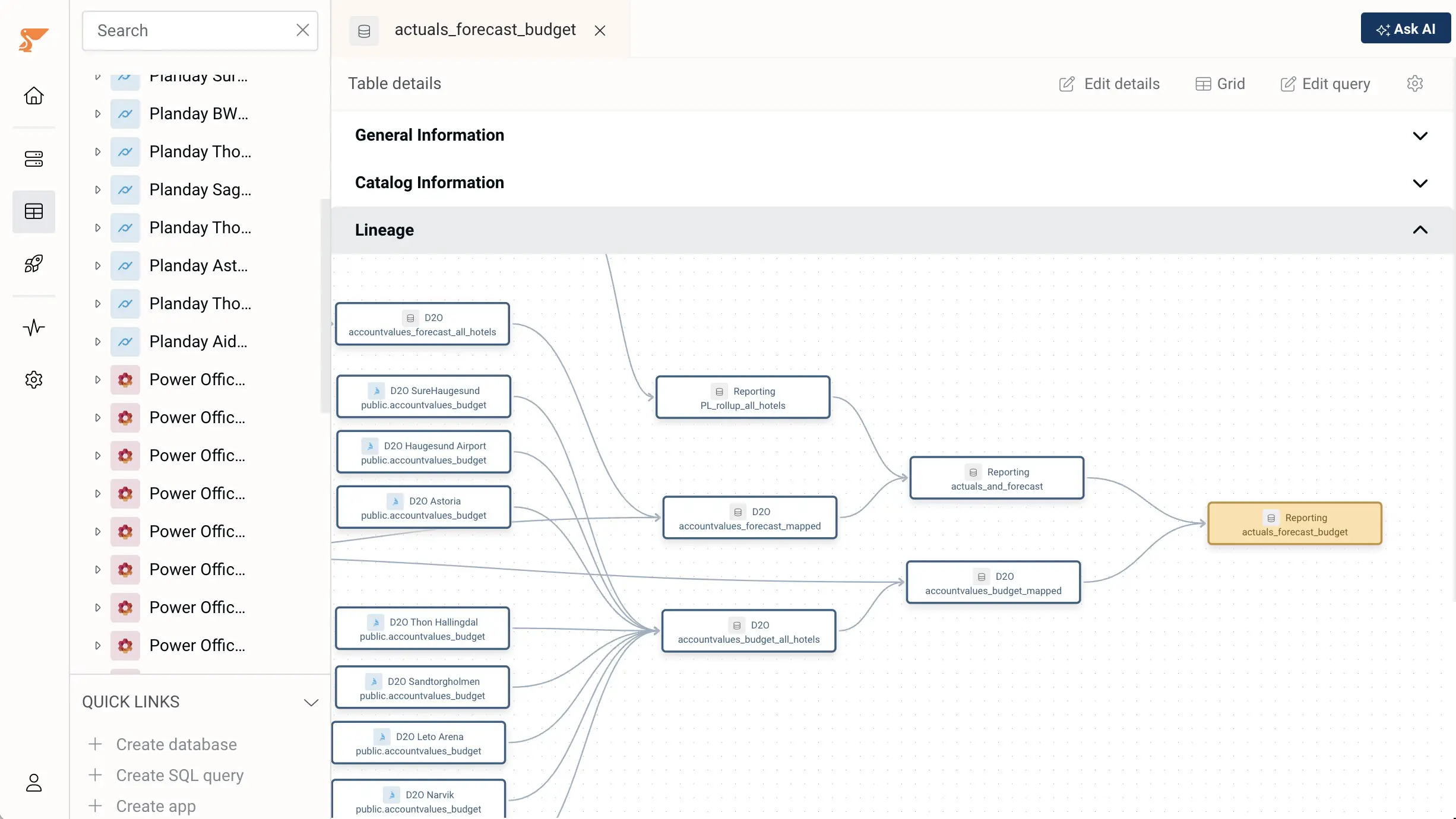
Where the data resides doesn’t change. Peliqan also doesn’t interfere with the applications, dashboards, or AI applications that companies want to use. Everything in between, however, is taken care of by the company.
Hundreds of Connectors
Peliqan relies on hundreds of connectors. With these, the data platform builds bridges to the places where the data already resides. Companies don’t need to perform large migrations: data can be stored in the cloud and on-premises. Even when the data lives in multiple spreadsheets in SharePoint or sits in a Google Drive, that’s not a problem.
Of course, there are also connectors to other suites. “Exact Online is popular in our region,” Rappelet knows. With Teamleader, Odoo, and Afas, other local SaaS solutions are also served. It goes without saying that suites from multinationals like Salesforce are also part of the connector range. In most cases, a connector is already on the list, but if it’s not, Peliqan will add one. “We take care of that engineering.”
(Sometimes) Zero Copy
Data synchronization happens in two directions, both via ETL connectors and direct connections via zero copy where possible. “In recent months, we’ve been actively working on RAG connectors,” Rappelet adds.

If data is not suitable for zero copy connection, it is typically copied to the cloud. “For this, we principally work with AWS,” says Rappelet. “But an on-premises deployment of the platform is also possible.”
Via the connectors and synchronizations, the data ends up in the Peliqan platform. There, Peliqan processes and transforms all data automatically. This creates a data warehouse, without the client having to worry about the complex work behind the scenes.
Foundation for Apps and AI
On top of this, SMEs can then build applications that use and link all their data, create dashboards to gain new insights, and ultimately build AI tools as well. Peliqan thus promises to somewhat level the playing field between SMEs and large companies with enormous budgets for data engineers.
The approach resonates, not just in Belgium. “Half of our customers come from the Benelux,” Rappelet knows, “but we’re now active in fifteen countries. Companies from all over the world find their way to us. We have more than 250 connectors out of the box. When someone in Venezuela googles how to connect Netsuite, they also end up at Peliqan. However, we have a slight focus on Europe.”
Competition with Snowflake and Excel
Peliqan competes on one hand with Excel and on the other with large data platforms like Microsoft Fabric or Salesforce Datacloud. Rappelet thinks Peliqan has a unique position.
The added value over Excel is clear, but he also sees advantages compared to data platforms from big players: “Companies that are active at the enterprise level have their focus there. That’s where the bulk of their economic value lies. Peliqan does have that SME focus. Parties like Snowflake and Databricks are competitors at a different level in that respect.”
Competing with Microsoft is of course not straightforward. “No one has ever been fired for choosing Microsoft,” Rappelet realizes. “But our solutions can coexist. Microsoft Fabric is good, but you need a data engineer for it. Our solution is really simpler. The CFO can delve into Peliqan and understand what’s happening.”
There’s no magic that goes brrrrrr and generates a financial report.
Piet-Michiel Rappelet, co-founder Peliqan
“Of course, some technical expertise is always needed,” he continues. “There’s no magic that goes brrrrrr and generates a financial report out of thin air. Someone does have to work with the data.” Rappelet wants to unlock that work for technically skilled profiles who don’t have a data engineer degree.
From India to a European Data Cloud
Rappelet and Peliqan have big European ambitions, but the founder nuances. “We don’t work exclusively in Belgium. Part of our company is in India. That’s a strategic choice for cost efficiency during the startup. Maintaining APIs and connectors is complex, but in a certain way also routine work. The talent pool is larger in India and the quality is similar.”
The founders, sales, and a part of the development are here though. “We will gradually bring more of that development to Belgium,” Rappelet adds.
Also regarding hosting, the link with AWS stands out. “We can deploy our technology anywhere. Are we going to proactively deploy our solution on OVH Cloud? Or do we wait until the first partner wants that? It’s a chicken-or-egg story, which is purely strategic. Technically, we can grow to become the first truly European data cloud.”