


Generative AI is becoming embedded in Flanders with 43 percent active users. This makes AI the fastest-growing technology since the rise of smartphones.
Three years ago, generative AI made its entry into our daily lives. What was initially received with suspicion is now almost indispensable in our daily operations. Language models such as ChatGPT, Gemini, or Claude gained popularity in no time.
43 percent of Flemings use AI tools at least monthly, according to the annual imec.digimeter, which maps the possession and use of media and ICT in Flanders. For this survey, imec questioned 3,001 Flemings.
Generative AI is most often used as an alternative search engine and for productivity gains, mainly in a professional context such as the workplace or in education. Enthusiasm seems to have increased, although concerns surrounding this technology are also growing.
Fastest adoption ever
Flanders has embraced AI at a rapid pace. 43 percent of Flemings use AI tools at least monthly, compared to 28 percent last year. Of those, 11 percent use generative AI daily, and 21 percent weekly. This makes generative AI the fastest-integrated technology in Flanders. Only seven percent are unfamiliar with generative AI.

“We can state that generative AI has definitively become a thing of the Flemish masses,” according to imec. This is also evident from the diffusion pattern of generative AI. Diffusion theory states that there are two critical points. The first point is around 13–17 percent, where the technology has reached the innovators and early adopters. From 40–45 percent, we are at the point where the technology is definitively embedded in the mass market.
Generative AI has definitively become a thing of the Flemish masses.
The rapid diffusion pattern for generative AI is clearly visible in the graph above. According to these figures, generative AI has already reached the mass market after three years, while smartphones, Instagram, and Netflix needed five years or more for this. After seven years, TikTok has still not reached that point.
Alternative search engine
Flemings use generative AI primarily to find information faster and work more productively. For instance, 79 percent of active users indicate that AI saves them time, usually up to half an hour per day.
Many people also use AI as a new kind of search engine: 64 percent use generative AI to get answers faster, for example, with practical problems, administration, or news. In addition, AI helps with productivity tasks such as writing texts, translating, summarizing, or asking for advice, while 55 percent of users indicate that the technology also allows them to do things they couldn’t do before.
Agentic what?
Almost everyone in Flanders (95%) knows ‘generative AI’, although three-quarters (74%) of respondents indicate they are able to explain the concept. For the remaining quarter of Flemings, we would like to explain it once more. Generative AI creates content based on a question you ask, also known as a ‘prompt’. Your question can contain files including images or reports. The AI responds to that question but does not take any actions itself.
Agentic AI, on the other hand, goes a step further: it can independently take steps and perform various tasks to achieve a specific goal. 25 percent of Flemings are familiar with the concept, but only ten percent say they can actually explain the concept of ‘agentic AI’.
Students as heavy users
The research shows that students are quick to embrace the technology: 91 percent have already used generative AI for studies and 81 percent use it actively for school purposes. Many students use AI intensively: 68 percent at least weekly and 21 percent daily. For 15 percent, this happens via a paid premium account. In addition, 71 percent of students say that AI helps them understand difficult subject matter faster.
At the same time, 81 percent active users means 19 percent non-active users. “So we see a gap in use, but also in access. Opposite the 15 percent of students with access to a premium generative AI application, there are also 22 percent of students who cannot afford it financially. The chance that gaps and paradoxes will also develop in the field of AI, parallel to the smartphone and social media, seems real,” according to imec.
In the workplace
Usage is also growing rapidly in the workplace. 70 percent of employees have already used or experimented with generative AI at work. 51 percent use it at least monthly, 38 percent weekly, and 14 percent daily. Many users see concrete benefits: 41 percent notice a gain in quality and 45 percent say that AI helps to complete tasks faster.
Free versus premium
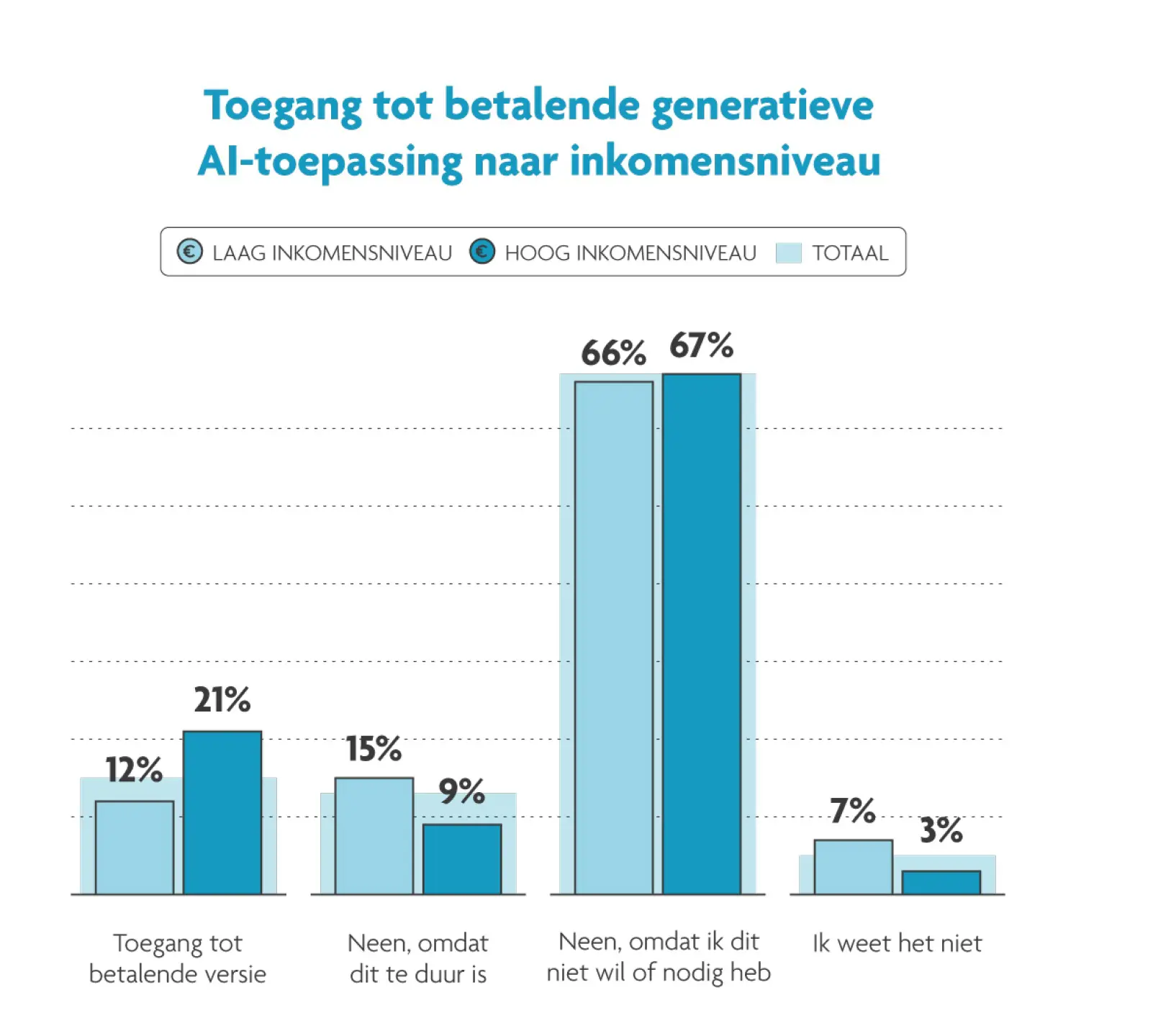
Although generative AI platforms have a decent free version, more and more Flemings are turning to paid premium access. This even involves a doubling (15%) compared to last year, with a significant difference based on income level.
“Within households in higher income categories, 21 percent have access to a premium account, compared to only 12 percent in the lower income categories. Opposite the 15 percent with paid premium access, there are also 13 percent of Flemings who find it too expensive.
The rapid rise of generative AI is also accompanied by a skills gap. Some users use the technology strategically for productivity and information processing, while others struggle to understand the possibilities or use them correctly.
Concerned (young) Flemings
Flanders remains predominantly positive about generative AI. “The camp of AI-positives is growing (34%) for the second year in a row faster than that of the AI-pessimists (23%). So ‘familiar’ certainly doesn’t automatically mean ‘loved’ for AI either, but it (for now) still enjoys the benefit of the doubt,” the report states.
Enthusiasm and wonder about AI are stagnating, but at the same time, concerns are increasingly surfacing. “Especially among young people, the peak in that enthusiasm seems to be over,” according to imec.
Among young people, the peak in enthusiasm seems to be over.
80 percent of Flemings are concerned that they will no longer see the difference between what is made by a human and what is made by AI. Furthermore, 58 percent are annoyed by AI-generated content they are shown involuntarily. And also in the conviction that AI will ensure that we can work faster and more efficiently, the stagnation at the population level (53%) stands in contrast to the decline among 18-24 (66%) and 25-34 year olds (63%).
New challenges
In a short time, generative AI has conquered a permanent place in daily life in Flanders. With 43 percent active users, the technology has broken through to the mass market in a few years and is increasingly being used as a tool for information, study, and work.
At the same time, there is a growing realization that this rapid adoption also brings new challenges, such as differences in access, skills, and use. Especially among young people, the initial enthusiasm seems to be gradually giving way to a more critical attitude. The technology promises clear efficiency gains but also raises questions about reliability. Generative AI thus becomes not only a powerful tool but also a technology that forces society to think about how we want to deal with it.