


Cisco and OpenAI are jointly launching a new security solution: Shirudo. The open source project uses AI to continuously defend systems, but also to harden them against AI attacks.
Shirudo is not just Japanese for “shield”, it is also the name of a new open source project launched by Cisco together with OpenAI. Shirudo protects Linux systems in real time , constantly searches for new vulnerabilities at the level of the operating system’s kernel and tests them.
Infrastructure that defends itself
“With Shirudo, we are introducing self-defending infrastructure,” explains Sunil Potti, SVP and GM Security, Observability and Data Platform at Cisco. He believes that is necessary: “Security and AI are the topic of our lives.”
Potti notes that AI is an outlier compared with other technology. “For trains, planes or the cloud, the rule was that every time the technology improved, safety improved with it. For AI, the opposite is true. With every new frontier model, the risk vector only gets bigger.”
In that context, the digital world is heading for the abyss: AI breaks through security, and while teams do their best to block an AI attack wave, a new, more advanced successor is already waiting.
The pace has to go up
AI has already shortened the time between a patch and active exploitation of a flaw from months and weeks to days and now even hours. Models find zero days that humans have overlooked for years, and criminals immediately know what to do with them. According to Cisco, defence at the pace of human action is reaching its limits.
Shirudo is meant to answer that problem. The open source project integrates AI on the defensive side. That is not new in itself: cybersecurity has relied on AI since well before the generative AI hype. The way it does so is innovative, though: Shirudo introduces an AI-driven loop in which an environment is permanently evaluated, tested and, if necessary, patched, at the pace of AI.
New approach
Shirudo uses eBPF for this. That Linux technology lets small programs run in a sandboxed environment inside the operating system’s kernel, without changing the kernel’s source code or requiring the machine to restart. Such a program hooks into an event, such as a system call or an incoming network packet, and can monitor or block the kernel’s behaviour at that point. A verifier checks before loading that the program cannot crash the system. Engineers from Isovalent, which Cisco acquired earlier, helped lay the foundations of eBPF.
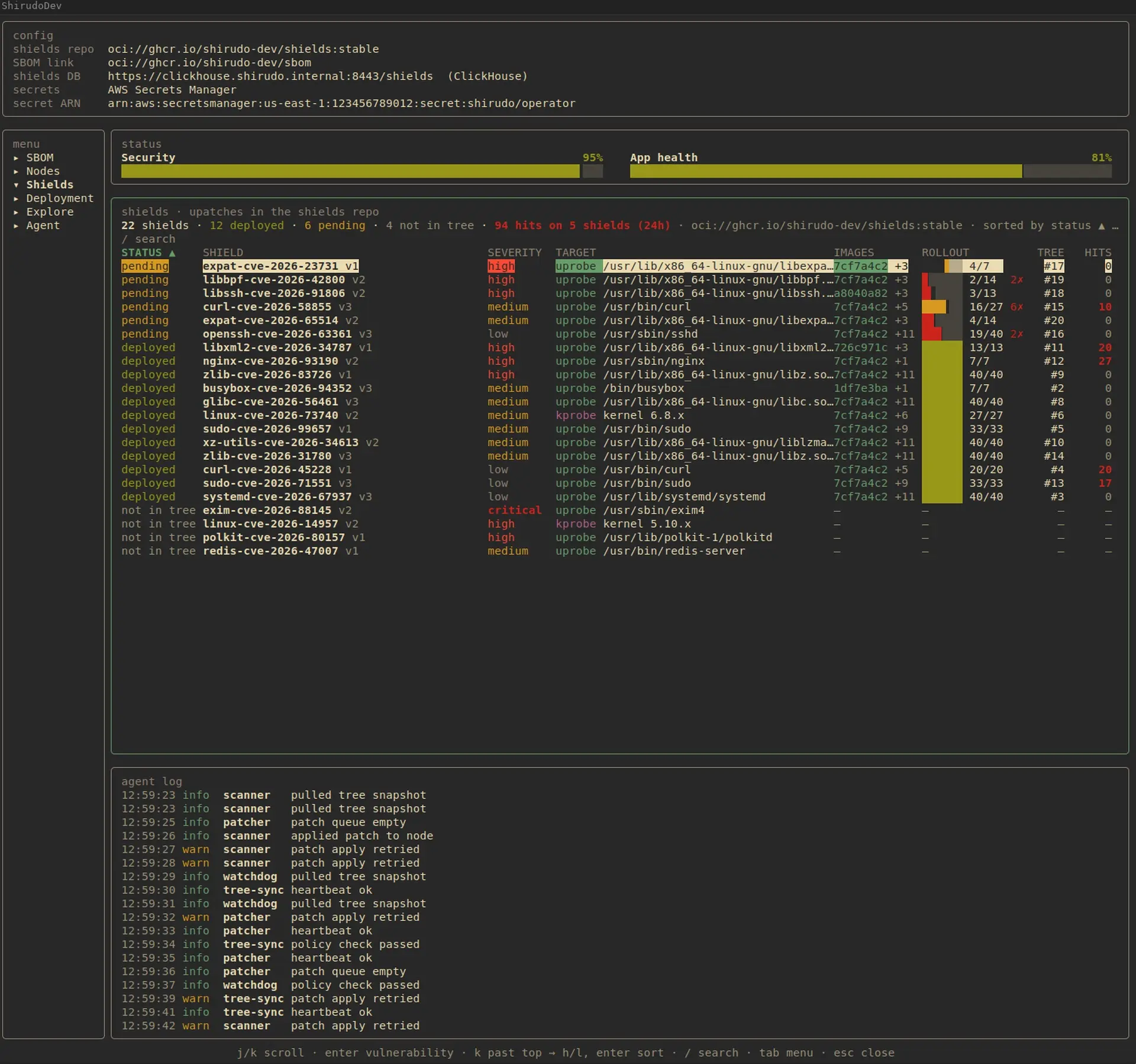
An agent in user space, outside the kernel, taps events from the kernel and passes them on to the AI-driven loop in the control plane. That loop also receives source code and threat intelligence, such as vendor notifications about new flaws. For each vulnerability, the agents work out which systems are affected and which route an attacker takes to get in. Then they write a small shield that blocks the vulnerable code path, plus test cases to check that shield.
Agents are non-deterministic and goal-driven. They will absolutely find other mechanisms.
Sunil Potti, Cisco
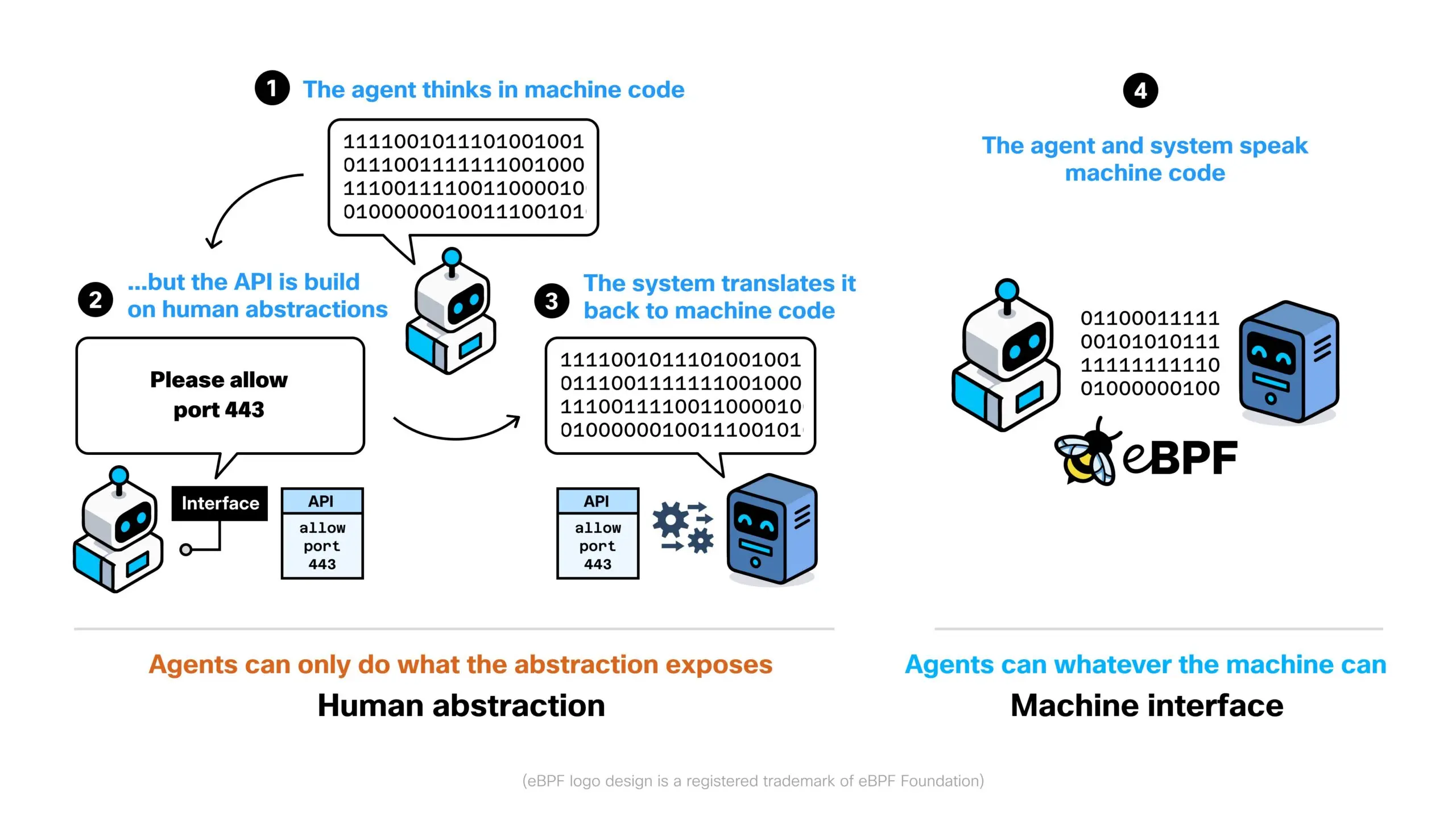
Today, a sensor collects data and applies a simple allow-deny list of policy rules, which is also what Cisco itself does. Shirudo is meant to change that: “You change the behaviour of your security and control layer dynamically and let it improve recursively, depending on what happens in the environment,” says Potti. That is necessary, because AI agents do not follow fixed paths. “Agents are non-deterministic and goal-driven. They will absolutely find other mechanisms. Security has to improve faster than whatever agents can come up with to achieve their goal.”
Shirudo tests every shield
Every shield first goes through a test. The agents recreate the attack and check whether the shield stops it and whether the service keeps running. Only once that is proven does the shield start actively blocking, without a restart. Against Java4shell and a recent PHP vulnerability, Shirudo wrote code in this way that detects and blocks attack attempts. As soon as the definitive patch is available, the shield disappears again. “It continuously delivers virtual shields on demand, while you buy time to roll out the real patch,” says Potti.
A first model generates the test cases, a second model acts as judge and a human keeps watch, Potti explains. He expects test environments to be added, with a digital twin of the runtime in which validation takes place offline before a shield goes into production. Every shield is also cryptographically signed. The host checks the signature before it runs the shield, even if an attacker already has administrator rights.
Shirudo rests on an observation about how security works: security systems are essentially designed for humans. AI agents can act directly in the code, with superhuman speed and precision, without the delay of a human interface. Cisco does stress that it does not want to replace security teams: humans set the boundaries within which the agents work.
Open source
Shirudo is open source and available on GitHub, under a BSD-2-Clause licence. The project is still in the pre-release phase. Cisco and OpenAI are asking developers, researchers and companies to contribute tests that reproduce vulnerabilities, to try out shields on their own kernel versions and to report where a shield blocks legitimate traffic. According to Potti, more than 500 people have already signed up.
Cisco does not mention a price or a paid version, but Potti does reveal something about the revenue model. Cisco already uses Isovalent’s eBPF technology in Hypershield and Live Protect. “As we expand Shirudo’s capabilities, integrations in the network will be how we make money from it, in the next generations of Live Protect and Hypershield,” he says.
The need is there
Shirudo looks like a worthy attempt to make the cyber defence of infrastructure work at the same pace as attacks. That is necessary, because AI plays a role in just about all attacks today, complex or not.
Just this week, a hacker with little technical knowledge made off with the data of more than a million Flemish residents. The hacker, a term used loosely here, let an autonomous AI agent based on DeepSeek do the work. The agent wrote its own scanners, exploits and scripts and, after 1,801 prompts, obtained personal data on residents of 82 Flemish municipalities, some 1.2 million people in total.
In this case, the data was poorly protected: it was stored unencrypted and jumbled together on a single server of a service provider, with an admin interface exposed openly on the internet behind a weak administrator password. This case mainly shows how much easier it is to exploit problems now that shady characters can enlist AI for their cause.
The figures speak for themselves: between 1 January and 28 September, the Centre for Cybersecurity Belgium (CCB) received 588 reports of cyber incidents, more than the 556 for all of 2025. Geert Baudewijns, CEO of Secutec, has seen “an enormous increase in incidents” in recent months and attributes it entirely to AI. “Today it actually takes only four hours before a CVE can be exploited,” he told us earlier.
Welcome capacity
With Shirudo, Cisco is unleashing a new kind of security solution on the world. Whether the shield will provide relief against the AI threat remains to be seen. What is certain is that extra capabilities on the defensive side are welcome to block the barrage of AI-driven attacks.