

From vulnerability to exploit in ten hours, and agents that burn through tokens: this is the new reality now that AI dictates the pace. The foundation you build on matters more than ever, according to Red Hat.
You won’t stand out in a red hat at Red Hat Connect in Brussels. Jeff Lo, VP Portfolio, takes the room back to the moment when, in his view, the rules for software changed drastically. He doesn’t have to go far back in time for it: he speaks of a ‘Mythos moment’, referring to Anthropic’s notorious AI model.
“AI is becoming the new standard for development and applications. Far more code is being pushed through your pipelines, and much faster. But the infrastructure can’t keep up.” That has implications for security: “Going from CVE to exploit now takes less than ten hours. It used to take months to years.”
Patches can’t keep up
According to Lo, the biggest problem is not how fast AI is used to discover vulnerabilities, but how slowly patches are applied. “Components that are no longer maintained create a vulnerability gap. No single team or product can maintain everything. On average, companies need 45 to 90 days to roll out patches. That is far too long.”
Lo wouldn’t raise this if he didn’t believe the solution lies in his employer’s portfolio. Red Hat wants to narrow the ‘patch gap’ with Lightwell, an initiative launched with parent company IBM to release patches for open source code faster, including outside its own products. Since the launch in June, Red Hat claims it has been able to catch more than 400 previously unknown vulnerabilities.
Stef Schampaert, country manager of Red Hat for Belgium and Luxembourg, sees hackers finding vulnerabilities faster than companies can patch them. “That gap has to be closed.” For Red Hat, the project also serves as a way in with customers. “Security is part of our products. Lightwell is a good project for getting in the door with CISOs,” he adds.
The POC lie
The rapid rollout of AI also creates a maintenance problem, he says. Lo: “Thousands of agents in production is no longer unusual, and maintaining them is the hardest part.” Red Hat puts forward Ansible for this, with automation that responds to events. “Nobody wants to just let agents do their thing.”
Schampaert sees the same principle growing among customers. “Standardise and automate before you innovate. You don’t simply trust AI.” After a period in which AI was viewed too broadly, growth is only coming now, he says. “Business applications with AI are reaching larger companies, and those need to land somewhere. Companies are moving from playing with POCs to adoption at cruising speed.”
Guest speaker Philippe Jäggi of the Luxembourg IT company DEEP believes companies must stop running endless pilot projects as soon as possible. “A POC is lying to yourself. You only do what is fun, not what is hard,” he judges sternly. He argues for governance and a return to the good habits of software development. “AI is not stable: you can’t call anyone when it crashes. Sorry to say it, but we need to be ‘boring’.”
A POC is lying to yourself. You only do what is fun, not what is hard.
Philippe Jäggi, Head of Business Line Cloud DEEP
The price of tokens
In his keynote, Lo also talks about ‘tokenomics’, a new buzzword for the rising cost of AI. “Anyone using AI models from an external provider pays for input and output. That is easy at first, but over time it becomes a problem. The price per token is falling because inference is becoming more efficient. The problem lies in consumption: complex reasoning makes token costs explode.”
Sonet Popathal, who heads Intel’s data centre business in the EMEA region, says AI agents consume ‘up to a thousand times more tokens’ than classic AI applications, a figure she takes over from CEO Lip-Bu Tan. “To keep costs down, companies need to orchestrate memory and workflows well and spread the work across CPUs and accelerators, with the right ratio between CPU and GPU.” Intel naturally prefers customers to buy more CPUs from them rather than phoning Jensen Huang for GPUs.
According to Lo, companies should therefore evolve from consumer to provider and get their models and infrastructure under control. He argues for a hybrid approach with free choice of model. “The most important question remains the same: what do you build on? Without a reliable foundation, there is no reliable AI.” “A good foundation gives you choice,” Schampaert adds.
Cloud is not cool
That opens the way for the speakers to raise another popular theme: sovereignty. “Sovereignty is control: who do you entrust your data to and how is it processed? Three hyperscalers own 63 percent of the world’s cloud infrastructure today,” says Popathal.
Jäggi links sovereignty to the ability to leave. “Trust means giving customers the option to leave. Freedom of choice is true sovereignty.” He argues for ‘open borders’ for software and a consistent stack across multiple environments.
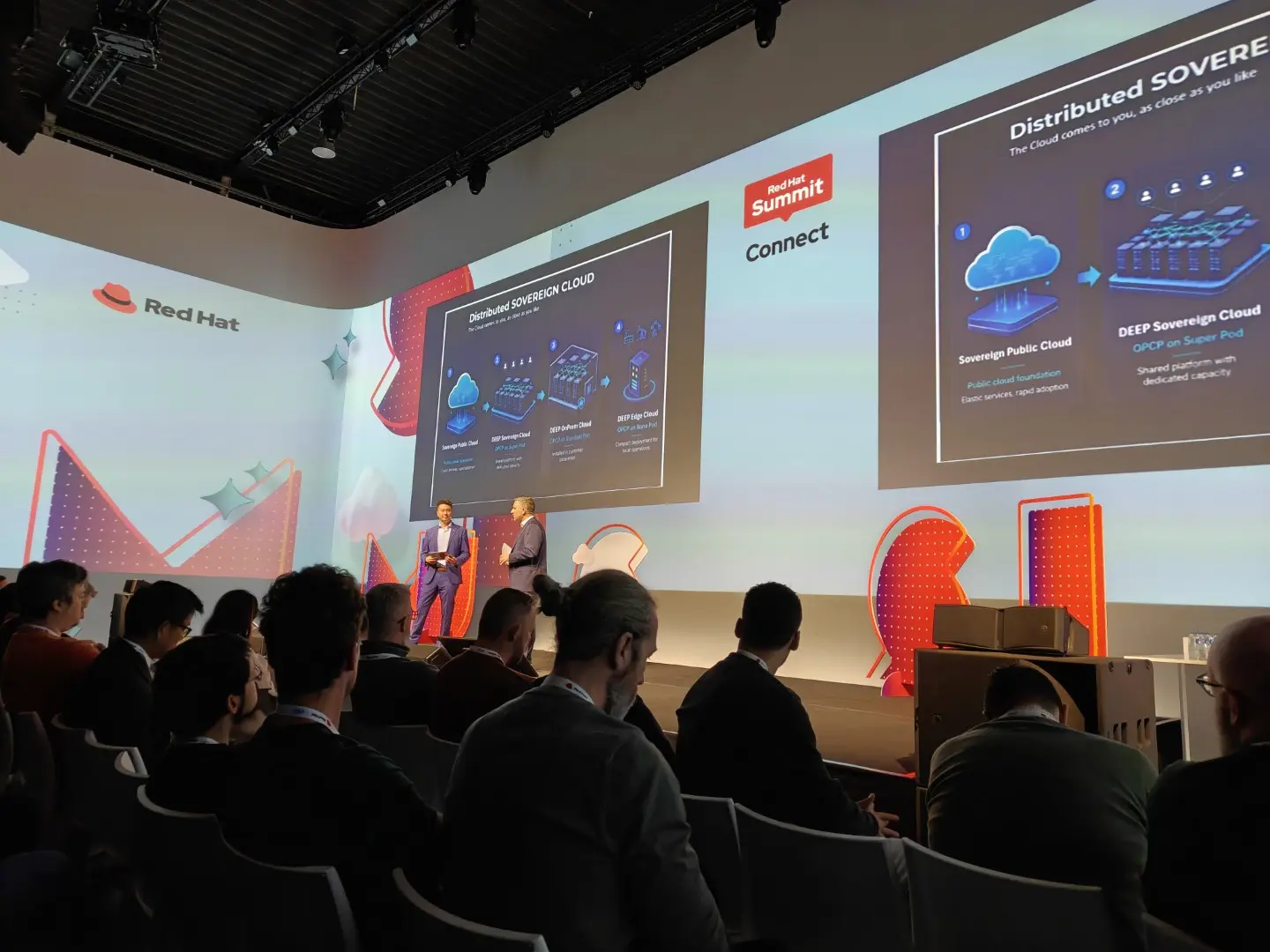
That freedom of choice does mean the right choices have to be made. “Global marketing campaigns don’t need to run on a sovereign cloud. Sometimes I see small customers wanting big GPUs that they don’t need at all. The cloud is not ‘cool’, it just gives you computing power.”
Lo distinguishes between data sovereignty within legal borders and operational sovereignty. By ‘operational’ sovereignty he means the ability to run AI wherever you want, with security and compliance built into the platform, and the option to switch when circumstances change. According to Lo, open source provides the transparency and control needed for operational continuity.
Not as hot as it looks
According to Schampaert, the shift to open source is an important step towards sovereignty, “especially in a world where we don’t always work together so well anymore. We sometimes forget ourselves how important open source is for what we do. It is the key to collaboration where the best ideas win, regardless of where they come from. Red Hat has poured an ‘enterprise sauce’ over it, so that companies are no longer afraid of open source.”
According to Schampaert, the fact that Red Hat has been under the wing of IBM, an American commercial company, since 2019 changes nothing about its belief in open source. The controversial move three years ago to no longer make the source code of Red Hat Enterprise Linux fully open source sowed doubt about the direction the company wants to take. “It’s not as bad as it sounds,” Schampaert counters.
Red Hat positions itself as an open source services company, with IBM as its software partner. Schampaert: “We have no IP. We harden the code to deploy it securely and give everything back to the community. We could just as well have no nationality. It is your code, not ours.”
He doesn’t see everything being replaced by European alternatives. “Ninety percent of all the software we use in Europe is American. It is impossible to replace everything with European vendors. Open source matters much more than where technology comes from. Openness is sovereign by definition.”
A dig at VMware
In his argument on sovereignty, Lo takes another jab at a company that today stands squarely opposed to freedom of choice. “The fuss around Broadcom and VMware is not an infrastructure problem, but a platform problem. Questions about chips, servers, cloud, applications and AI come together in an open hybrid cloud. The answer is freedom of choice.”
Red Hat gets its biggest growth from OpenShift, Schampaert notes. “We are only at the beginning. Discontent with VMware among customers and partners is a reason to switch to OpenShift Virtualization. Customers are looking at what options they have.”
Schampaert acknowledges that OpenShift is not a one-to-one replacement for VMware. “That’s why it isn’t always the first thought, but a movement has started. The switch requires a migration process. OpenShift exists as an application, virtualisation and AI platform. Where a customer runs its applications makes no difference to us: Red Hat works with hyperscalers and with local providers.”
In Belgium and Luxembourg, Red Hat wants to work closely with partners to bring virtualisation and AI to cruising speed. “There are many new developments in the market. The real growth in AI is only coming now. Automation was initially viewed too broadly, but it is now landing in business applications at large companies.”
Open source matters much more than where technology comes from. Openness is sovereign by definition.
Stef Schampaert,