


Nearly 7,000 conversations with Meta’s AI assistant Muse were visible via the public internet, including conversations containing sensitive corporate data. The fault lies with Meta, but it highlights the risks of Shadow AI.
Muse, Meta’s personal AI assistant, is reportedly “built from the ground up for privacy and security.” That is what Meta CEO Mark Zuckerberg claimed at the launch of the personal AI assistant. It now appears that the construction of all that privacy and security never actually got off the ground as Zuckerberg intended: data from at least 6,800 private conversations were publicly accessible due to a design flaw in the tool.
This concerns conversations that users chose to share with others on their own initiative. In such cases, Muse generates a unique URL, and anyone who clicks it can view the conversation. This is not an inherently insecure system: complex URLs used for private purposes do indeed offer good protection against unwanted eyes.
Shareable URL
However, Meta failed to build such a secure URL system. Instead, Muse’s shareable URLs were generated in a way that was easy to discover.
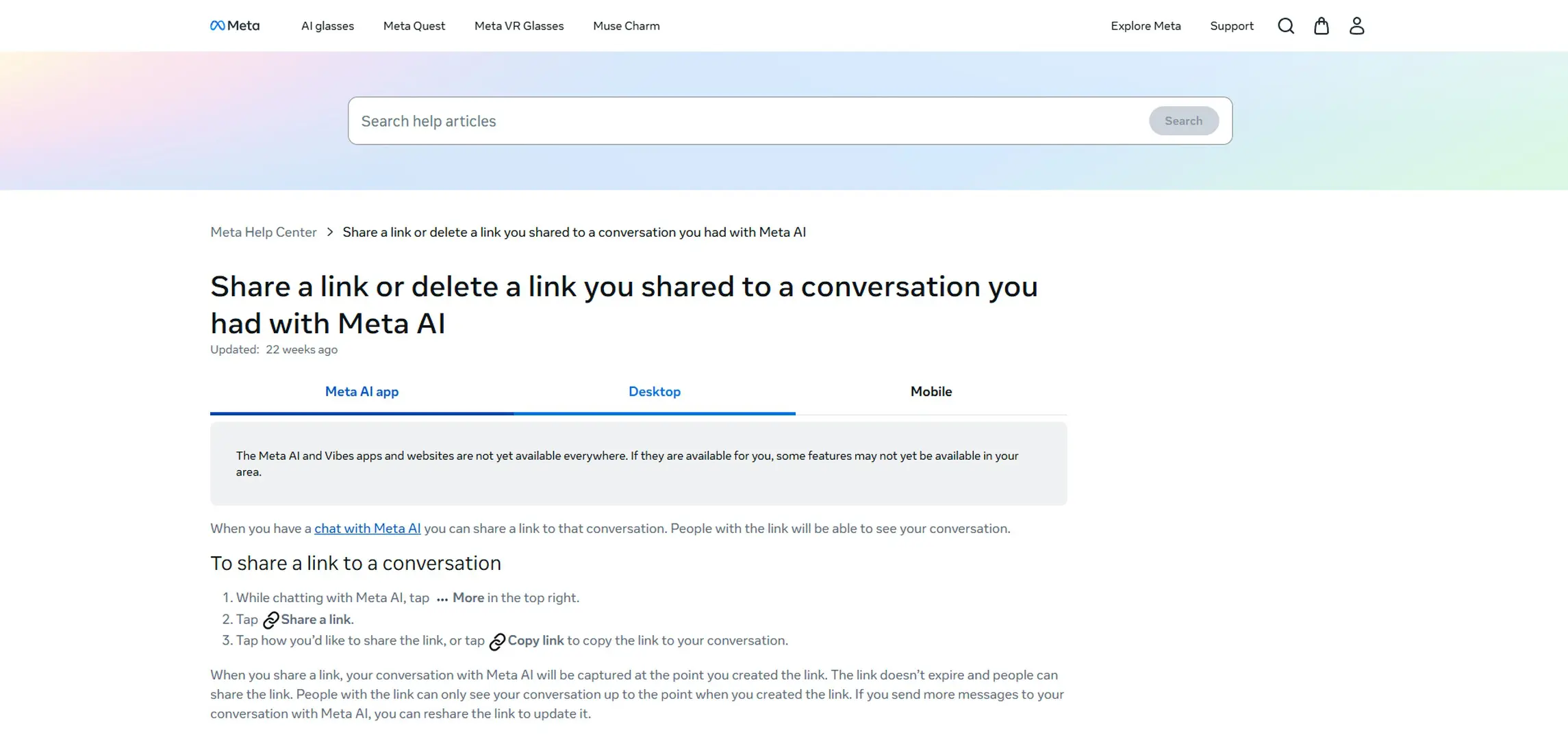
When a user asks Muse, Meta’s AI agent, to share a conversation, Muse places that conversation on its own webpage and the user receives a link to forward, as expected. Anyone with that link can view the conversation without logging in, and the link never expires. The address of the page in question consists of the conversation title plus a random code (for example, home-sale-budget-9f21c8a3.cf.metaaiusercontent.com). That code was supposed to ensure that no one could guess the address.
Guessing, however, is not the problem: when the recipient opens the shared link, the computer first asks a DNS server at which address that domain name can be found, similar to looking up a number in a phone book.
Forgetting passive DNS
Companies providing passive DNS collect all those lookups in a searchable database. This can be useful for security purposes, for instance, as it creates a traffic log linking addresses and domains as they were during the lookup. Security researchers from Claroc searched such a commercial database for all domain names under the Muse domain. This provided them with a list of more than 6,800 shared conversations, each with its title included.
If you had asked us beforehand, we would have bet that gathering this data would take real effort. We only needed one query.
Claroc
Guessing or cracking was not necessary: they opened the addresses in a standard browser and the pages loaded immediately. They viewed several hundred of them. “If you had asked us beforehand, we would have bet that gathering this data would take real effort,” say the Claroc researchers. “But we only needed one query.”
Trade secrets
Based on a sample, the researchers indicate that most conversations were relatively harmless, but not all. They found personal data, including internal business documents, such as the preparation for a confidential meeting with managers of a major AI company. They also found financial data from a large marketing firm, and the holiday schedule for all employees of another company.
To be clear, this massive privacy bug has nothing to do with the inherent safety or lack thereof of AI technology. It is a design flaw. While Meta and Zuckerberg claimed they built Muse from the ground up for privacy, a critical mind might ask whether Meta even knows how to build anything with privacy as a core value. This bug certainly suggests they do not.
Meta has paused the chat-sharing functionality for Muse in response to the researchers’ revelations. The company is now investigating how to make the sharing functionality more secure.
Shadow AI
Sharing corporate data (and personal data) with an AI assistant is not without risk. The data ends up with the company behind the assistant. That company must then implement adequate security. Meta failed to do so.
Responsibility also lies with the users who shared sensitive data with the AI assistant, presumably not always with the knowledge or approval of their company. Widely available AI tools simply do not meet the same requirements as enterprise-certified solutions.
Nevertheless, so-called shadow AI has become commonplace, including here. For instance, we recently saw figures from Secutec’s SecureDNS. These showed that the ChatGPT domain was the most requested of all (followed by several other AI tools and social networks). This means that employees of companies connected to the DNS service are visiting ChatGPT en masse.
Blacklist
However, many connected companies work with Microsoft, yet Copilot ranks much lower. This implies that employees are visiting an AI service of their choice on their own initiative. The data and conclusions come with a caveat: we do not know the exact policies of all DNS users; ChatGPT is not necessarily on a blacklist. Presumably, however, Meta’s Muse was not on a blacklist at the affected organizations either.
AI assistants are IT tools with which users very easily share highly confidential information. Both companies and users should pause to consider this before getting started: how is the tool secured? Which company owns the AI assistant? Is it a European or an American player? And does the provider of the AI tool in question have a solid reputation regarding privacy?