

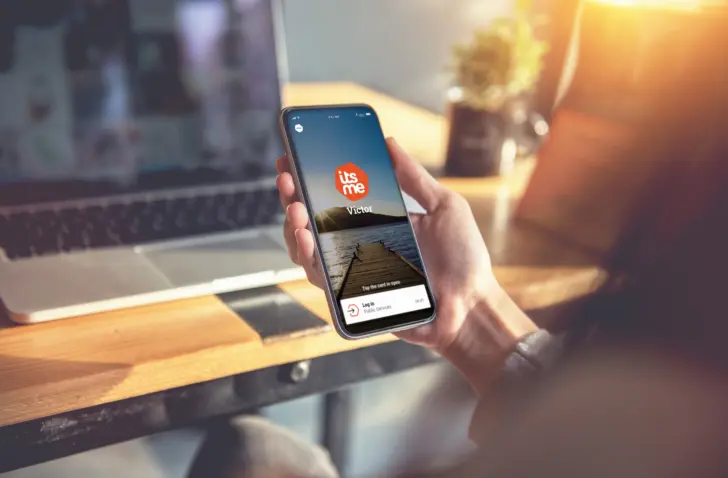
Eight million Belgians use itsme to log in to government websites or banking applications. But what happens to your data? itsme is less sovereign than it seems.
The mobile application itsme is now deeply embedded in the digital fabric of our society. This year, it reached the milestone of eight million users in Belgium and is making the move to the Netherlands. Governments, banks, and telecom operators have widely embraced itsme.
itsme is easy to use and offers a uniform experience for logging into various digital services. Multi-layered security is designed to ensure that your itsme account cannot be easily hacked. Your account is linked to your phone and further secured with a PIN, and the connection to services you log into runs through an encrypted connection. But what else lies behind the app? Being secure is not necessarily synonymous with being sovereign.
Wake-up call from the Netherlands
They know this all too well in the Netherlands. DigiD, a competitor to iDIN and now also to itsme in the Netherlands, was indirectly threatened by American influence late last year. Former IBM subsidiary Kyndryl was eyeing Solvinity, the company that manages the infrastructure for DigiD and works with various government agencies. The Dutch government, owner of DigiD, was not in favor of this, and after many rounds of debate, it was decided to block the takeover.
It should come as no surprise, then, that the acquisition of iDIN by itsme is under the microscope in the Netherlands. In Belgium, we use itsme daily without really asking ourselves who or what is behind the application. Now that digital sovereignty is high on the agenda in Belgium and Europe, perhaps we should start asking those questions.
Who owns itsme?
itsme was launched in 2017 as the result of a collaboration between the banking sector (Belfius, BNP Paribas Fortis, ING, and KBC) and the telecom sector (Proximus, Orange, Telenet). The application is officially housed within the company Belgian Mobile ID. Five years ago, the government bought in for 14.5 million euros via the Federal Participation and Investment Company, gaining a twenty percent stake in itsme.
Like any privatized company, Belgian Mobile ID pursues commercial goals. In a response to ITdaily, it explicitly states that shareholders do not have access to itsme data, but it remains unclear to what extent they influence the strategic and technological course.
What data does itsme store?
As a trusted authentication app for eight million Belgians, itsme possesses a significant amount of citizen data. The company is not secretive about this: when creating your account, you must agree to share data such as your name, phone number, and national registration number. If you quickly clicked ‘agree’ without knowing what you shared, you can consult itsme’s privacy policy here.
If you link itsme to your bank account, those identity details are also shared with your bank. itsme explicitly promises that it shares no more data than necessary, and only with your consent. Your data is also not used for advertisements or to serve other commercial purposes, as stated literally in the privacy statement.
itsme is not allowed to lie about this either. As a European provider of electronic identification, it is bound by various European regulations, such as eIDAS, PSD2, and the GDPR. Under these legal guidelines, it may store your data for a maximum period of ten years.
Where is that data stored?
In the context of sovereignty, this is the million-dollar question. We asked itsme ourselves and were told that the infrastructure runs ‘primarily on Azure’. This is again no secret: those who look will find technical information about a configuration with Azure B2C, a cloud tool for identity management in mobile applications, and itsme can also be found in the Azure Marketplace.
Itsme explains that the choice for Microsoft was made based on an extensive technical and legal analysis. Microsoft’s ‘holistic vision on security, trust, and data processing within the EU’ was the deciding factor. The Belgian company Codit, a subsidiary of Proximus NXT, was the Microsoft partner for Belgian Mobile ID. In a reaction to this article, Itsme stated that this collaboration ended in 2023, and the expertise is now managed in-house.
A technical blog from AWS might give the impression that itsme is also with Amazon’s cloud division. This interpretation was made by ElioVP, a Belgian company providing HPC services, which saw it as a good reason to ditch itsme. itsme refutes this: the blog discusses nothing more than an integration possibility with Amazon Cognito, AWS’s authentication technology.
To be clear: AWS is not a cloud partner of itsme. The infrastructure does not run in the AWS cloud, so your itsme data is not with AWS. However, that does not change the fact that with Microsoft, itsme has chosen a non-European cloud provider.
Is that a problem?
That depends on the lens through which you view it. For the average user, it doesn’t matter much. Microsoft invests in European data centers and has had a cloud region in Belgium since last year, although itsme does not clarify which Azure region it utilizes. The GDPR also applies to Microsoft: it cannot simply remove your data from the European Union.
As a US entity, Microsoft is also bound by US law. The US Cloud Act positions itself above any local or regional law. The legislation stipulates that the US government and intelligence services may demand access to data in data centers as part of, for example, a legal investigation, even if they are not on US soil.
Cloud providers like Microsoft emphasize that this is primarily a theoretical risk and that they have an arsenal of technical and legal means to combat such rare requests. We recently had an extensive conversation with Frank Callewaert from Microsoft Benelux about this. But Microsoft itself admits that, when push comes to shove, it cannot promise complete sovereignty.
itsme does not see this so much as a concession on sovereignty. It explained to our editorial team that Microsoft cannot access personal data. “The real compliance issues are about architecture, not about which infrastructure,” it said in a statement. However, this does not 100% eliminate the theoretical risk of the Cloud Act.
The European Union’s Cloud and AI Development Act asks governments and sensitive sectors to consider all legal risks when choosing a cloud provider. Although not explicitly stated, this is essentially an argument against non-European providers.
New challengers
For a long time, there was no full-fledged alternative to itsme. The app had a monopoly on the Belgian market, partly facilitated by the government. That same government suddenly put forward its own MyGov app last year as a challenger to itsme. Loyal IT partner Smals handles the link with government services and documents at the backend of the application, but the management and the authentication component are fully the responsibility of the FPS BOSA.
The difference with itsme is that MyGov keeps data locally on your phone and does not send it to a central database managed by the government and/or partners. The Belgian government is a fervent user of Microsoft technology, although there is no proven link between Microsoft and the app. Smals, for its part, recently announced that it would be collaborating more closely with Google Cloud.
In 2026, a third challenger was added: Smart-ID. The originally Estonian application is officially available in Belgium since March after a years-long struggle. Smart-ID may not be Belgian, but it explicitly plays the sovereignty card. It manages its own infrastructure entirely by itself and on European soil, and is completely independent of major cloud providers. Whether that promise can convince the Belgian public remains to be seen.
A previous version of this article stated that an Itsme account is linked to a phone number and SIM card, which would enable a bridge between the application and network layers. Although the ambition to achieve that SIM link was expressed, Itsme points out that it was never realized.