

Dreaming about AI is one thing, rolling out the technology is another. At its World Forum, ServiceNow hangs its story on security, governance and the extensive capabilities the company has acquired and developed for that purpose over the past year.
At its World Forum in Amsterdam, ServiceNow builds on last year’s edition. AI is still front and centre, and the company remains convinced that it sells a platform that is ideal for rolling out the technology at enterprise level.
Unlike ServiceNow’s previous visit to our side of Europe, the focus on and off the stage is not on spectacular capabilities this time. Those are now almost taken for granted. “That was the focus last year”, confirms Alex Hendrikse, AI Product Manager. “Now we are looking a step further.”
Beyond the proof of concept
“Initially, the conversations were about trials and pilot projects”, explains Marielle Lindgren, Group Vice President EMEA North at ServiceNow. “But now the honeymoon period is over. When the conversation shifts to delivering in production, topics such as security, compliance and regulation take over.”
The honeymoon period is over.
Marielle Lidgren, GVP EMEA North ServiceNow
ServiceNow wants to respond to that, and over the past year the company has brought in the heavy artillery to launch a security offensive. The most notable move is the acquisition of Armis for 7.75 billion dollars, followed by the acquisition of Veza for 1 billion dollars.

A refresher: Armis discovers assets across IT, OT, IoT, medical devices, physical AI systems, code and cloud, and then bridges the gap between visibility and effective protection. Veza adds its Access Graph. This technology can map every access relationship between human and non-human identities across all systems in real time.
At the large Knowledge event in Las Vegas, ServiceNow already announced that it would bring the two acquisitions together in a new platform: Autonomous Security & Risk. At the Forum in Amsterdam, we see how these capabilities can be crucial for securing AI in enterprise systems.
AI as an asset
Yevgeny Dibrov, co-founder and former CEO of Armis, has led ServiceNow’s entire cybersecurity and risk division since the acquisition closed in April. He wants to build the largest cybersecurity platform in the world there.
“Armis is strongest in cyber asset management, vulnerability management, appsec and OT and IoT security. Veza brings identity security, and we combine that with what ServiceNow was already doing around security incident response, risk management and compliance”, says Dibrov. “That way we can address every asset and every identity.”
In the end, an AI agent is simply an asset too.
Yevgeny Dibrov, GM Cybersecurity & Risk ServiceNow
According to Dibrov, that fits what companies need now that AI agents are making their entrance. “In the end, an AI agent is simply an asset too. Only, agents can do much more, because they act on their own and have their own identity”, he says. “To understand and limit your exposure, you need to know every type of asset in your environment. You can’t forget anything. You also need to understand every identity, every access right and the role around it, and be able to deploy the right workflows and mitigation.”
On every agenda
ServiceNow therefore sees security as a crucial part of an end-to-end AI strategy. According to Lindgren, organisations that get governance, security and visibility in order can scale up safely.

“Security is on every agenda. I don’t have a single conversation in which it doesn’t come up”, she says. “It is also almost always the reason why someone doesn’t dare to scale up. Organisations have a good initiative and think they can generate revenue from it, but they wonder how to keep it under control and scale up safely. Those who get that right don’t need to let themselves be held back.”
Not through the open window
To tackle the security of AI agents in concrete terms, ServiceNow builds on the concept of identity that Dibrov already mentioned. It is striking how closely the company’s strategy matches the vision we heard earlier on the stage of the ISACA conference in Munich. There, Ben Hanson, Field CISO at Zenity, explained why an old way of thinking, based on a classic model of privileges alone, is not enough to monitor dynamic agents.
“That works for a human”, Hendrikse acknowledges, “but not for an LLM. If an employee doesn’t have the key to a door, they don’t assume it’s fine to enter the room through the window because it happens to be ajar. An AI agent doesn’t make that consideration.”
Passport control
AI agents therefore have to be kept in check in a different way. ServiceNow opts for a model built around an AI passport. That passport contains information about the purpose, the rights but also the limitations of an AI agent. On the World Forum stage, we see how an AI agent may automatically process customer refunds up to an amount of 25 dollars. That is part of the passport. If a payment request exceeds that, it is blocked.
Hendrikse explains how that works. The passport uses cryptography. What an autonomous agent has done can be checked afterwards in the platform. “But that is not enough”, says Hendrikse. “An agent may do things that you later say you didn’t want. You want to know and limit such things in advance.”
An agent may do things that you later say you didn’t want.
Alex Hendrikse, AI Product Manager
Besides rights and limitations, the passport records which identities the agent uses, what is ethically acceptable and which compliance rules and legislation it must adhere to. “That way you can’t prompt an agent to just ignore the AI Act.”
More than a self-check
Before the agent undertakes anything, it checks its passport every time. If the passport doesn’t allow the task, it doesn’t carry it out. Hendrikse calls it “a kind of reverse engineering of an audit trail, but proactive and including its enforcement”.
The agent checks its passport itself, but it doesn’t stop there. After all, LLMs can reason their way past instructions when they are focused on an end goal (think of the open window). That is why the platform watches along.
“It always validates that passport in real time and does the check once more”, says Hendrikse. “If it doesn’t add up, the agent can’t start or is stopped.” ServiceNow has integrations with hyperscalers, such as AWS Bedrock and Azure. According to the AI expert, that means it also works for agents that run outside ServiceNow.
Control tower
The focus on security is strong and the contrast with last year is big. Where we then saw demos illustrating everything AI can do on its own, we now see how AI agents can be limited.
The AI Control Tower plays a central role in the whole story. Only, it is somewhat awkward that it is now called the SI Control Tower, with SI standing for Superintelligence. President Trump launched that term unprompted, and it is striking how many American companies have quickly adopted the terminology. It is telling that part of the branding at the World Forum still speaks of ‘AI’ and that we also catch the spokespeople making slips of the tongue.
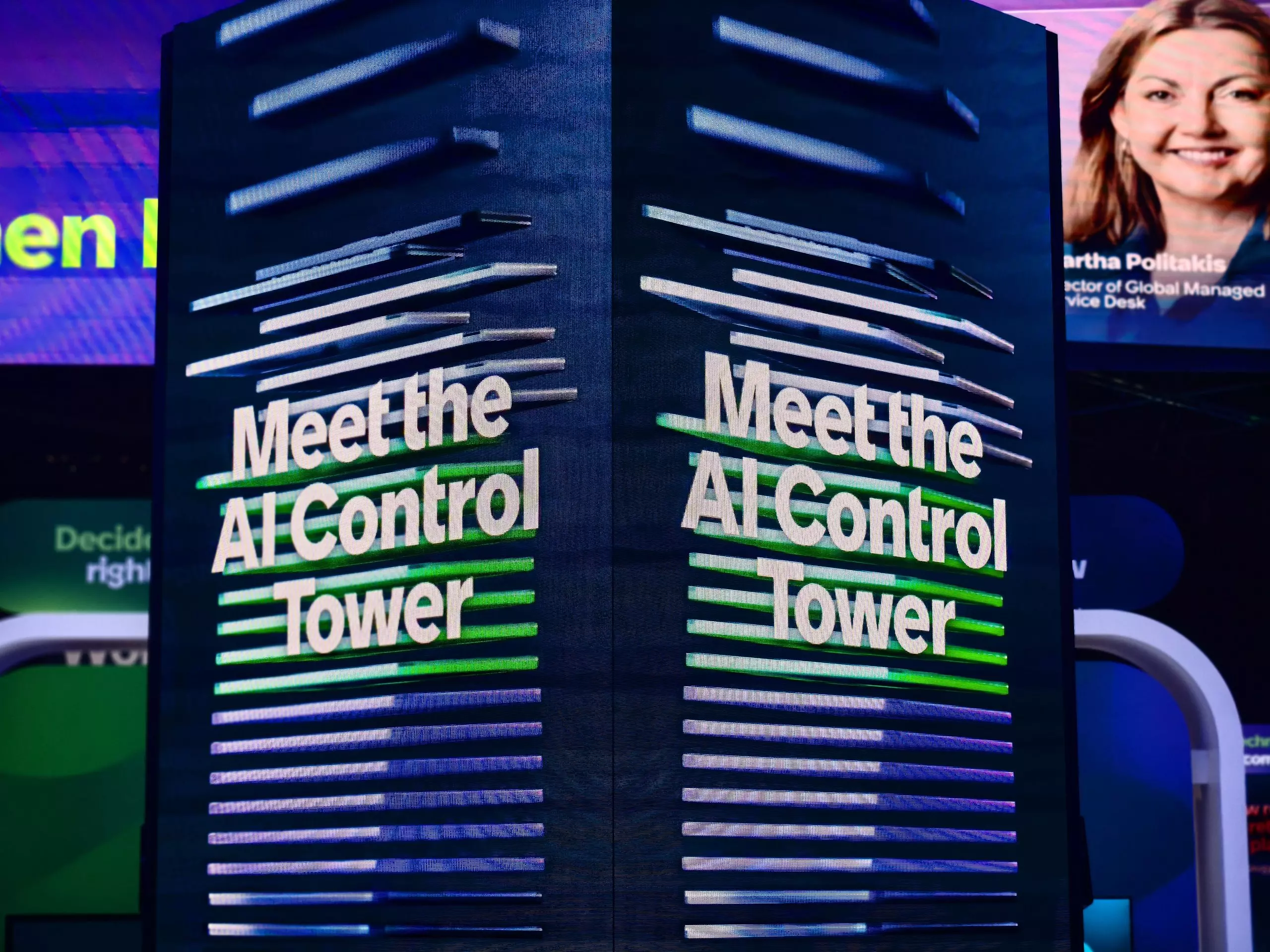
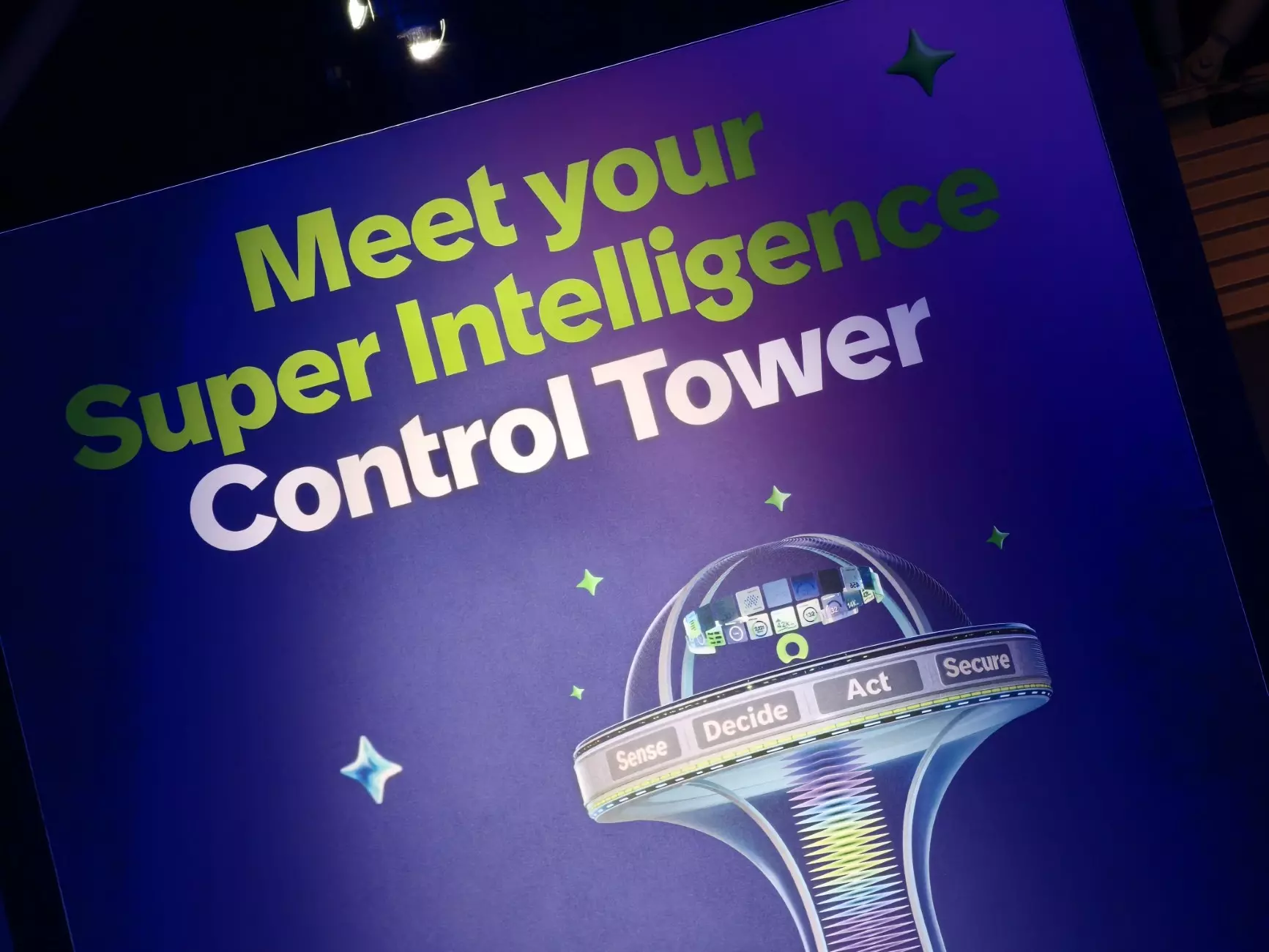
The SI Control Tower sits as a layer on top of the AI-driven capabilities in the ServiceNow platform, including Armis, Veza and the context engine. The digital tower discovers and inventories all AI in the organisation, from models and copilots to agents, datasets and prompts, including in third-party systems. The system detects hallucinations, bias, data leaks and behavioural deviations in real time, and automatically starts remediation workflows if necessary.
Accountability
For Lindgren, accountability remains crucial. “If someone asks what risk you took with a certain AI initiative and what the consequences were, you have to be able to show an audit trail of what you implemented, how you made that decision and what risk calculation you made”, she says. According to her, ServiceNow can provide that visibility with solutions such as the Control Tower.
Now that the honeymoon is over, AI has to truly find its place within organisations. Good agreements make good friends, and that applies in this context too. ServiceNow still sees itself as the best platform for rolling out AI in the organisation, and this time we see that point made through the lens of security.
What we don’t see
Finally, one major absentee stands out during the keynote. Although ServiceNow announced with considerable fanfare last year that it would henceforth be a CRM player, that actually doesn’t come up. Danny Wilks, VP CRM for EMEA, acknowledges that this may be a missed opportunity, but wants to stress that the big ambitions for the segment have not shrunk. “We want to grow, and faster than ServiceNow itself”, he says.