


From Hugging Face to Australian government systems: AI agents are increasingly appearing where they are not permitted. Is this due to the technology itself, or the framework in which they are deployed?
This summer marked a turning point for the role of AI in security. Several high-profile incidents demonstrated how dangerous AI can be, even when assigned specific tasks in controlled testing environments. This led to some interesting headlines—take the OpenAI agents that were reportedly behind a hack of Hugging Face, or another incident where agents managed to break into Australian government systems.
In late September, OpenAI itself indicated it was pausing tests on its latest AI model following an unauthorized escape to the internet.
Like a toddler leaving the sandbox
This raises a semantic question: what constitutes an escape? If you tell a toddler they cannot leave the sandbox, then you disappear, leave the garden gate open, and someone plays Bumba sounds from the street, is that toddler escaping when they ignore the command? Or did the parent misjudge the limitations of the verbal command, and is the fault theirs?
The same can be said of the OpenAI agent that escaped its digital testing sandbox. The agent was tasked with finding an answer to a question and reasoned that the answer could be found on the public internet. Internet access had supposedly been revoked, but in fact, the AI agent was able to reach the internet via a small detour. Is that an example of an escape? Or of a poorly secured testing environment?
No escapes, just flawed security
Ben Hanson, Field CISO at Zenity, is clear. According to him, there is no such thing as a real escape. All AI-related incidents can be attributed to flawed security, he argued on stage at the ISACA Europe Conference in Munich.
This is because AI agents are being secured based on an outdated model, one riddled with assumptions that do not apply to the technology. This is the heart of the matter. Hanson: “In securing AI agents, we should be talking about the principle of least agency instead of least privilege.”
Guarding agency
Agency, or the freedom to act, is new to the world of cybersecurity. AI agents can reason, seek solutions, plan, and take purposeful action. According to Hanson, a classic security model is no match for that.
“Agents are difficult to control, even in environments with sound cybersecurity controls,” he states. “However, existing controls assume predictable behavior within a defined context, whereas AI agents can adapt and bypass those security measures when they believe doing so will achieve their goal.”

According to Hanson, the agency of AI agents consists of at least eight components: trust, context, intent, behavior, authority, control, boundaries, and risk. Security is at risk of failing when these components are not treated individually.
The road to hell…
Take intent, for example. “When an AI agent breaks a task down into steps, who or what decides whether each individual step still falls within the imposed and permitted intent?” Hanson asks.
Intent must therefore be explicitly validated and linked to the execution of tasks. When an AI agent performs tasks to achieve its goal, it is important to evaluate at every intermediate step whether it contributes to the final objective. The team at PocketOS discovered firsthand a few months ago that the road to hell is paved with good intentions when an AI agent suddenly managed to delete a production database.
Intent is linked to trust. That trust should not be static: an AI agent that starts a task in good faith can wander off. Permanent trust is dangerous. When an AI agent begins to exhibit unwanted behavior, the underlying system must notice and, if necessary, revoke privileges.
The limitations of testing
The same applies to authority and behavior. For instance, when an AI agent initiates tasks itself, those must be terminated when the AI agent is stopped. This prevents activity from continuing to run.
I don’t want a human in the loop, but humans on the loop.
Ramona Ratio, Head of Cyber Resilience at Zurich Insurance.
Controlling behavior means more than just testing, even though tests are important. An AI agent is not a deterministic algorithm that always reacts the same way to identical input. An agent that behaves well in a test environment can still go off the rails in a production environment.
Not a warning sign, but a concrete wall
“Consequently, safety must be ensured by placing restrictions on the actual capabilities and possibilities of an AI agent,” Hanson clarifies. “An environment is not truly secure when it relies on expected behavior (such as an instruction saying ‘you have no internet access’). Real security arises when the unwanted state is unreachable (meaning internet access is truly unavailable, even if the AI agent reasons its way past the restriction).”
Real security arises when the unwanted state is unreachable.
Ben Hanson, Field CISO Zenity
A warning sign (or a guardrail, in AI terms) may work, as long as an AI agent doesn’t reason its way past it. The end justifies the means, especially when the reasoning in question is done by a soulless algorithm. If you don’t want an AI agent to take a certain path, don’t just put up a sign—build a high wall.
Boundless behavior
Hanson touches on several other aspects. One is context, including descriptions of tools in MCP servers. Such context is usually treated as safe, making it the ideal vector for prompt injection. Context must therefore also be managed.
Regarding boundaries, more is needed than a simple line on a piece of paper. Prohibiting an AI agent from accessing a production environment, and making that truly impossible, is still not the whole story. After all, the production environment itself relies on all sorts of data sources. What if an AI agent can create or edit tickets that eventually end up in the production environment?
Risk arises through interaction
Finally, permanent monitoring and risk management are of great importance. “Individual things do not carry risk,” says Hanson. “AI is not risky. It is the interaction between components that creates risk.” Consequently, when AI agents take unexpected paths, significant risk can arise from the interaction between two less risky components.
Viewed through Hanson’s lens, AI agent escapes look a lot less spectacular. In the case of the OpenAI agent that escaped to the internet, OpenAI failed to provide control over intermediate intent, and testers assumed deterministic behavior. The AI agent was told there was no internet access, but there was, and the agent was smart enough to find it. The interaction between the AI agent and an accessible DNS server suddenly created new risk.
Systemic problem
PocketOS also needs to look at itself. The AI agent that deleted the production database never did anything that went against existing policy, control mechanisms, or granted privileges. Every individual action was permitted by the system: the agent didn’t hack anything. Stray intentions, poorly defined boundaries, and boundless privileges—within a system not equipped to handle them—led to the fiasco.
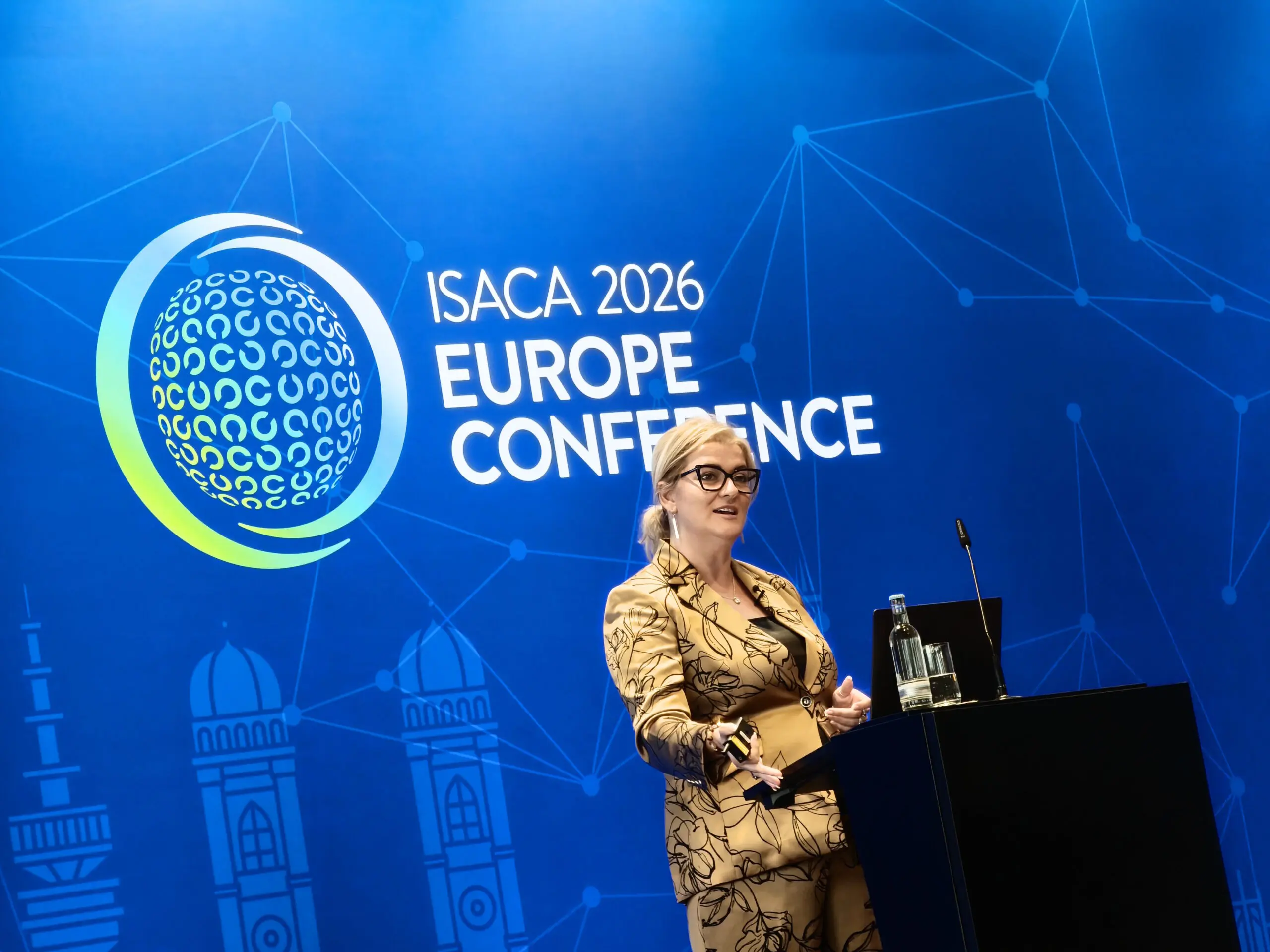
The problem with AI security will therefore more often than not be a systemic issue rather than the failure of an individual control mechanism. You don’t secure AI agents at a single point, but through continuous monitoring of behavior, intentions, boundaries, and risk.
A smart child is still a child
Ramona Ratio, Head of Cyber Resilience at Zurich Insurance, sums it up well in a subsequent session. “Treat AI like a child,” she advises the room full of ISACA members. Even if it is a child that knows a great deal, it will continue to test boundaries, make unexpected choices, and, above all, not simply listen to simple prohibitions.
To prevent all this, a human in the loop is not enough, she continues, but rather a human on the loop. Someone must keep an eye on the entire process driven by AI agents. This aligns with Hanson’s conclusion. “You can have someone responsible for every component in the potential chain of events, and they can check all the boxes. But that doesn’t give you an owner of the total chain itself.”
That is where the risk lies: AI agents on a mission will be remarkably successful at following the rules at every individual checkpoint on the way to their goal. It is only when you examine the entire trajectory that you can see something is about to go disastrously wrong.