


The PC will become an AI agent if Nvidia has its way. CEO Jensen Huang sees the computer working centrally in the home, just as there is a place for a car. With RTX Spark, he wants to redefine how people think about computers.
RTX Spark is the chip Nvidia plans to use to enter the PC CPU market. At its core is an ARM chip, developed in collaboration with MediaTek. The RTX Spark chip pairs a Grace CPU (20 cores) with a Blackwell GPU (6,144 cores), featuring up to 128 GB of memory (LPDDR5X) and a TDP between 45 and 80 watts. With these specifications, the processor is equipped to deliver up to 1 petaflop of local AI processing power.
“It took us three years, working with Microsoft, and two and a half years with MediaTek, to get here. Hundreds of people. That’s how hard it is, and that’s why everyone is so excited about it,” says Nvidia CEO Jensen Huang.
Chatting with your computer
During a Q&A session with the press at Computex, he dissects what he believes the future will look like. “Today, our computer sits on our desk waiting for us to use it. In the future, when we leave it, we will be talking to it constantly.”
He refers to a chat function, for example via WhatsApp, through which you stay in touch with agents on your computer all the time. “My agents are going to have names, they’ll be in my WhatsApp, and we’ll just chat all the time. I talk to them, and they talk back. WhatsApp calls me. Are you following me? That is the personal computer of the future.”
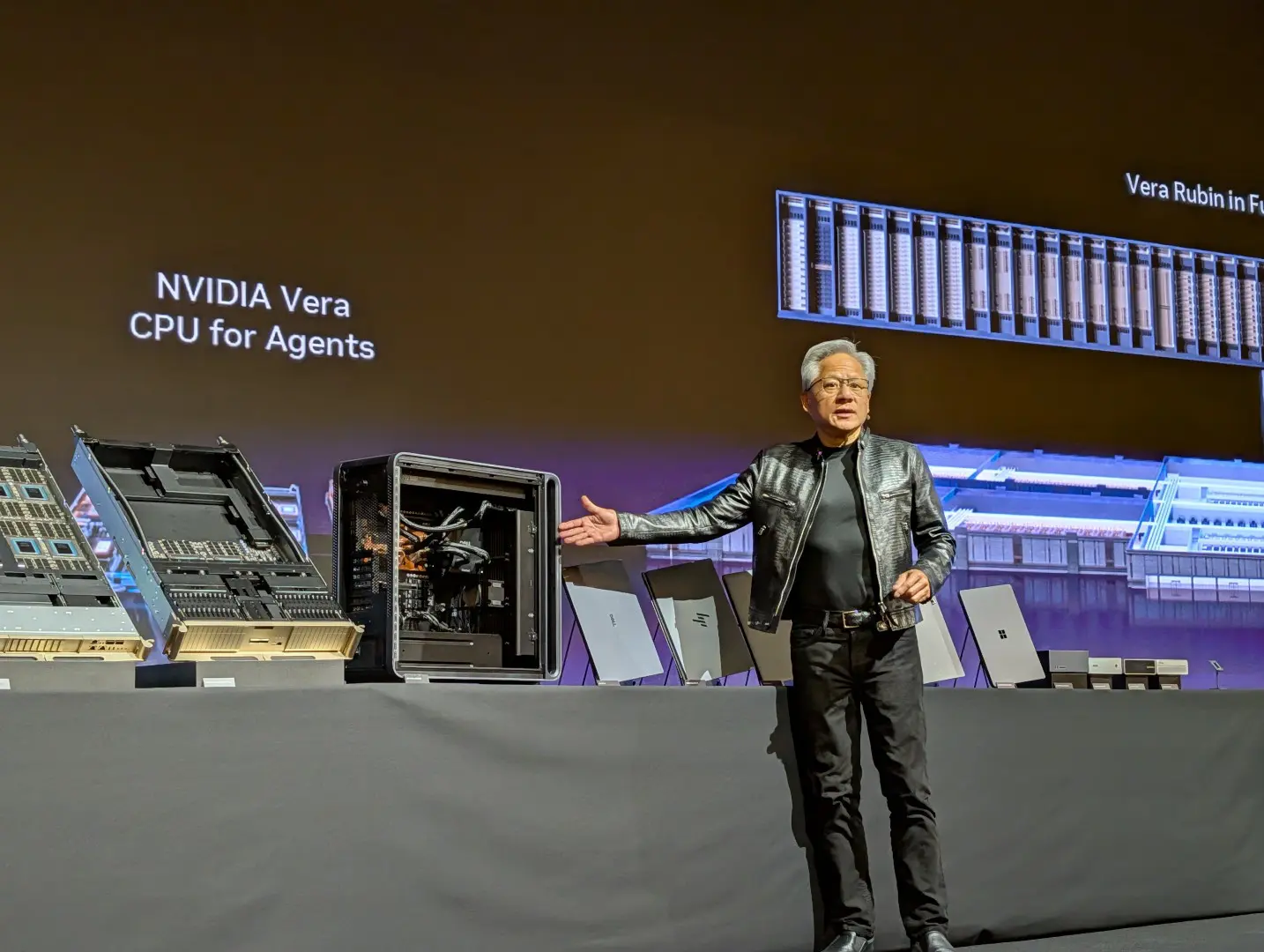
As he speaks these sentences, he stands by the various RTX Spark systems and emphasizes that all PC brands are on board.

Valuable agents
According to him, computers won’t need to be replaced quickly in the future. “The agent will soon be so valuable to you that you’ll want it in a beautiful case, a beautiful computer—secure, high-performance, something you can take with you, something you use for a long time.”
“I might have this system in my home for five to ten years, just like my home cinema. And in that case, my agent inside it will just keep getting smarter.”
“So the way we think about our computers could change radically, just as the way we think about our phones has completely changed. We do everything with them now, except make calls. Those devices have been reinvented.”
“Now we are reinventing the computer. It is an agentic computer; it is now an agent, an assistant, no longer just a tool. And that is the big idea.”
‘SaaSpocalypse’
During his account, he also briefly mentions the ‘SaaSpocalypse’ where software companies and SaaS providers are taking a hit.
“Those tools were built very well by humans. So agents aren’t going to replace tools; agents are going to use tools. There will actually be more agents using more tools, and now you see the scenario unfolding: when the agents arrive, their sales go up.”
ARM still has work to do
AI agents everywhere, according to the Nvidia CEO—which also seems logical to us, as the man has every interest in the concept having a future. Especially since that is the most logical application for the RTX Spark CPU-GPU tandem.
With its own CPU, Nvidia still has everything to prove. In collaboration with MediaTek, the foundation is ARM. Qualcomm has been trying to enter this market for two years with Snapdragon X, but has so far failed to convince. Nvidia now believes that the tandem with CUDA can ensure more success, citing many applications (for developers, designers, creative professionals) that simply work—though these are not the tools the average employee uses daily.
The enthusiasm surrounding Qualcomm was there at launch but vanished like snow in the sun. Can Nvidia maintain the momentum? The first devices from Acer, Asus, Dell, Gigabyte, HP, Lenovo, Microsoft, and MSI will appear on the market after the summer. Microsoft already announced the Surface Laptop Ultra yesterday to fuel the hype.