

The use of AI at Belgian companies rose from 10.3 percent in 2021 to 34.5 percent in 2025, just above the Netherlands. Large companies use AI far more often than Dutch ones for ICT security and workflow automation.
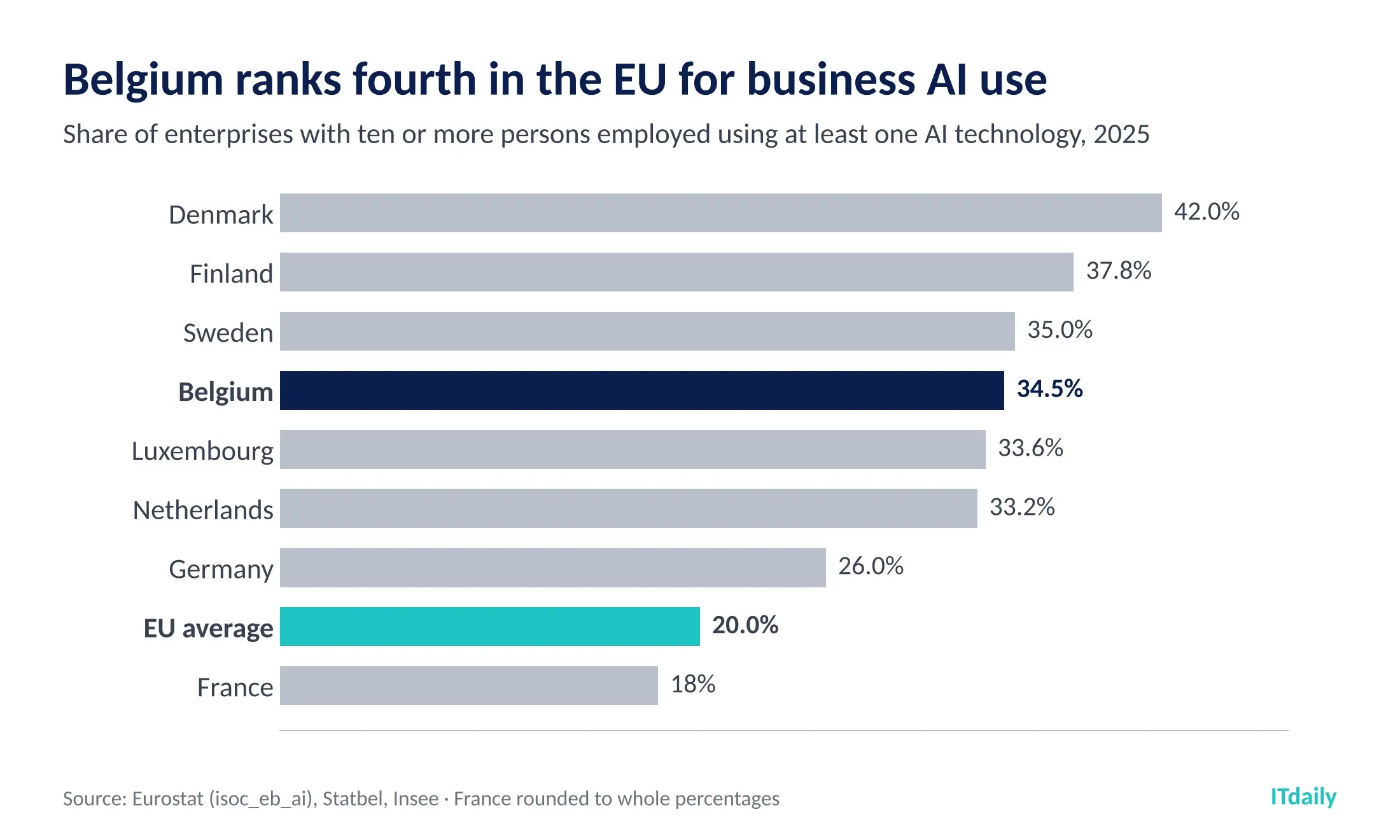
In 2025, 34.5 percent of Belgian companies with ten or more employees used at least one AI technology. This is shown by the survey on ICT use in companies that Statbel conducts in Belgium for Eurostat. Only Denmark (42%), Finland (37.8%) and Sweden (35%) score higher. The Netherlands comes in at 33.2 percent, the EU average at twenty percent.
Santhul Joseph, partner and AI engineer at Crux Digits, analysed the full Eurostat series from 2021 to 2025. In the ranking the company drew up across the 27 member states, Belgium stood in seventh place in 2021. Via 13.8 percent in 2023 and 24.7 percent in 2024, it climbed to fourth place.
Lead among larger companies and industry
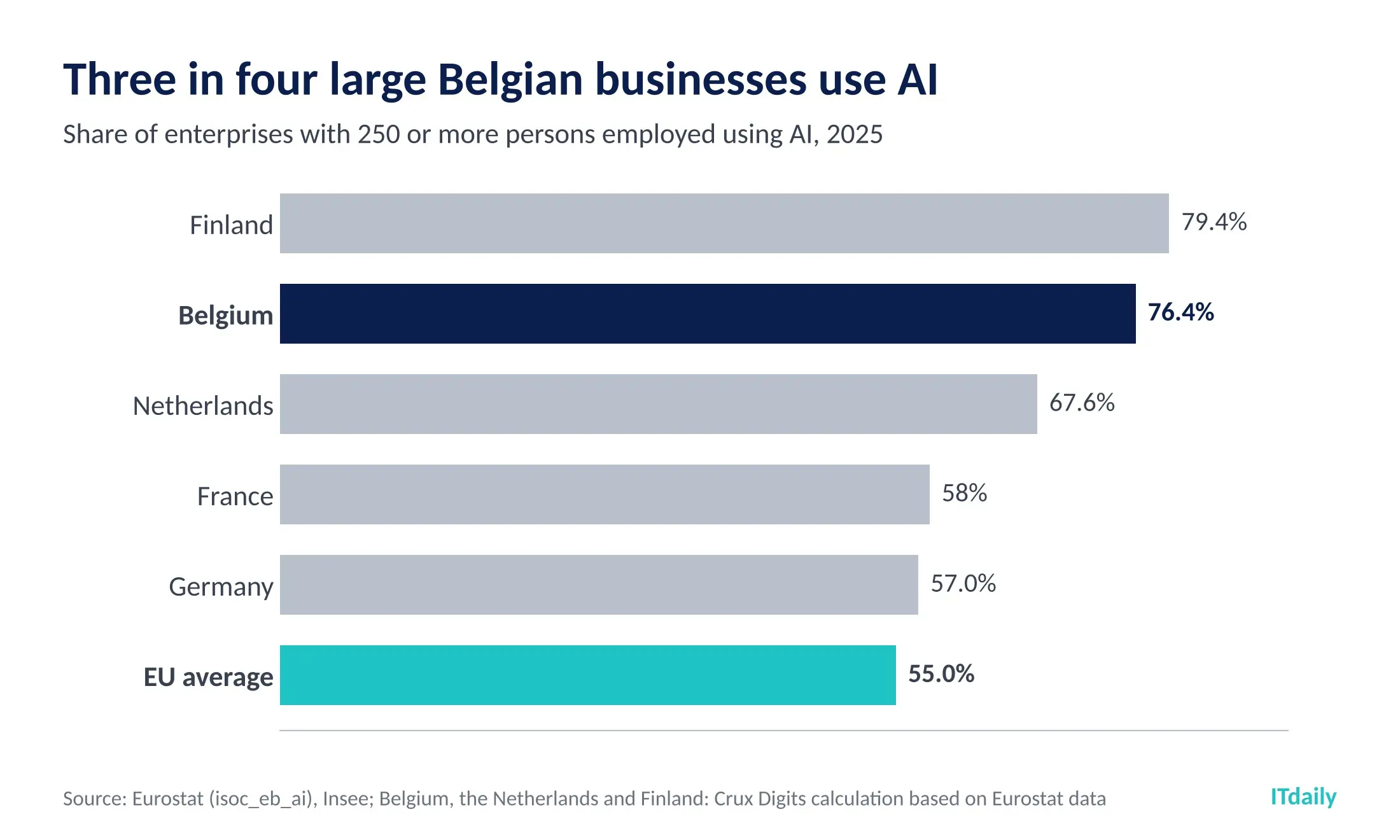
Among companies with 250 or more employees, the share rose from 41.4 percent in 2021 to 76.4 percent in 2025. Only Finland does better, at 79.4 percent. The Netherlands reaches 67.6 percent, France 58 percent and Germany 57 percent. The EU average for large companies is 55 percent. For large Belgian companies, Statbel still recorded 47.9 percent in 2023, so most of the growth came in the last two years.
Among medium-sized companies, with 50 to 249 employees, the share went from 16.9 to 54.5 percent. That puts Belgium second in the EU, behind Denmark. The Netherlands reaches 46.6 percent, France 31 percent and the EU 30.4 percent. In 2021, Dutch medium-sized companies were still 4.5 percentage points ahead of Belgian ones. Among small companies, with ten to 49 employees, Belgium and the Netherlands are level at 28.8 percent, against 23 percent in Germany, seventeen percent in the EU and fifteen percent in France.
In industry, 39.8 percent of Belgian companies use AI, against 28.6 percent in the Netherlands and 17.3 percent in the EU. In 2021, that figure was 10.4 percent in Belgium. For food, chemicals and machinery, among others, Eurostat publishes no Belgian figures for 2025.
Workflows and security
The biggest difference with the Netherlands lies in how large companies apply AI. The share of large Belgian companies that use AI to automate workflows or support decisions doubled, from 22.6 percent in 2021 to 45 percent in 2025. In the Netherlands, it went from 25.1 to 30.6 percent. Eurostat includes AI-driven robotic process automation in this category.
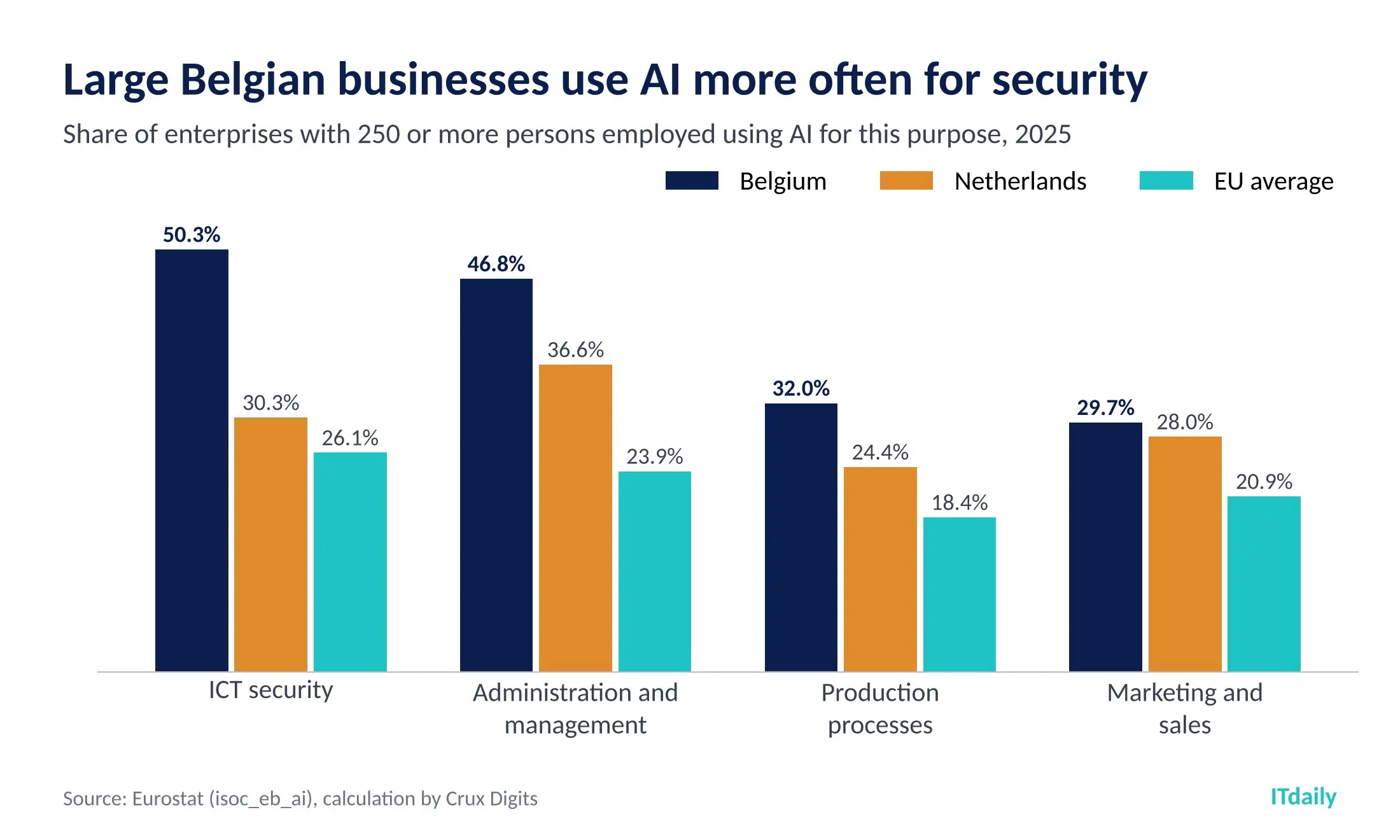
For ICT security, 50.3 percent of large Belgian companies use AI. In the Netherlands, that is 30.3 percent, in the EU 26.1 percent. Among large companies in Brussels, ICT security is the most frequently cited purpose (51%), according to the Brussels Institute for Statistics and Analysis (BISA). That is a result of the Belgian cybersecurity framework around NIS2 and CyFun. The survey only asks about use and purpose, so it cannot prove such a link. It also makes no distinction between a deliberately chosen AI application and an AI feature in existing security software.
Large Belgian companies also lead for business administration and management (46.8% against 36.6% in the Netherlands) and for production processes (32% against 24.4%). For marketing and sales, the gap is small, at 29.7 percent against 28 percent.
Belgium in the European ranking
The climb to fourth place hides the fact that Belgium ranked higher a year earlier. In the Eurostat figures for 2024, Belgium was third, with 24.7 percent, behind Denmark (27.6%) and Sweden (25.1%). In 2025, Finland grew by 13.5 percentage points to 37.8 percent and overtook Sweden and Belgium, which gained 9.8 percentage points.
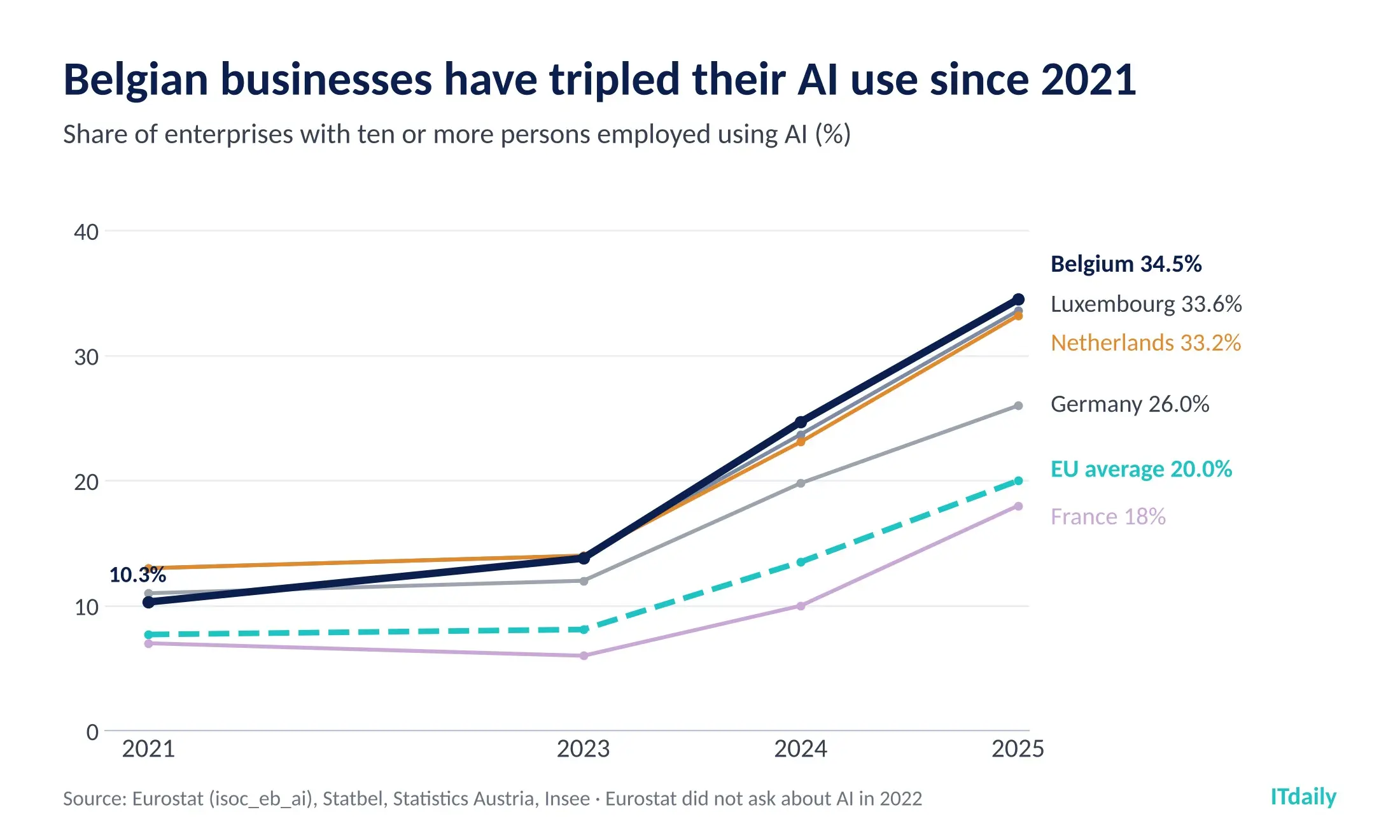
Of the neighbouring countries, Luxembourg comes closest to Belgium, at 33.6 percent, just ahead of the Netherlands. Germany went from eleven to 26 percent since 2021 and ranks eighth in the EU. France climbed from seven to eighteen percent and remains below the EU average, which rose from 7.7 to twenty percent over the same period.
How AI at Belgian companies is measured
The figures on AI at Belgian companies come from the Eurostat tables, updated on 15 June 2026. The financial sector, healthcare, education and government are not part of the survey. In 2022, Eurostat did not ask the AI questions, and Eurostat does not break the data down by Flanders, Wallonia and Brussels.
BISA did do so for Brussels, for companies with at least two employees. Of those companies, 29 percent used AI in 2025. Among companies with more than 250 employees, it was 71 percent.
A company counts as an AI user as soon as it deploys at least one AI technology. That means a single licence weighs as heavily as a completely rebuilt process. According to Statbel, the most widely used technology in Belgium is the analysis of written text, at 23 percent of companies.
In 2025, Eurostat added the generation of images, video and audio to the list, a category that was still missing from the 2024 questionnaire. Part of the growth between 2024 and 2025 may therefore come from that broader definition, in every member state.
Barriers at large companies without AI
A small group of large Belgian companies, 8.7 percent, considered AI but do not use it. Of these, 82.2 percent cite a lack of expertise, 60.1 percent problems with the availability or quality of data and 52.7 percent uncertainty about the legal consequences, against 28.9 percent in 2021. Costs are cited by 51.3 percent, against 24.9 percent for the same group in the Netherlands.
The next Eurostat measurement with AI questions should show whether large Belgian companies keep growing now that three in four already use AI, and whether Belgium catches up with Finland again. It will also show whether lack of expertise and legal uncertainty remain the biggest barriers for companies that drop out.