


Anthropic introduces its most powerful LLM ever with Claude Fable 5. Its capabilities are comparable to the latest version of Mythos, although Fable has firmly embedded restrictions and guardrails. Mythos 5, without restrictions, is being released simultaneously.
Anthropic introduces Claude Fable 5. This new Large Language Model (LLM) is immediately the most powerful horse in the Anthropic stable. Fable 5 is the most high-performance model Anthropic has released to date, surpassing Claude Opus 4.8.
Mythos model
The AI specialist calls Fable 5 a ‘Mythos-class’ model. The preview of Mythos was announced in April, but was not generally available. Indeed, the Mythos AI model was labeled too dangerous to simply release to the world. This was due to the LLM’s advanced reasoning capabilities. Mythos can find bugs in software and IT environments and link them together to autonomously detect vulnerabilities in an unprecedented way.
Anthropic Claude Fable 5 is a Mythos-class model
Out of caution, Anthropic chose in April to only share Mythos with a selection of specialized parties, including major software makers and security specialists. They could then start looking for bugs in their own code to subsequently patch them.
Strict guardrails
Fable 5 is a mature version of that Mythos model, but is now available to the general public. However, the risks have not disappeared, and Anthropic realizes this. Fable 5 is available with very strict guardrails to prevent misuse.
For example, the LLM will not process prompts on certain topics. Anthropic has blacklisted cybersecurity as well as offensive questions about biology or chemistry, among others. Fable 5 will pass questions on those subjects to Claude Opus 4.8, even when the prompts are not necessarily intended to be malicious.
The dangers surrounding cybersecurity were in the spotlight with the launch of the Mythos preview, but those same capabilities also allow the LLM to, for example, develop medicines and design proteins. That too can be both useful and dangerous.
The guardrails are set very conservatively, Anthropic notes, so that well-intentioned prompts will also sometimes be blocked. Given the risk that misuse of Fable 5 entails, Anthropic is making that trade-off intentionally.
That doesn’t mean Anthropic is finally closing the door on AI that can handle risky prompts. On the contrary: alongside Fable 5, the company is also introducing Mythos 5. This is exactly the same LLM, but without guardrails and restrictions. Mythos 5 succeeds the Mythos preview and, like its predecessor, is exclusively available to hand-selected partners under the umbrella of Project Glasswing.
Coding, knowledge work, and more
Fable 5 is thus the public version of Mythos, and even with guardrails, the model is relevant. In many domains, Anthropic Claude Fable 5 is allowed to excel at will. For instance, the LLM is even better at coding than its already impressive predecessors. Fable 5 can work and reason independently for longer than other Claude models without losing its way, implying it can interpret and execute much more complex prompts.
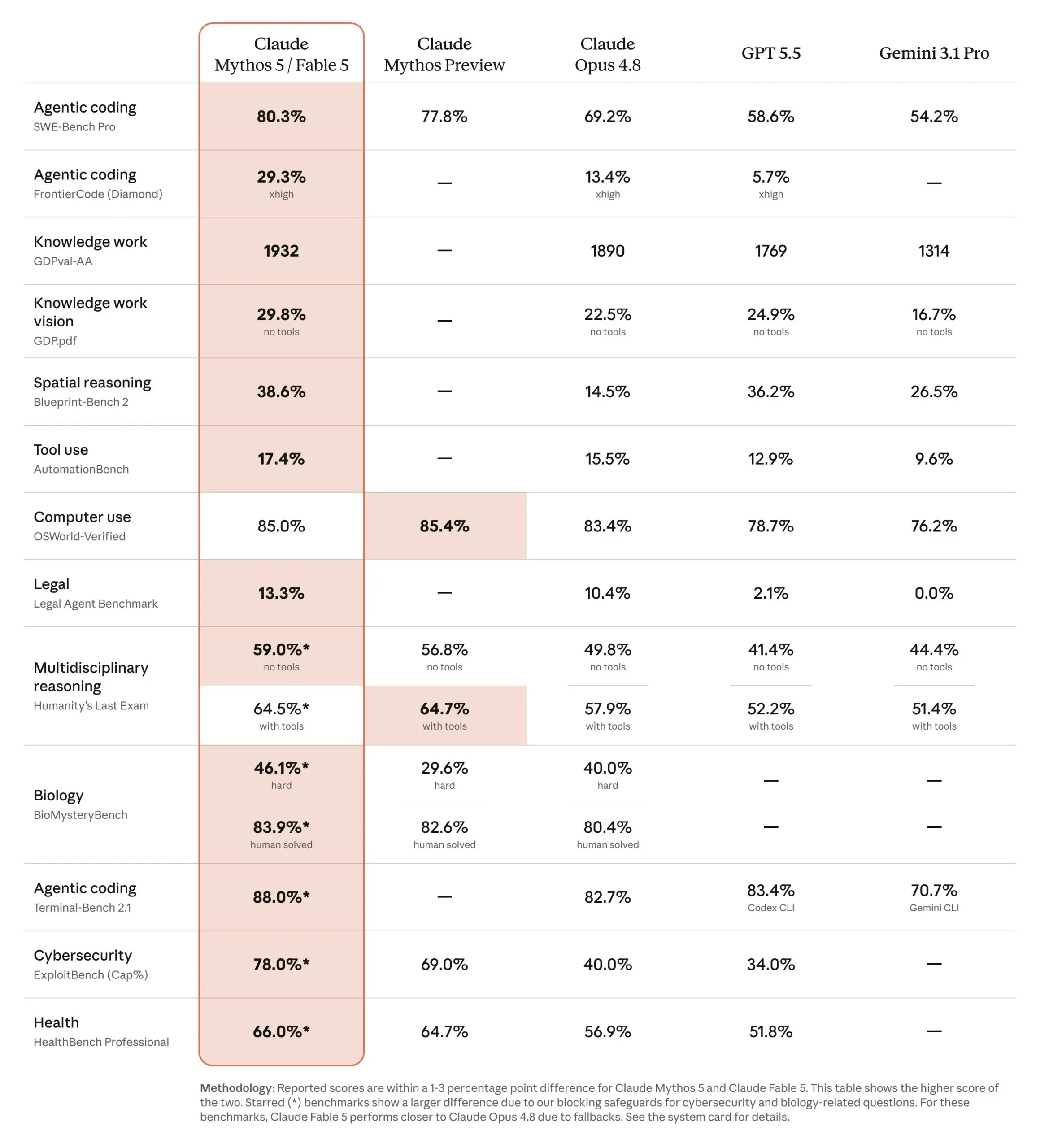
Anthropic also sees a leap forward in capabilities regarding knowledge work, computer vision, memory, and science. The AI developer shared several examples. For instance, Fable 5 reportedly migrated a Ruby codebase of 50 million lines in a single day, whereas that work performed by a team would have taken two months.
For knowledge work, Anthropic refers to the Hebbia Finance Benchmark, which examines how well an LLM can reason. Fable 5 can perform complex analyses better than any other LLM available today. The interpretation of graphs and tables has improved, but Fable 5 is also better at looking up facts, reasoning through concepts, defining causes, and more.
Pokémon
If you present Claude Fable 5 with an image, the LLM understands what is in it better than ever before. Fable 5 can extract exact figures and symbols from images and work with them. Combined with its coding capabilities, the model can also reconstruct the functionality of an app based solely on screenshots.
Anthropic demonstrates the possibilities with several examples. For instance, Claude Fable 5 can play Pokémon, but can also build a simulation of the solar system and predict a solar eclipse based on correct physics rules.
With Claude Fable 5, Anthropic is launching a new Frontier LLM that, according to the company itself, represents another leap forward compared to, say, Opus 4.8, but also OpenAI GPT 5.5. The model is said to handle tokens more efficiently than its predecessor, but that doesn’t make it more economical: since Fable 5 can reason more complexly, token consumption will likely still be higher.
Price and availability
Anthropic Claude Fable 5 is available today for Pro, Max, and Team enterprise plans until June 22. On June 23, Anthropic will remove Claude from those subscriptions. From then on, usage is only possible via credits. When server capacity allows in the future, Anthropic intends to integrate Fable 5 as standard in all subscriptions.
Developers can get started with Claude Fable 5 via the Claude API. The cost is ten dollars per million input tokens and fifty dollars per million output tokens. Claude Mythos 5 follows the same pricing strategy but, as mentioned, is not generally available.
Anthropic recently called for a pause in AI development so that humanity can catch up. It is certainly not proactively taking that pause itself. The company built in the strict guardrails for Fable 5 so it could roll out the model as quickly as possible. Like major competitor OpenAI, Anthropic is pursuing an IPO. The scoop of making a new generation frontier model available highlights the AI specialist’s relevance once again.