

Building supercomputers is more complex today than ever: technology is evolving faster than the teams that must deploy and manage them. HPE warns that success is not just about GPUs and computing power, but about people, processes, cooling, compliance, and a well-thought-out service architecture. We get a look behind the scenes at HPE Discover Barcelona 2025.
Anyone looking to set up a supercomputer or large-scale HPC (High Performance Computing) platform today is starting a journey that goes far beyond ordering a few racks of GPUs. The traditional vision—stacking hardware, connecting the network, and submitting jobs—is definitively over. Instead, supercomputers have evolved into AI factories: complex ecosystems where compute, storage, networking, cooling, security, compliance, and people must work together seamlessly.
During HPE Discover in Barcelona, Chris Davidson, responsible for HPC and AI at HPE, explains why this is so difficult. What stands out in the conversation: the biggest risk is not that the technology will fall short, but that organizations underestimate everything that needs to happen around that technology.
“It’s not about a single product, but about bringing technology and people together into a working solution.”
According to Davidson, HPE no longer views supercomputers as machines, but as complete solutions. An HPC platform consists not only of GPU servers, but also of high-performance networks, specialized storage, advanced cooling, an orchestration and management layer, and a robust package of services.
These services range from design and implementation to long-term support, troubleshooting, and optimization. Without that layer, a supercomputer often remains below its potential, or worse: it never meets its production targets.
Users moving faster than the infrastructure
On top of that, the typical HPC user has fundamentally changed. Where supercomputers were once primarily used by command-line experts and scientists, they are now also used by AI teams accustomed to the simplicity of the cloud.
“Today’s user sees a new AI tool on GitHub and wants to run it in production next week,” says Davidson. “That attitude ensures that modern supercomputers are rarely homogeneous. They run a mix of traditional HPC workloads, AI training, inference tasks, data analysis, and experimental frameworks.”
“New models, libraries, and runtimes are arriving at a rapid pace. The infrastructure must be able to respond to this permanently, while the life cycle of such a system is normally measured in years.”
This requires flexibility in everything: from the choice of CPUs and GPUs to the structure of the software stack and the way container platforms and open-source tools are integrated. HPC is no longer a one-time integration exercise, but a constantly changing compromise between performance, stability, and innovation.
The law of energy and heat
As if that weren’t enough, the sector is simultaneously pushing against the boundaries of physics. The energy requirements of modern CPUs and especially GPUs have risen explosively in recent years. Where a few hundred watts per node used to be sufficient, we are now far above that.
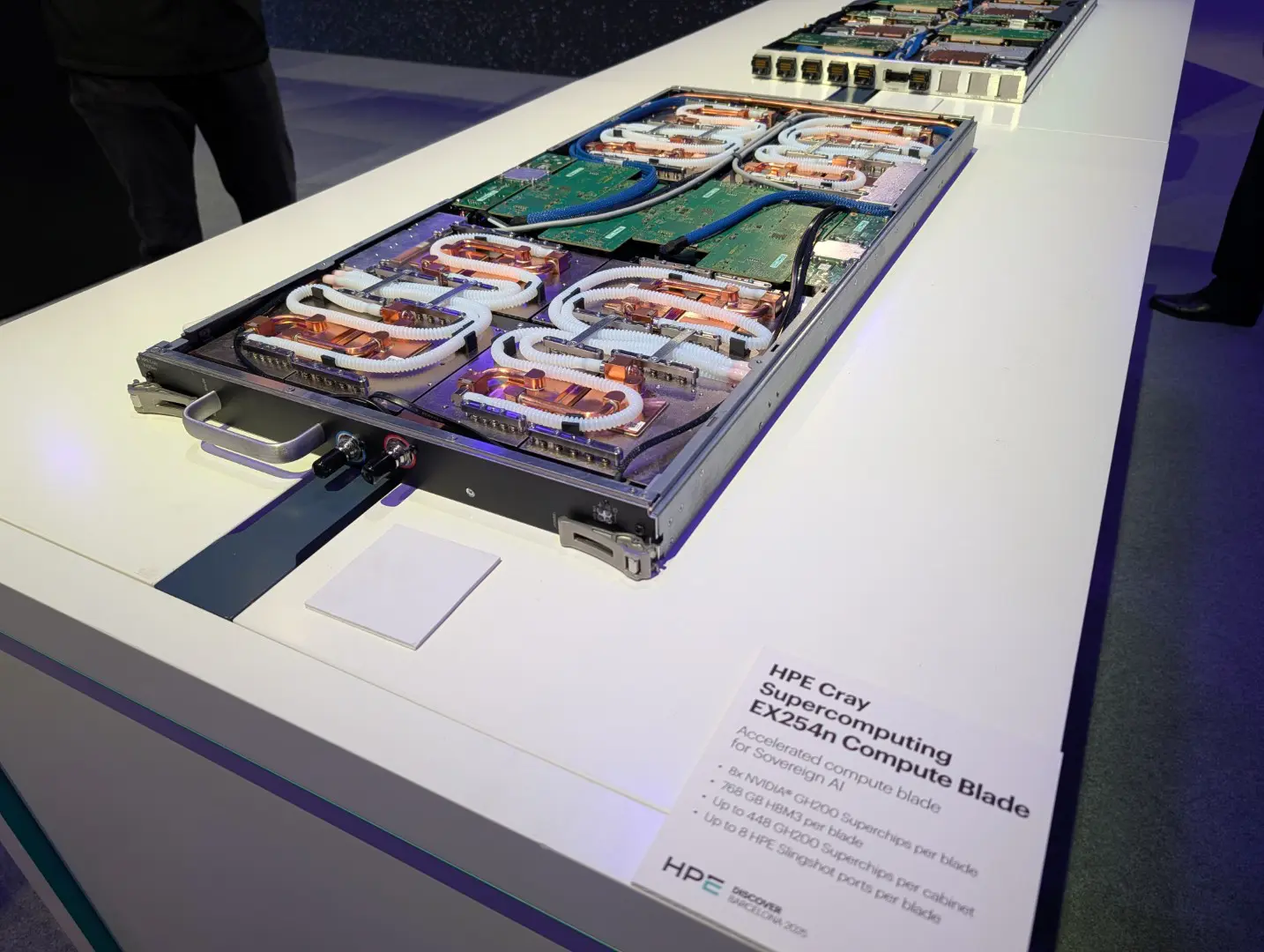
Davidson pulls no punches: “CPUs and GPUs now require much more power than five years ago, which leads to more heat and more stress on components. This has a direct impact on failure rates and uptime. We don’t just cool CPUs or GPUs, but the entire system — from busbars to switches.”
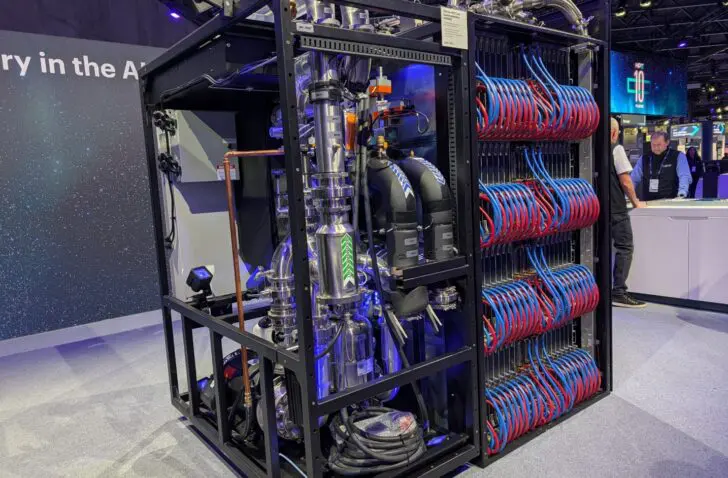
The introduction of new solutions, such as a sidecar pump that enables more efficient liquid cooling without shutting down the system, illustrates how cooling has become a strategic part of the design. This is not a minor optimization, but a core requirement for operating supercomputers reliably at all.
Long trajectories, shorter deadlines
Traditionally, large HPC systems were developed in long-term trajectories. From an initial concept to effective delivery often takes several years. During that time, relatively little changed in the basic architecture of CPUs and interconnects.
Today, that is different. AI and GPU innovation have dramatically accelerated the pace. Management expects faster results, while chipmakers, in turn, launch new generations more regularly. Davidson: “Systems are designed over a long period, but the work cycle is getting shorter. During the process, silicon roadmaps and workloads change, and you have to adjust constantly.”
Being successful here does not mean having a perfect plan, but having the ability to make intelligent corrections along the way.
Chris Davidson, responsible for HPC and AI at HPE
HPE therefore works with mixed teams of the customer, HPE experts, and partners who work together on the architecture throughout the entire process. The initial design is not an end point, but a starting point that is constantly adjusted as more becomes clear about workloads, chips, and operations.
“Being successful here does not mean having a perfect plan, but having the ability to make intelligent corrections along the way.”
The real challenge: running, not building
Yet, according to Davidson, the biggest difficulty is not the construction phase, but what comes after. “Installing the system is one thing; keeping it running is the real work. In practice, this involves monitoring, proactive problem detection, firmware and driver management, capacity planning, onboarding new users and workloads, and rapid incident response.”
“This is where the human factor comes to the fore again. We are investing heavily in services, observability, and even our own AI tools to support our own deployment and service teams in identifying and resolving problems.”
Davidson emphasizes that the shortage of expertise is one of the biggest risk factors. Building, deploying, and managing such complex systems requires specialized profiles: solution architects, performance engineers, and service teams that understand hardware, software, and workloads. Without those people, even the best-designed infrastructure will eventually stall.
Compliance and digital sovereignty as an extra layer
As if technology, energy, and skills weren’t enough of a challenge, a significant layer of regulation is added in Europe. GDPR, NIS2, ISO standards, and national requirements for digital sovereignty help determine how and where HPC and AI platforms can operate. In some cases, this even involves completely air-gapped environments where no connection to the outside world is permitted.
“Not only must compute be sovereign, but also data, metadata, key management, and operations,” says Davidson.
“As a result, supercomputers are no longer purely technical projects, but also strategic instruments in the digital autonomy of countries and organizations. Architectural choices are driven not only by performance and cost, but also by legal, geopolitical, and security criteria.”
Conclusion
Building supercomputers has never been easy, but in 2025, it has become a discipline in its own right. Davidson: “HPC is no longer an isolated technology layer; it is an ecosystem in which hardware, software, people, energy, and regulation continuously influence each other.”
Anyone wanting to deploy an HPC or AI platform today that remains relevant for several years should take one main lesson from Davidson’s story: success lies not in the computing boxes themselves, but in the cohesion between them—and in the people who design, deploy, and keep everything running. Only those who understand this build not just a supercomputer on paper, but a supercomputer that continues to perform in practice.