

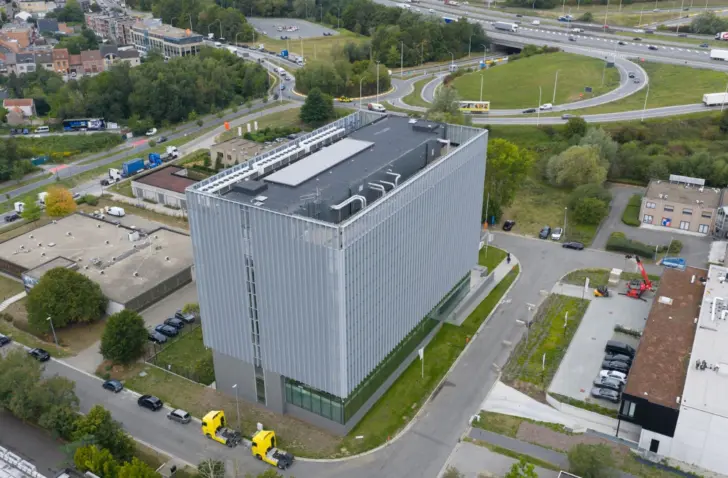
When it comes to AI, don’t think only of huge factories, but also of clusters tailored to businesses. To house them, data centre operators are racing to provide enough suitable floor space and capacity. New technology, however, brings new challenges.
AI is not the preserve of hyperscalers alone. The large AI factories of players such as Microsoft, Meta and Tesla represent only one side of the story. Enterprise customers are also increasingly considering installing their own AI infrastructure. That brings new challenges and new expectations, and not only because of the growing density of AI hardware.
New challenges
As a European colocation data centre operator, Penta Infra has to deal with this. Harmen Laan, Head of Engineering at Penta Infra, sees a clear evolution over the years. “Penta Infra started out with relatively small data centres,” he says. “We’re talking about 700 kilowatts to one megawatt. We are now looking at designs for data centres of between 10 and 20 megawatts. That is a considerable leap in power.”
That growth runs in parallel with the market, which is shifting from fairly conventional to higher density, which brings a demand for liquid cooling.
From exploration to concrete demand
People have been talking about this for some time, but in recent years demand has become more concrete. In the Benelux, the Sofia supercomputer of the Vrije Universiteit Brussel (VUB) was one of the first customers for Penta Infra with a concrete application. “Looking at the market, we initially saw frontier AI being deployed in research institutions or very specific performance compute organisations. We now see AI increasingly and more concretely being used outside the traditional frameworks, such as with Neoclouds and GPU-as-a-Service,” Laan explains.
Existing customers, too, have been sounding out the data centre specialist’s capabilities for some time to handle requests for AI-related projects. Over the past two years, that cautious exploration has turned into concrete orders. But: “HPC/AI requests are also coming more and more from end users with smaller deployments. So it’s not only existing customers who are asking for it.”
“At first we heard: we want liquid cooling, without any specific details. When answering the question, it was often clear that the application and the scale were not yet concrete, nor were the provisions that had to be made for it,” says Laan, who classes such requests as exploratory. “Now you have far more concrete requests that also lead to orders.”
Besides large players exploring the market, Laan sees more and more start-ups and new companies urgently looking for power and capacity for their AI environments. Scarcity is now so great that the search is even visible on social media. “There are now even posts on LinkedIn from parties looking for power. I’ve never seen that before,” he says. Those who have managed to get their hands on scarce AI hardware want to be able to deploy it quickly, because the equipment is expensive and depreciates fast.
Speed and capacity are trump cards
That urgency immediately explains why time to market is so crucial in the data centre industry. “When a customer comes with a request, you have to be able to move fast,” Laan realises. And where an AI or HPC customer previously needed 350 or 700 kilowatts, one to two megawatts is now quickly requested.
To meet that demand without months of waiting, Penta Infra is actively expanding its portfolio of European colocation data centres. For a data centre operator, the key is therefore to provide the capacity before the demand actually arrives.
The impact of AI on the data centre
That is not a given. After all, AI infrastructure does not fit into every data centre. Laan points to two structural aspects: clearance height and floor load. “AI machines have a high density of components and are heavy,” he explains. That applies even to systems that use traditional air cooling.
AI machines have a high density of components and are heavy.
Harmen Laan, Head of Engineering Penta Infra
More advanced hardware sometimes requires liquid cooling. The data centre has to be fully equipped for that. More complex water piping is needed, and there must be heavier provisions for equipment above the racks. “Both below and above the racks, you need quite a lot of free space to house all that technology,” says Laan.
Moreover, not every cooling installation is the same. The infrastructure behind liquid cooling has not yet been standardised. “There are guidelines from ASHRAE and OCP, but the interface between building and rack has not yet been clearly defined. As a result, it is still very much custom work,” says Laan.
In practice, he sees a lot of custom work in the server room itself: the piping under the floor, the power connection and the building management system each have to be specifically tuned. A detail such as the spot where the cold water pipes come up in the room can already be a stumbling block.
Brownfield or greenfield
Not every data centre is therefore suitable for the most modern workloads. Penta Infra grew partly through the acquisition of existing data centres, which were built for a previous generation of IT workloads. These now have to be modernised to support the next generation of IT workloads.
“In practice, we can make AI possible even with the limitations of brownfield data centres,” Laan does say.
Today, Penta Infra uses a mix of renovation and new construction. For new projects, the data centre is always set up to the latest standards to support AI.
In renovations, certain spaces can be converted for AI workloads, but often with some limitations. “We can also create AI spaces in existing buildings. It takes a bit more custom work, but it works perfectly well,” Laan clarifies. Converting an old site is therefore possible, as long as the floor load, clearance height and technical installation allow it.
AI: a flexible concept
Whether a data centre is suitable for AI depends not only on the site but also on what the customer means by AI. The large AI factories with their state-of-the-art Nvidia hardware are not the rule, but the exception.
“Many people forget that there is a very large area between AI factories on the one hand, and what customers want in practice on the other,” Laan stresses. Where hyperscalers aim for the very latest, enterprise customers choose mainly on the basis of availability and speed of rollout. The scale is different too. That means air-cooled solutions in practice sometimes win out over water cooling. However, air-cooled servers do not simply fit into every data centre either.
Many people forget that there is a very large area between AI factories on the one hand, and what customers want in practice on the other.
Harmen Laan, Head of Engineering Penta Infra
Where a traditional setup averages 5 to 10 kW per rack and uses 40 to 60 percent of it, in AI systems all the chips run in parallel at full power. Laan: “A data centre used to have a stable load over time. With AI, that stability disappears. When an AI system wakes up to train, for example, it suddenly works at full power.” Data centres and cooling installations must therefore now be able to cope with those peaks.
Integration as the key
According to Laan, the biggest change that AI brings lies in the way of working. “A conventional rack is plug-and-play,” he explains. That is different with AI, and certainly with liquid cooling. “Liquid cooling requires an interface with the data centre’s technical installation. That forces collaboration across multiple parties: the chip supplier, system builders such as Dell, HPE, Supermicro and Lenovo, the integrator and the customer. We have delved into that piece of integration and integrated design.”
That way of working can still be a stumbling block. “We advise customers to involve us early, preferably even before they buy their systems,” says Laan. “The key to success lies in integrated thinking, together with the data centre operator, the customer and the integrator.” In time, Laan does expect some form of standardisation to emerge.
Capacity, flexibility and sovereignty
What drives organisations to place their AI clusters with an operator such as Penta Infra? Penta Infra sees the European market evolving mainly towards local consumption of AI, not the training of models at the level of OpenAI. “In Europe you get central AI factories, either American or European, and alongside them locally built clusters in data centres like ours,” Laan expects.
The theme of sovereignty is also coming into focus ever more prominently: customers looking for a colocation facility that falls under European jurisdiction, certainly because AI workloads also process sensitive data. “Penta Infra is entirely in European hands,” Laan stresses.
Maintenance is also becoming a point of attention. AI systems are maintenance-intensive, with servers with GPUs regularly having to be taken out for servicing. “In the coming years, there will be more focus on on-site maintenance facilities,” Laan concludes. The systems are being rolled out now; in the years ahead, they above all have to keep running.