


Between the public hyperscaler and the server in one’s own basement lies a whole spectrum of sovereignty choices, and every shade has its place. Adrien Springer of Cegeka sees organizations returning to the drawing board en masse: the cloud strategy that was fixed for years is being called into question everywhere.
Cegeka dubbed its sovereignty positioning ‘Fifty Shades of Sovereignty’ with a wink. The name is more than a pun, explains Adrien Springer, Director of Product & Strategy – Cloud & Digital Platforms at the Limburg-based IT service provider.
“Because it is not black and white. There is no such thing as sovereign or non-sovereign. There are many possibilities in the market and every possibility has its place in that discussion.”
Four drivers, one momentum
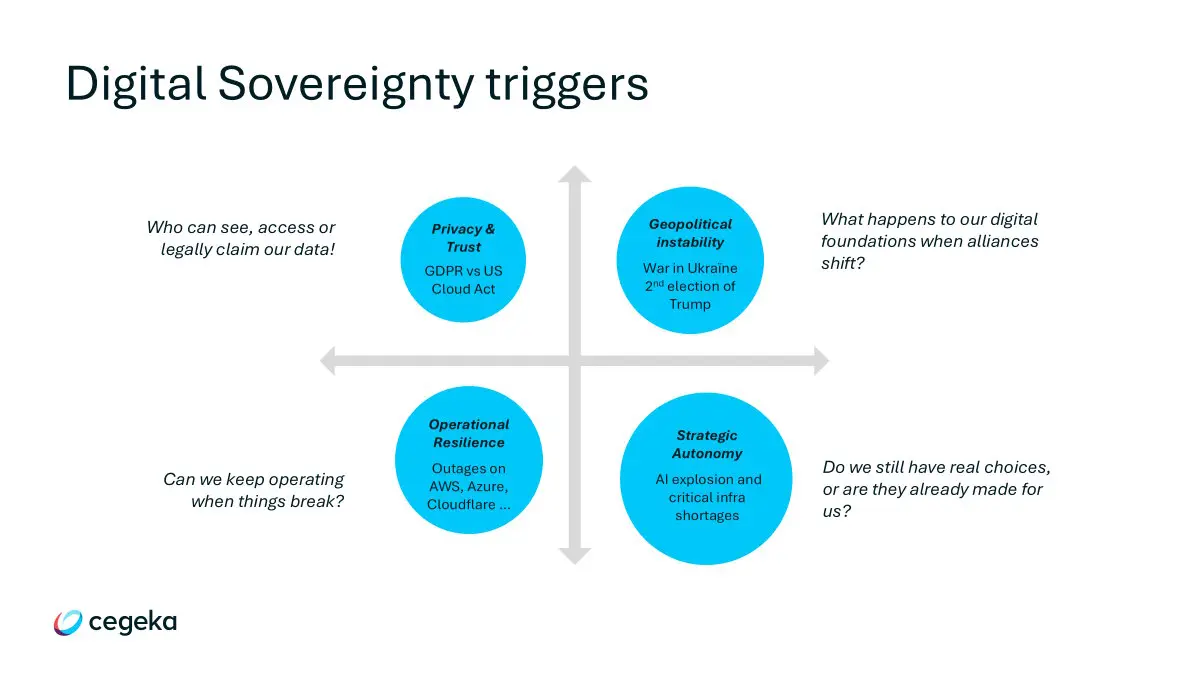
Why is this conversation landing on every organization’s table now? Springer sees four major domains that reinforce each other. It all started years ago with the data issue: the US Cloud Act and the Schrems rulings made organizations wonder who has access to their data. The geopolitical narrative then caused the debate to escalate.
“Who are our friends, who are our enemies, who can we ultimately trust?” Although that geopolitics is twofold: countries like Ukraine are actually looking toward hyperscalers to secure their data, because local data centers are less secure at that moment than the large cloud platforms.

The third domain is operational dependency, where the Broadcom story around VMware has triggered a lot. “If your entire ecosystem revolves around one vendor, that vendor makes choices that are not in line with what you expect, and you cannot step away from it, then you are very heavily dependent and you have no control,” says Springer. The fourth and, according to him, most relevant domain, especially in conversations with governments and actors in critical sectors.
Governments and financial institutions want to transform and achieve efficiency gains thanks to AI, but they do not control the models, nor where they run. “How autonomous are you then in your choices?” According to Springer, the four factors together mean that no one can ignore it anymore. “It is simply a point that must be addressed.”
Cloud strategy back on the table
For years, however, the question did not arise. According to Springer, ‘public cloud first’ was a justified strategy at the time: standardizing on one ecosystem and vendor to realize cost efficiency, to automate, and to focus the skills within the organization. Customers chose Microsoft, AWS, or Google and worked further on the upper layers where value is created: the application landscape and data usage.
“Since the end of last year, they are all coming back to that infrastructure layer. What is our cloud strategy now, and which strategy are we effectively pursuing? That is all being called into question again.”
What is our cloud strategy now, and which strategy are we effectively pursuing? That is all being called into question again.
Adrien Springer, Director Product & Strategy – Cloud & Digital Platforms bij Cegeka
Evangelizing about sovereignty is no longer necessary, Springer observes: it is now a matter of translating the theme into practice. IT, together with security, must once again provide direction to the organization: where do you build which workload, where do you develop which application?
The result is a return of the hybrid cloud strategy, albeit in a new form. “I don’t mean that an application runs a bit here and a bit there. An application or workload runs on the left, in the middle, or on the right. You must always take multiple factors into account. Future regulation (ref. CADA) can ensure that a workload lands in a more or less sovereign environment.”
Two axes and a price tag
Cegeka captures that spectrum in a model with two axes. The first axis is the need for sovereignty, where the SEAL levels from zero to four from the European framework help to determine it. The second axis is the need for functionality, scalability, and innovation.
In the top left are the classic hyperscalers, where sovereignty plays no role but scale is crucial for innovating and launching new services. In the bottom right are the highly sovereign environments: SMEs with compute, storage, and networking in their own basement, completely in their own hands but very limited, and looking for more functionality to innovate and grow.
Everything in between forms the fifty shades, and thanks to the European framework, Cegeka can map every technology solution on that axis. “Our role is to inform customers and guide them to the right choice for their context.”
There is a third dimension, and according to Springer, it is the most difficult to define concretely: cost. “Today there is no unambiguous answer to the question of whether sovereign is more expensive than non-sovereign. In the cloud strategy, that question must certainly be included: is it affordable for certain organizations to go completely to the right in that sovereignty expectation?”
One thing the European Commission has already taught us: the highest level, SEAL 4, is currently not achievable. “Because we don’t control the chips and we don’t build them ourselves either. We’re not going to get there.”
Europe provides the measuring tape
That European framework, the Cloud Sovereignty Framework that the Commission published at the end of 2025 and applied in April 2026 to a tender of 180 million euros, is a crucial component in the story for Cegeka and all other service providers.
“We were very pleased to see that coming, because it objectifies the debate. All claims made from the market, technology, and organizations can be placed within a framework, and it all becomes a lot more measurable,” says Springer.
The framework is still in its infancy but was recently reinforced with the publication of the Cloud & AI Development Act (CADA). Customers can use it to clarify their requirements; Cegeka can use it to make sharper investment choices.
SEAL in Belgium
The big question among customers is how that SEAL story translates to Belgian regulations. Many organizations work with governments and fear a sudden shift. “If the government expects next year that everything I interact with them on in terms of data flows runs on SEAL 3, then I suddenly have to turn my entire strategy around. The market is asking for clarity on where we need to go.”
A concrete framework analogous to CyberFundamentals, with which the CCB made the NIS2 directive tangible, would be welcome. Springer sees the framework as a useful tool that Cegeka wants to help formalize in the market, although he also draws a line.
If the government expects next year that everything I interact with them on in terms of data flows runs on SEAL 3, then I suddenly have to turn my entire strategy around. The market is asking for clarity on where we need to go.
Adrien Springer, Director Product & Strategy – Cloud & Digital Platforms bij Cegeka
“Belgium is deliberately waiting, without taking hasty decisions. Now that CADA has been published, speed can be made. Europe’s direction is becoming clearer. If you compare that with the Netherlands: they were already running there and can now continue in the right direction.”
Strategy first, technology second
According to Springer, many organizations are still at the start of the issue, and those who start often begin the wrong way: with a technology choice. “The right start is looking at your business strategy and your application landscape. Where do you want to go? What is the data strategy and data categorization, and what risk are you willing to take? Only then should you look at which platforms are the right ones.”
An element that is often forgotten is the collaboration model: do you still want to keep a lot in your own hands, or do you partner with a party in the market to partially outsource it?
The cloud strategy is thus back on IT’s plate, which by definition lost some control with the advent of the cloud when agile teams set up environments themselves, sometimes simply purchased with a credit card. Moreover, you don’t make the choice within the spectrum every week, Springer warns, so the chosen platform must be able to evolve.

“That is why open source is crucial in that debate: it is such a broad landscape of tooling and functionalities that you can add to such a platform.” Cegeka says it has been building open-source cloud-native platforms for large customers and sectors in the European market for years.
At the same time, things are already running in production with confidential computing, mainly with governments, and the hyperscaler path also remains open: for those who want to evolve further in that ecosystem, Cegeka guides them, among other things, toward Microsoft’s sovereign solutions. “Cloud sovereignty is not stepping away from the cloud. It is maintaining the right cloud mix in your strategy and having the possibility and flexibility to respond to changes.”
And the timing? Count on an analysis phase of a month or two, after which the right choices and the first investments fall between three months and two years. “It makes no sense today to look three or four years ahead, because by then the world will look completely different.”
Coalition of the willing
Sovereignty revolves around technology, but technology is not the only solution and Cegeka is only one of the actors, Springer concludes. He counts on the government, which helps determine the rules of the game and is itself a large consumer, on technology partners, on the private market in sovereignty-sensitive sectors, and on investors who jump on the bandwagon.
Sovereignty within technology means that you take back a piece of control yourself, and therefore that you make investments yourself in things where scale and capital are needed.
Adrien Springer, Director Product & Strategy – Cloud & Digital Platforms bij Cegeka
“Sovereignty within technology means that you take back a piece of control yourself, and therefore that you make investments yourself in things where scale and capital are needed. We believe that we are part of the answer to that complex issue, but we also need a coalition of the willing.”
One thing is certain for him: there is no way back. The sovereignty debate continues, and every organization will have to choose its own shade.
This is an editorial contribution in collaboration with Cegeka. For more information about their solutions, you can go here.