

At the Innovation Day in Brussels, Salesforce is urging Belgian companies to scale up their AI projects. That starts with laying a solid foundation: the data beneath the agents.
Salesforce has once again persuaded Matthew McConaughey to record a video message for the Innovation Day in Brussels. The actor tells the room that the focus should not be on which AI model is the smartest or fastest, but on how to make those models work for your business. Intelligence is of no use if AI doesn’t know the context of your company and customers: it’s not only what McConaughey preaches, but Salesforce too.
Taking the stage after a Hollywood star is a bold task, but Ervan Pouliquen doesn’t shy away from it. It is the second Salesforce event where he addresses the room as ‘country leader’ for Belgium and Luxembourg at Salesforce. The CEO, who is originally French, is already a true Belgian deep down. “We want to put Belgium on the map. Belgium is not a big country, but we can become the smartest country.”
To achieve that goal, Pouliquen gives the room a clear assignment: “Stop talking about AI and just do it.” He repeats that ambition in an interview. “Everyone who is here today is a candidate for the Champions League”, referring to one of his own quotes. “You can feel that something is growing. AI is no longer optional and the ingredients are there to make that ambition a reality. The future is now.”
Probabilistic versus deterministic
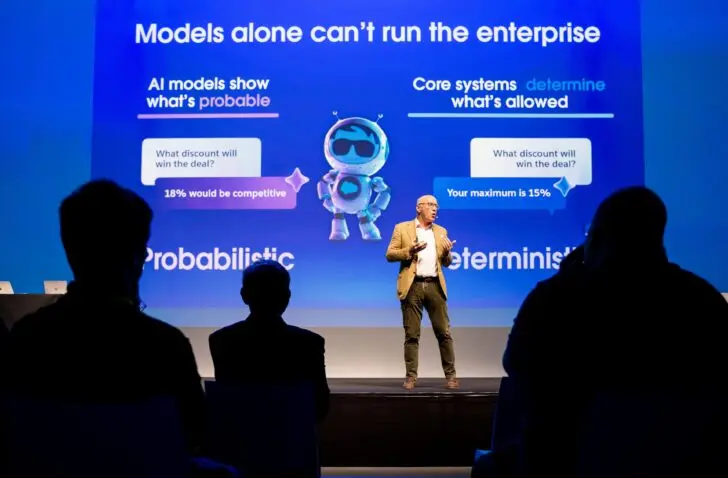
In practice, though, it is often not that simple. Pouliquen shows a statistic stating that only 22 percent of companies succeed in scaling up AI. He explains why so many companies are stuck by pointing to the difference between language models and business processes. “A language model works probabilistically, a business process demands deterministic logic. The LLM doesn’t have the answer, it has to look for it in your business data. Don’t build your house on sand”, says Pouliquen.
That AI can’t work without reliable data is a nail that people like to hammer on today. But Salesforce has far more than a hammer in its toolbox. In Salesforce’s architecture, Data 360 and Customer 360 form the (data) foundation. Agentforce and the recently introduced AIforce are the agent and interface layer on top of that.
Torben Markussen, SVP Solution Engineering EMEA North at Salesforce, explains that Customer 360 feeds the agents with a company’s data, logic and semantics. Only then can you climb further up the pyramid. Maarten Laukens, Solution Engineering Manager at Salesforce, spells out the order. “Start with the data, make sure the system understands your processes and deterministic logic, and only then add agents.”
The colour of your eyes
Mari Turhanen takes a completely different approach. She asks everyone in the room to look their neighbour deep in the eyes. “The colour of someone’s eyes is not what makes them unique, but every eye does have unique patterns.” Turhanen is not an ophthalmologist but Director Solution Engineering at Salesforce, so she quickly steers the conversation back to AI.
“Models are like the colour of your eyes: someone else can use the same AI model as you. The unique patterns lie in the context and in your company’s data. Models don’t know that world. You have to see them as new employees who first need to learn the language of your company. The work therefore starts with understanding your own data”, she makes clear.
“We all dream of an ideal world in which data is neatly curated, but in practice data sits in silos”, she continues. It was no coincidence that a year ago Salesforce put roughly eight billion dollars on the table to acquire Informatica. Informatica cleans up data and brings everything together, “including the data that sits outside Salesforce”, Turhanen explains.
Pouliquen goes even further and even calls Informatica “the smartest acquisition Salesforce has ever made”. As long as companies fail to work out the deterministic part, they stay stuck. This is where the knowledge that AI needs resides. Agents work while you sleep, but to sleep with peace of mind, you need to know they are right. “With Salesforce, we serve up on a plate the key that LLMs need to get to your data.”
Agents work while you sleep, but to sleep with peace of mind, you need to know they are right.
Ervan Pouliquen, Country Leader Salesforce Belgium & Luxemburg
Headless cockpit
Salesforce wants to make it even easier for customers and agents to find and understand data. “Working across multiple applications and dashboards costs time and value. That’s why Salesforce is now coming to you, without copying data that isn’t needed. That way you can build your own headless cockpit”, says Laukens. Salesforce initially preferred its own Slack as a starting point, but it now lets customers work outside the familiar environment too.
On the sidelines of Dreamforce, Salesforce announced a close partnership with Anthropic. With Claudeforce, Claude understands how the Salesforce portfolio fits together through skills and plug-ins. Pouliquen: “This is a real eye-opener. You no longer need to learn the tools. With AI, anyone can become a developer, but people quickly realise that there is a context gap. Our value lies in gathering relevant information, so that the customer no longer has to do it themselves.”
Salesforce itself also offers ready-made agents, including Agentforce Coworker. Laukens describes this, with a slight penchant for exaggeration, as ‘the biggest democratisation in IT’. “For companies that haven’t yet got going with AI adoption, this is the perfect first step. Running your business with AI agents is no longer futuristic.”
At the Innovation Day, Salesforce does not yet play all its cards. Barely a few hours after the event ended, Microsoft surprised at Ignite with ‘Copilotforce’, which brings Salesforce data and skills to Copilot and Teams. “In time, you won’t even need to open Salesforce anymore”, says Pouliquen.
Fear of tokens
Turhanen envisions a not-so-distant future in which companies expect to deploy hundreds to millions of agents, which must stay within their limits. “But how do you set those limits and how do you make sure they hold?”, she asks, and not only Turhanen. The question gets an immediate answer: Guardian determines which data an agent can access, while MuleSoft is meant to become the registry of all your agents, including those from other vendors.
“In the ‘new’ world, people will work with agents, and agents will also work with agents from different platforms. Soon you will need a ‘superagent’ that is the boss of other agents. Interoperability is important for that, but so is zero data retention. This ensures that data can stay in the tool. Opening up our interface is a big leap towards enterprise AI”, Pouliquen adds.
Salesforce also wants to take away companies’ ‘token anxiety’. One example is the Help Agent, which only bills when it has actually been of help. “The market will shift to hybrid models in which customers pay for the ‘seats’ upfront, but where outcomes count just as heavily in the total cost. The more you use, the more you gain”, he explains.
Salesforce has even devised an entirely new measuring tool for it: the agentic work unit. Pouliquen: “This can serve as proof of adoption. It measures work that has actually been done by agents.”
The ‘Belgitude’
After nine months, Pouliquen feels completely at home in his role. By his own account, he wants to combine Salesforce’s strengths in enterprise AI with what he calls the ‘Belgitude’: “Humble, professional and willing to work together. That combination is something you only find in Belgium. My ambition is to get a Belgian customer on the Dreamforce stage next year.”
For him, there is no doubt that AI must be at the top of every CEO’s agenda. “If this isn’t on your agenda yet, you don’t have the right priorities. Because of high employee costs, the potential of AI agents in Belgium is big, but also critical. We can do it, but it has to happen now. AI is not a CIO topic, but a CEO topic”, he concludes.
The ‘Belgitude’ is unique: humble, professional and willing to work together.
Ervan Pouliquen, Country Leader Salesforce Belgium & Luxemburg
This editorial contribution was produced in collaboration with our partner Salesforce.