


AI offers enormous opportunities, but for many organizations, the question remains how to deploy this technology in a safe and controlled manner. A pragmatic approach is recommended: start small, involve employees in the process, and build further step by step.
Electronic payments are indispensable in daily life today. This means a constant focus on innovation, reliability, and service. This is also true for Axepta BNP Paribas: the company supports merchants with payment solutions for physical stores, mobile payments, and e-commerce, while also handling transaction processing behind the scenes.
To organize these services efficiently, Salesforce plays a central role within the organization. Many companies primarily use Salesforce as a CRM platform, but Axepta BNP Paribas uses it much more broadly. According to CIO Ruben Mortier, it now serves as the central platform where everything related to the customer comes together. “From identifying a potential customer to signing the contract, and further to service, billing, and invoicing. We are going to integrate the entire process end-to-end in Salesforce.”
AI with a clear purpose
Within the company, AI is not deployed because it is a hype, but for concrete applications that create real value. The focus is on three areas: increasing employee productivity, optimizing processes, and improving customer service.
For the first area, Axepta BNP Paribas uses My Companion, an internal AI assistant developed within the BNP Paribas Group. Because it operates in a regulated sector, it is essential that this solution works entirely within a secure environment. “We have an internal AI chatbot called My Companion. It is a completely internal tool, so it does not access public sources.” According to Mortier, the solution has been well-received by employees, who increasingly expect AI to be part of their daily work environment.
First steps with Agentforce
In addition to supporting employees, the company is investigating how AI can simplify repetitive processes. Agentforce plays an important role in this. The first application the company has rolled out supports the processing of contract cancellations. This helps the system make a recurring administrative process more efficient. The customer care team handles customer inquiries daily, and the company invests heavily in accessibility. “Our pick-up rate—whether an available employee answers the phone when customers call us—is above ninety percent,” says Mortier. “That is truly one of the things we continue to invest in.”
Many questions and administrative tasks are recurring. By partially automating these processes, employees can concentrate on more complex cases and personal customer contact. Agentforce is therefore seen as an enhancement of service, not as a replacement for employees.
Human in the loop
AI may be evolving at a rapid pace, but human control remains an important principle. Especially within the financial sector, Axepta BNP Paribas wants to avoid critical decisions being fully automated. “What we find important is human in the loop, human in command,” says Mortier. “We really want to keep the validation of certain decisions with people.”
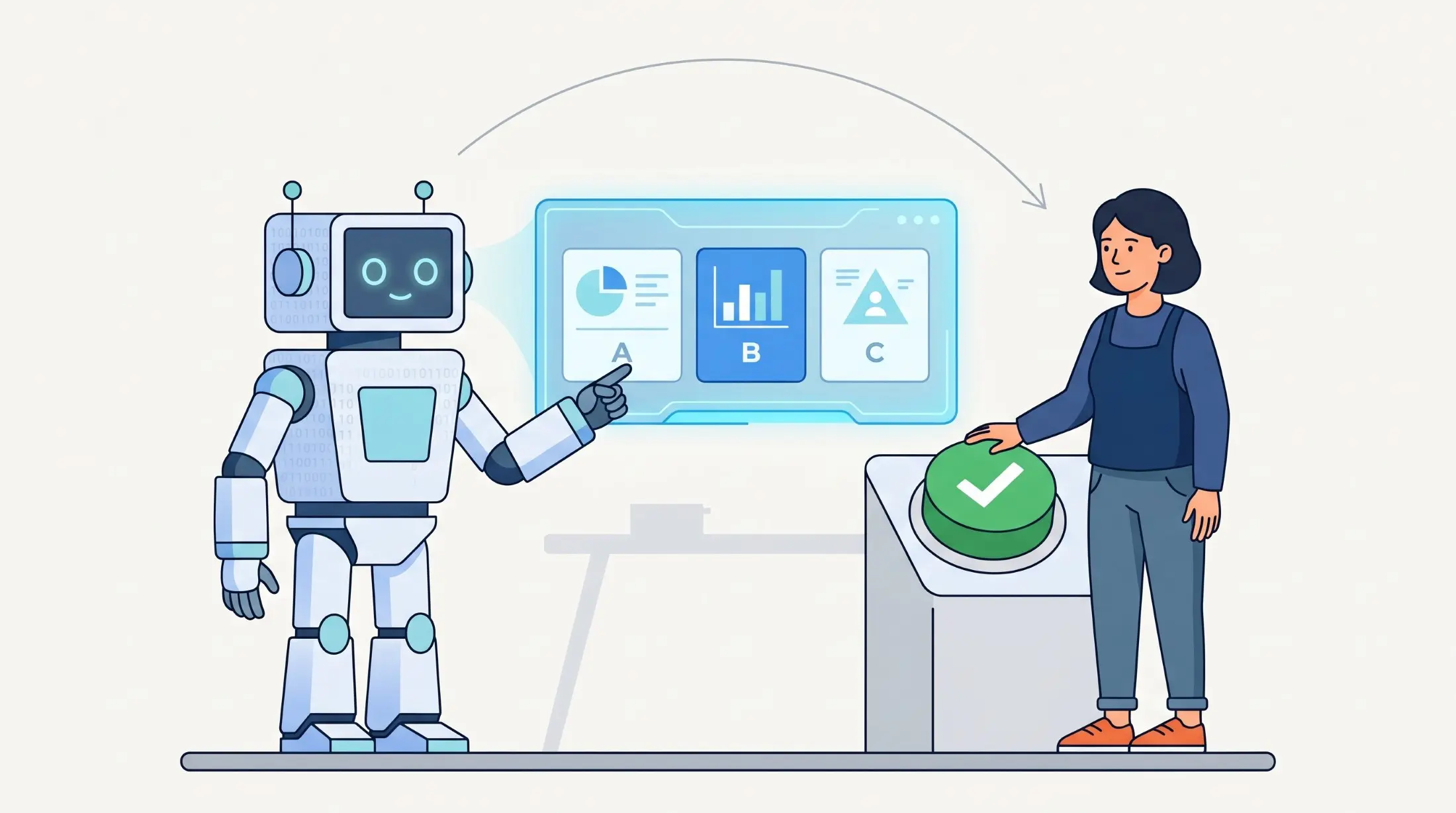
This principle applies to areas such as compliance, fraud detection, and risk management. AI can help by recognizing patterns, performing analyses, and making recommendations, but the final decision always remains with the employees. Strategic choices are also not left to algorithms. “AI is there to support, while final responsibility remains with humans.”
Adoption determines success
According to Mortier, the biggest challenge of AI projects lies not in the technology itself, but in the way employees work with it. That is why Axepta BNP Paribas chose not to automate large-scale processes immediately. “Start small,” he advises. “With a very specific application where you know a virtual agent can really help.”
The first Agentforce application was developed together with employees. Employees who helped develop the solution later became ambassadors within their teams. After the launch, usage was actively monitored to gather feedback and refine the solution. According to Mortier, this approach is essential for building trust. “You have to invest in it continuously, but once it’s running, it delivers real added value.”
Moving forward step by step
In the future, Axepta BNP Paribas sees opportunities primarily in fraud detection and cybersecurity. By analyzing transactions in real time, AI can recognize deviant patterns faster and signal potential risks.
The company does not believe in major AI revolutions overnight, but in a phased approach where technology, processes, and employees evolve together. This vision is the common thread in the AI strategy today: starting from concrete business challenges, experimenting in a controlled way, and putting employees at the center of the transformation.